Newsroom


When invasive fish enter a new river, what stops them from taking over? The answer, a new study suggests, lies in the diversity of native species already present.
A recent study published in Global Change Biology has identified a global mechanism underlying biotic resistance to freshwater fish invasions. Drawing on freshwater fish assemblages from more than 2600 river basins worldwide, the study found that native niche differentiation is the strongest predictor of invasion resistance.
The study was conducted by researchers from the Institute of Hydrobiology of the Chinese Academy of Sciences, in collaboration with partners from Hunan University of Science and Technology, the University of León (Spain), Zhejiang Freshwater Fisheries Research Institute, and other institutions.
Biological invasions are a major driver of biodiversity loss in freshwater ecosystems, but the mechanisms determining community resistance to invasion remain hotly debated. In particular, the long-standing invasion paradox has generated conflicting evidence regarding how native biodiversity resists invasions.
To address this, researchers analyzed freshwater fish assemblages from 2,622 river basins across the globe, quantifying niche, functional, and phylogenetic differentiation within native fish communities and assessing their effects on non-native fish occurrence and richness. The analyses incorporated human pressure, basin area, latitude, and other environmental factors.
The results showed that native niche differentiation is the strongest predictor of invasion resistance. Higher niche differentiation was consistently linked to lower occurrence and richness of non-native fishes, indicating that more complete resource use and stronger competitive interactions among native species boost resistance to invasion. This pattern proved remarkably consistent across the globe as well as among all six major freshwater biogeographic realms.
The study also found that human activities strongly promote invasions, with invasion intensity peaking at intermediate latitudes.
Overall, the findings highlight native community niche structure as a key determinant of biotic resistance, providing a unified explanation for the invasion paradox and offering new insights for freshwater invasion management under global change.
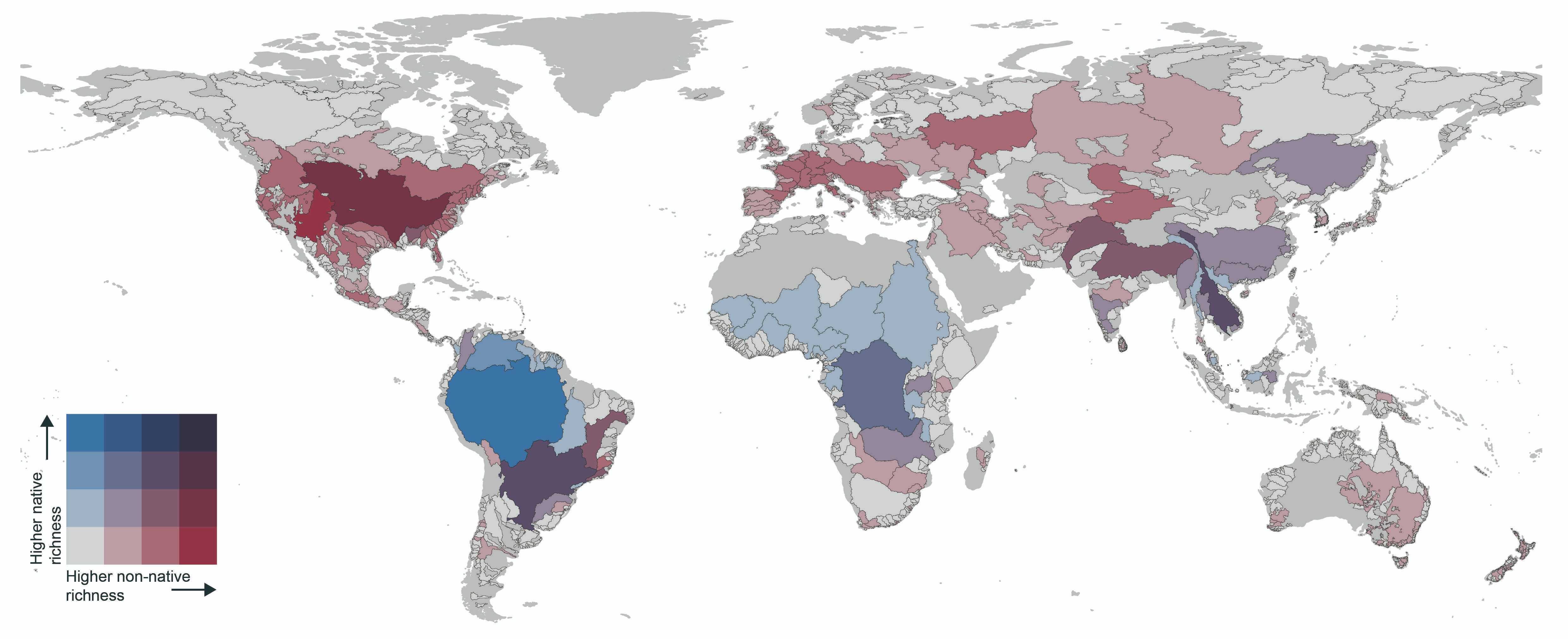
Native niche differentiation promotes biotic resistance to freshwater fish invasions worldwide. (Image by IHB)