
Newsroom


A membrane that is thinner than a human hair could power next-generation energy storage. In a recent study published in National Science Review, a research team led by Prof. LI Xianfeng from the Dalian Institute of Chemical Physics (DICP) of the Chinese Academy of Sciences (CAS) has explained the microstructure formation mechanism of nonsolvent-induced phase separation (NIPS) by separating the formation processes of different pore structures, including macrovoids and cellular pores.
Based on these findings, the team developed a free-standing ultrathin porous polymeric membrane with a thickness of only 2.7 μm that simultaneously offers high selectivity and high conductivity. When applied in a vanadium flow battery, the membrane demonstrated outstanding electrochemical performance.
NIPS is a classical method for preparing porous polymeric membranes and has been widely used in industrial membrane manufacturing for more than six decades. However, because multiple pore structures form simultaneously during the NIPS process, the underlying mechanism of microstructure formation remains incompletely understood. This knowledge gap has hindered the rational design of membrane structures and the precise control of membrane performance.
"We developed a novel observation cell for the NIPS process, which enabled us to decouple the formation of macrovoids from that of cellular pores by modulating the flow geometry at the nonsolvent–polymer solution interface," said Prof. LI.
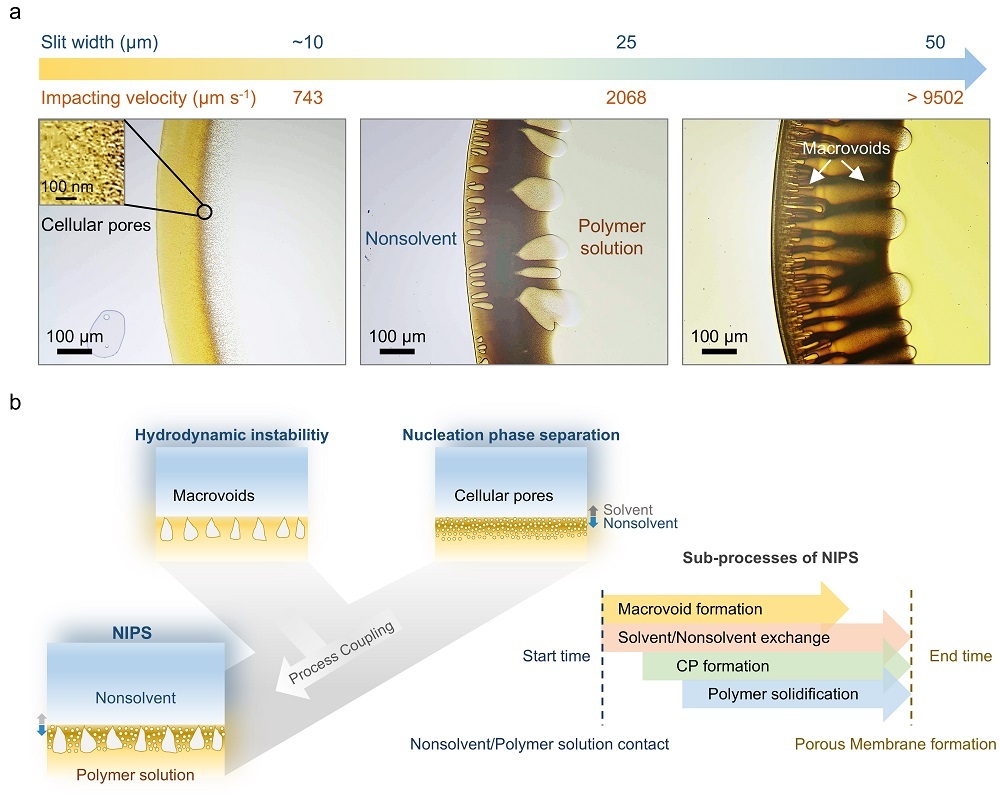
Decoupled formation of macrovoids and cellular pores and the underlying NIPS mechanism. (Image by JIA Chaoyang and LU Wenjing)
Using the experimental setup, the researchers revealed that macrovoid formation originates from hydrodynamic instability and demonstrated that macrovoid growth can be precisely controlled by tuning the interface geometry between the nonsolvent and the polymer solution. They further clarified the thermodynamic origin of cellular pore formation and established a quantitative model linking cellular pore area density to key thermodynamic parameters.
By eliminating the mass-transfer interference and spatial heterogeneity introduced by macrovoids, the researchers revealed the intrinsic relationship between membrane formation kinetics and solvent–nonsolvent interdiffusion during the NIPS process.
The researchers then investigated the structure–property relationship of porous membranes fabricated via NIPS. Guided by this relationship, they developed a free-standing porous membrane just 2.7 μm thick. When tested in a vanadium flow battery, the membrane achieved an energy efficiency exceeding 80% at a current density of 220 mA/cm2.
"The study represents an important advance in the fundamental understanding of NIPS and provides valuable theoretical guidance for the rational design of porous membranes with precisely tunable structures and properties," said Prof. LI.
