Newsroom


Scientists from six Asian countries have launched an ambitious 10-year effort to build synthetic cells from non-living molecules, marking the region's first coordinated push to create an artificial single-celled biological system. The roadmap, published on May 26 in Nature Biotechnology and led by the Shenzhen Institute of Advanced Technology of the Chinese Academy of Sciences, was developed through the SynCell Asia Initiative which comprises more than 100 scientists from China, Japan, South Korea, Singapore, Thailand, and Malaysia.
Building a single-celled organism from scratch using phospholipids, proteins, DNA, and other biological macromolecules is one of the most challenging scientific goals in life science. Achieving this goal would not only deepen our understanding of "what is life" but also enable programmable, customizable functional cells for biomanufacturing and biomedicine, driving systemic change across fundamental science and biotechnology.
Over the past several decades, global efforts to create synthetic cells have taken shape in Europe and the United States. Although individual functional modules have advanced considerably, systematically integrating these modules into a fully functional synthetic cell in space and time is still a global challenge.
In order to tackle this problem, scientists from six Asian countries formally established the SynCell Asia Initiative in 2023. Through SynCell Asia Workshops, they developed a scientific framework and action agenda rooted in Asian perspectives and regional strengths.
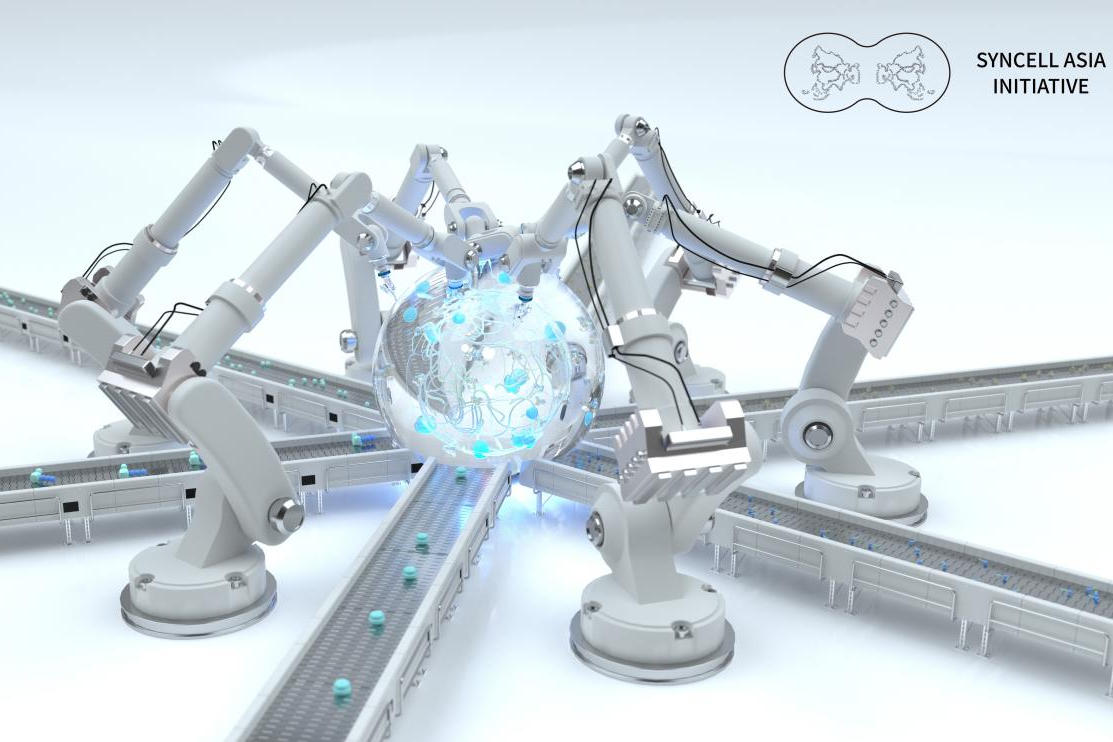
The roadmap described in this study identifies four core challenges in building a synthetic cell: metabolic continuity, ribosome autonomy, modular design rules, and spatiotemporal coordination. In terms of process design, the roadmap advocates a "central factory plus distributed workstations" model: standardized synthetic cell chassis and reagents will be prepared centrally and distributed to participating labs, forming a closed-loop design-build-test-learn (DBTL) cycle.
Single-synthetic-cell omics using automated platforms to collect genome, transcriptome, proteome, metabolome, and quantitative imaging data at single-cell resolution will provide high-dimensional data for machine learning models. Scientists have also proposed combining "white-box" mechanistic models with "black-box" data-driven models to better predict and control synthetic cell behavior.
The 10-year roadmap comprises two stages. The first stage, "ProtoCell" (Years 1–5), aims to develop a stable phospholipid vesicle with a minimal genome (≥200 genes), ≥90% of proteins expressed by a cell-free transcription-translation system, and endogenous synthesis of key metabolites. A "digital twin" of the synthetic cell will also be developed to explore how mechanical and biochemical signals coordinate division.
The second stage, "AutoCell" (Years 6–10), aims to achieve endogenous, genome-encoded ribosome regeneration, replacing the external cell-free expression system and enabling true self-replication. Specifically, the aim is for AutoCell to complete ≥10 continuous, coordinated growth-division cycles, evolve under environmental selection pressures, and form synthetic cell communities with emergent behaviors such as material exchange and division of labor.
The SynCell Asia roadmap will leverage deep complementarities in technological capabilities across Asian countries to create a novel model of cross-border collaboration, shared infrastructure, and open standards. Under this model, synthetic cell research will transform from fragmented, modular exploration into a systematic, standardized, collaborative process.