
Newsroom


When lithium batteries face extreme cold, their performance often plummets — a major challenge for energy storage, electric vehicles, and aerospace exploration. Now, scientists in China have found a way out by rethinking "polarity-contrast."
A recent study published in the Journal of the American Chemical Society has proposed a "polarity-contrast" electrolyte design strategy that can effectively enhance the kinetic characteristics and electrochemical stability of lithium metal batteries under extreme low-temperature conditions.
The study, led by Profs. CHEN Zhongwei, LUO Dan, and WANG Dongdong from the Dalian Institute of Chemical Physics of the Chinese Academy of Sciences, provided a new electrolyte design paradigm for constructing low-temperature-resistant, anion-dominated solvation structures.
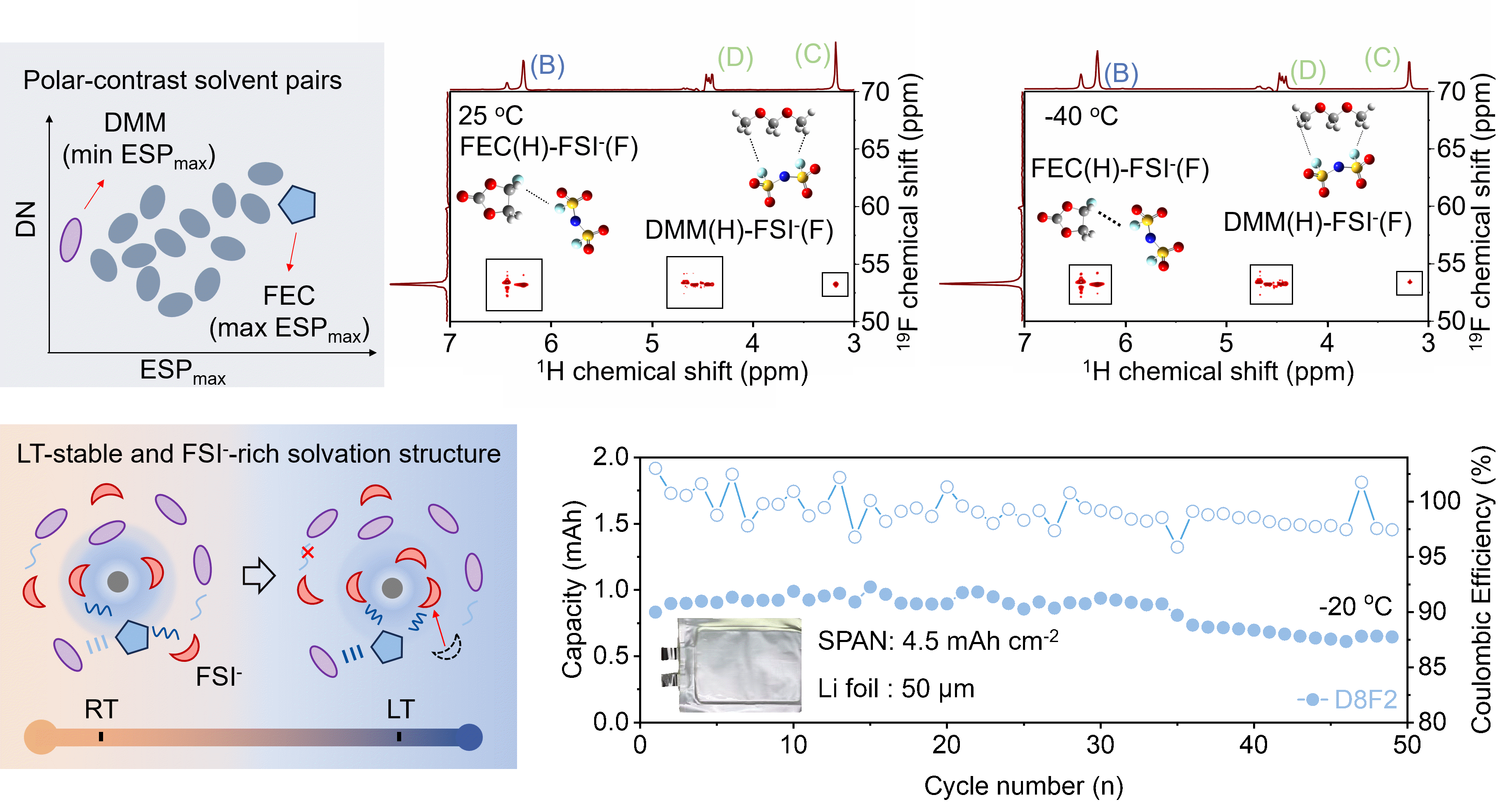
Polarity-contrast electrolyte for low-temperature lithium metal batteries (Image by REN Jingxuan, WANG Dongdong)
Under low-temperature conditions, lithium metal batteries suffer from sluggish ionic transport in electrolytes, retarded Li+ desolvation kinetics, and intensified interfacial side reactions. These issues cause severe capacity degradation and poor cycling stability, hindering their application in extreme environments.
To address these challenges, the research team proposed a "polarity-contrast" electrolyte design strategy. This strategy constructs a stable, anion-dominated solvation structure at low temperatures by modulating the ion-dipole interactions between anions and solvents.
The researchers identified a polarity-contrast solvent pair: dimethoxymethane (DMM), which has the lowest ESPmax, and fluoroethylene carbonate (FEC), which has the highest ESPmax.
Specifically, the weakened interaction between DMM and FSI- at low temperatures facilitates the entry of anions into the Li+ solvation sheath. Meanwhile, FEC further anchors FSI- through enhanced ion-dipole interactions, thereby creating a stable anion-dominated solvation environment under cryogenic conditions. In addition, the strengthened dipole-dipole interactions between DMM and FEC promote Li+ desolvation kinetics.
By precisely tuning ion-dipole and dipole-dipole interactions, the team achieved an anion coordination transition at low temperatures, providing a novel design principle for electrolytes in low-temperature lithium metal batteries.
Using this strategy, the electrolyte induces the formation of a LiF-rich solid electrolyte interphase, enabling uniform lithium deposition and highly reversible plating/stripping behavior at low temperatures.
The Li||SPAN full cell retained 80% of its capacity after 150 cycles at -40 ℃, even at a high areal capacity of 4.5 mAh/cm2. Moreover, the Ah-level pouch cell showed stable cycling for 50 cycles at -20 ℃, demonstrating good low-temperature cycling stability and capacity retention.
"Our study not only reveals a novel mechanism underlying the dynamic evolution of solvation structures under low-temperature conditions but also offers fresh theoretical foundations and research strategies for designing electrolytes for low-temperature lithium metal batteries," CHEN said.
