Newsroom


Designing efficient organic photocatalysts requires integrating strong light harvesting, efficient charge separation, and rapid mass transport within a single material. In nature, leaves achieve this through a hierarchical "stem–mesophyll" architecture, where structural compartmentalization enables synergistic functionality. Covalent organic frameworks (COFs), featuring crystalline porous networks and tunable dimensionality, offering opportunities to integrate distinct functions through structural design. However, developing COF architectures inspired by natural, hierarchical designs that integrate multiple photocatalytic functions within a single system remains challenging.
In a study published in Nature Synthesis on May 22, researchers led by Prof. ZHAO Xin from the Shanghai Institute of Organic Chemistry (SIOC) of the Chinese Academy of Sciences, together with collaborators from Southeast University, the Shanghai Synchrotron Radiation Facility, and Wuhan University, have developed a leaf-inspired COF heterostructure that significantly improves photocatalytic hydrogen production.
In this study, the researchers reported an in situ, one-pot synthetic strategy that constructs both one-dimensional (1D) and three-dimensional (3D) COFs from the same binary monomers within a single reaction system. The resulting material, termed 1D@3DCOF-2, yields a hierarchically integrated heterostructure inspired by the organizational principles of natural leaves.
In this strategy, chain-like 1DCOF-CN and porous 3DCOF-CN grow simultaneously within a single co-assembly process, integrating spatially to form an S-scheme heterojunction. A built-in electric field established at the interface that promotes directional charge separation and migration between the two components. The hydrophilic 1DCOF-CN, enriched with amino groups and imine bonds, efficiently anchors and disperses platinum (Pt) nanoparticles that serve as catalytic sites for proton reduction. Meanwhile, the porous 3DCOF-CN provides interconnected channels that facilitate light absorption, mass transport, and hole consumption.
With platinum as a co-catalyst and under visible-light irradiation, the heterostructure achieved a hydrogen evolution rate of 45.7 mmol g-1 h-1, outperforming 3DCOF-CN (31.1 mmol g-1 h-1) alone, whereas 1DCOF-CN showed negligible photocatalytic activity.
The photocatalytic hydrogen evolution rate of the heterostructure further reached 337.8 mmol g-1 h-1 in pure water with a low catalyst loading of 0.2 mg and maintained a hydrogen evolution rate of 50.8 mmol g-1 h-1 in seawater, highlighting its potential for practical solar-to-hydrogen conversion.
Combined experimental and computational studies revealed that the spatial integration of the 1D and 3D components is essential to preserving the efficient interfacial charge separation.
This work establishes a versatile, one-pot synthetic strategy for constructing seamlessly integrated hierarchical COF@COF heterostructures and provides new insight into harnessing dimensional integration in organic frameworks to mimic the structural integration of natural leaves for high-performance photocatalysis.
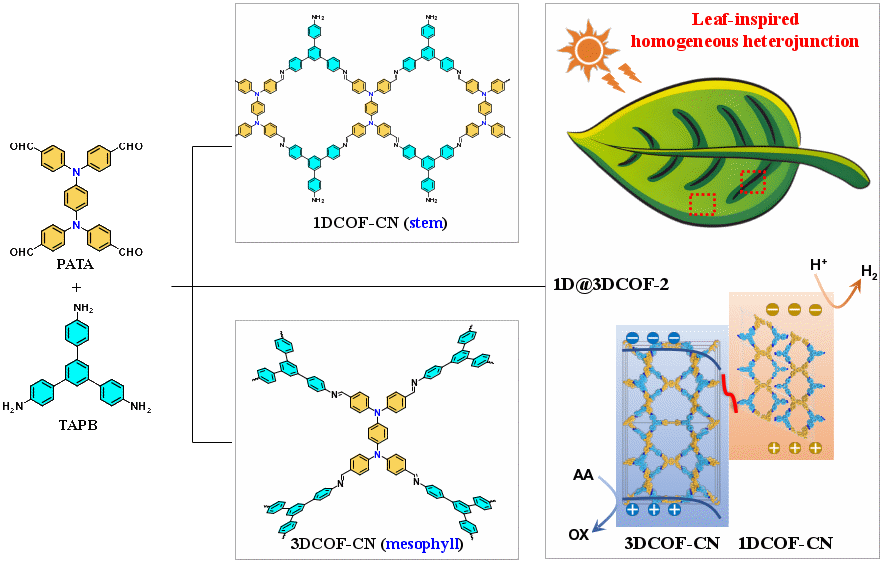
Schematic diagram of 1DCOF-CN, 3DCOF-CN and the integrated leaf-inspired 1D@3DCOF-2 heterostructure assembled from the same monomers. Inspired by the hierarchical organization of leaves, the heterostructure integrates mass-transport and catalytic functions within an architecture. AA: Ascorbic acid, OX: Oxidation product. (Image by SIOC)