
Newsroom


Ultra-large space facilities, such as space solar power stations, ultra-large-aperture antennas, and on-orbit servicing platforms, are priorities in aerospace development. Due to constraints imposed by rocket fairing dimensions and stringent launch overload conditions, the traditional "ground fabrication + rocket launch" method cannot support the construction of structures ranging from hundreds of meters to kilometers in scale.
On-orbit construction, which eliminates the need for folded launches and circumvents payload size restrictions, enables direct in-space fabrication, joining, and integration of components. This approach has emerged as a core technology for next-generation aerospace systems.
Now, a research team from the Shenyang Institute of Automation (SIA) of the Chinese Academy of Sciences has developed an integrated technique that combines pultrusion of carbon fiber/polyetheretherketone (CF/PEEK) composite tubular units with laser transmission welding, offering a lightweight, high-strength, and high-reliability solution for the automated on-orbit assembly of large space truss structures.
The results were published in Space: Science & Technology.
To address two major challenges in on-orbit construction—efficient fabrication of high-performance structural units and reliable joining of components—the researchers proposed an innovative technical route.
Using CF/PEEK thermoplastic prepreg tape, the researchers fabricated hollow tubular components through a continuous pultrusion process. They systematically investigated the effects of temperature and pultrusion speed on mechanical properties and determined the optimal process parameters. The resulting composite tubes have high specific strength, high stiffness, and excellent environmental adaptability, making them ideal for long-term service in space.
Regarding joining technology, the researchers innovatively adopted 3D-printed highly transparent PEEK connectors combined with laser transmission welding to achieve high-precision, high-strength integrated joining between tubes and connectors. This non-contact method features uniform stress distribution and high efficiency, effectively overcoming the drawbacks of traditional adhesive bonding, which is prone to aging, and mechanical fastening, which adds weight and offers insufficient reliability. The weld seams stably meet the load-bearing requirements of space structures.
To validate the engineering practicability of this approach, the researchers manufactured and assembled a scaled-down prototype of a parabolic antenna truss using the proposed process. The demonstration covered the entire workflow, from material forming and joining to structural assembly, proving that the proposed solution is well-suited for automated on-orbit construction in space.
The team has long been dedicated to researching the on-orbit construction of large space structures and composite material applications, continuously advancing the cross-integration of advanced manufacturing technologies and aerospace engineering.
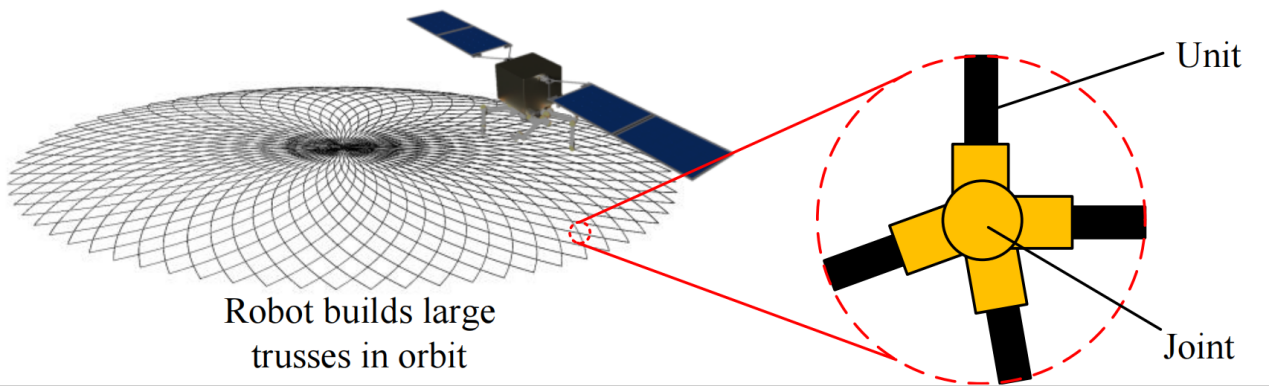
Schematic Diagram of On-Orbit Construction of Large-Scale Space Antennas (Image by SIA)
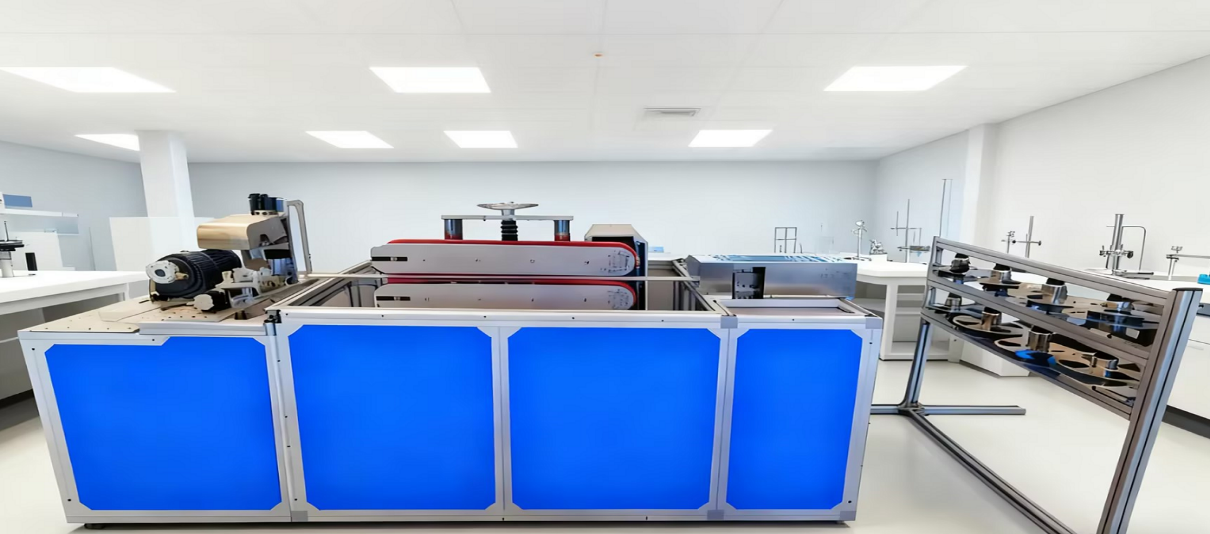
Prototype for Continuous Pultrusion Forming of Carbon Fiber Polyether Ether Ketone (CF/PEEK) Unit Pipe Fittings (Image by SIA)
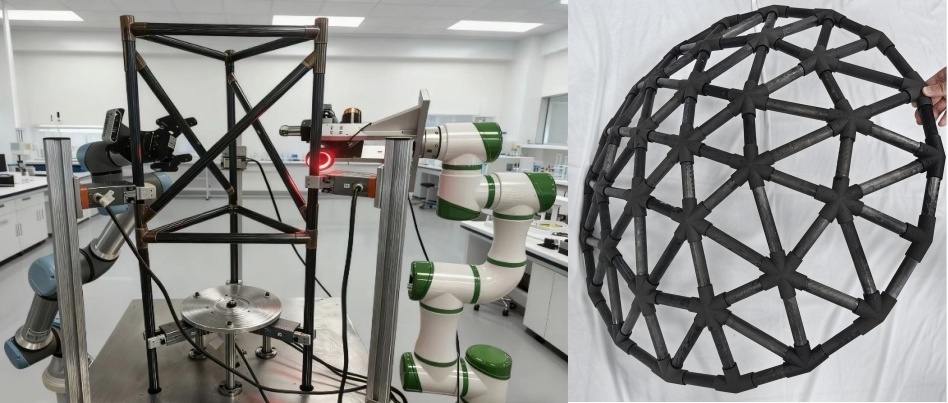
Ground demonstration and verification of on-orbit manufacturing for space structures (truss products on the left, mirror frame products on the right) (Image by SIA)
