Newsroom


Every time a meteorologist predicts a hurricane's intensity, a fishing fleet plans its season, a port authority routes a cargo ship around dangerous seas, or a government braces for El Niño, real-time ocean data are one critical resource. The Global Ocean Observing System (GOOS), a network of robotic floats, research vessels, and moored buoys spanning every ocean basin, makes the climate monitoring and prediction possible.
In a study published in Nature Climate Change on May 22, a team led by PhD candidate ZHU Yujing and Prof. CHENG Lijing from the Institute of Atmospheric Physics of the Chinese Academy of Sciences found how quickly the GOOS can be disabled and by whom. Researchers quantified, for the first time, how data losses in ocean monitoring would severely degrade the ocean heat estimates that underpin weather prediction, El Niño forecasting, and fisheries management.
Ocean heat content (OHC) reflects the heat stored in the ocean and supports forecasts and decisions from tropical cyclone intensity and marine heatwaves to changes in fish habitats and climate variability. Using OHC as a key metric, researchers quantified the impacts of GOOS change on climate monitoring.
Researchers simulated what happens to ocean monitoring quality when GOOS data are progressively removed. Removing 20% of observations degraded the accuracy of annual ocean heating estimates by 33%. At 80% data loss, the global ocean warming signal became statistically indistinguishable from noise and the monitoring system ceased to be useful.
Besides, removing US observations alone, which is over half of global data by volume, produced a 163% increase in monitoring error, worse than randomly losing 80% of all global data. The reason is that US-funded platforms span every ocean basin, plugging critical gaps that no other nation covers, which shows that the vulnerability of GOOS depends not only on how many observations are lost, but also on where those observations are located.
The findings point to the importance of maintaining a sustained, coordinated and geographically balanced ocean observing system. As different national programmes cover different ocean regions, the loss of a major contributor can create regional gaps that are difficult to compensate with observations from elsewhere.
"No single nation can monitor the global ocean alone. And no nation can afford not to. The ocean does not respect borders—but the consequences of losing track of it will be felt everywhere: in food prices, in extreme weather and early warnings, in risk management and in the decisions that governments make for their economies and citizens," said co-author Prof. Sabrina Speich from École Normale Supérieure–Université PSL, Paris
"GOOS is not only a climate science issue. It is a weather forecasting issue, a fisheries issue, and a national security issue," said co-author John P. Abraham from University of St. Thomas School of Engineering.
GOOS is one major achievement of international cooperation in ocean science. It depends on sustained contributions from many national programmes with different priorities, capacities and geographic footprints. "This ocean observing system is remarkable. The findings of this study provide a quantitative measure of how strongly ocean heat estimates depend on the observing system, and how quickly errors grow when observations are lost," Prof. CHENG said.
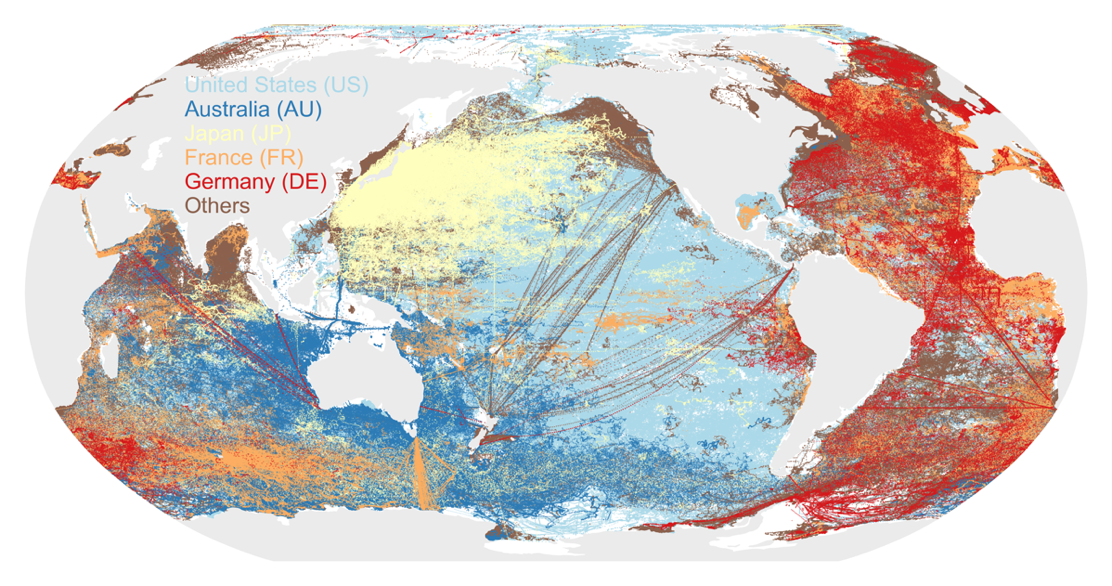
Geographical distribution of ocean temperature profile data from different nations from 2005 to 2023. (Image by Prof. CHENG et al.)