
Newsroom


A new study published on April 15 in Physical Review D suggests that the dramatic flickering and "changing-looks" of active galactic nuclei (AGNs) may be driven by a single, previously overlooked geometric feature: elliptical, eccentric accretion disks. The research introduces a unified physical model linking the origins of broad emission lines, the enigmatic X-ray corona, and asymmetric dust rings in AGNs.
For decades, the standard AGN model has struggled to explain how these objects can alter their appearance within just months or years. Now, Dr. DENG Hongping of the Shanghai Astronomical Observatory at the Chinese Academy of Sciences demonstrates that allowing the accretion flow to adopt eccentric, elongated orbits—rather than perfect circles—naturally unites the seemingly disparate components of the AGN puzzle.
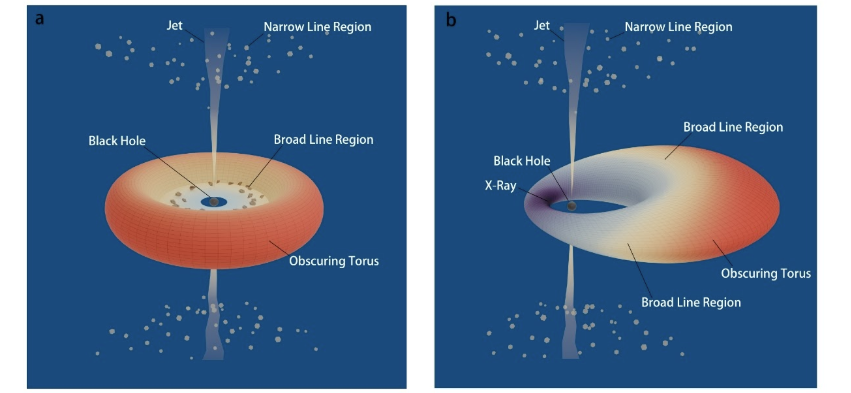
The standard AGN unification model and the eccentric disk AGN model. (Image by SHAO)
Contrary to the long-held assumption that eccentric disks quickly become circular, DENG's study reveals a robust "eccentricity cascade." Even gas arriving with moderate eccentricity is amplified by the inner disk into extreme elliptical orbits, where it undergoes intense compression and heating near the black hole. This non-circular geometry produces a unique temperature map: gas is cool and puffed up at its farthest point, but violently hot and vertically crushed at its closest approach.
This temperature asymmetry provides a compelling, unified explanation for three major observational mysteries.
On outer, low-eccentricity orbits, temperature variations sublimate dust near periapsis, leaving behind an incomplete, elliptical dusty ring — matching recent interferometric images. On moderately eccentric orbits, gas cools near apoapsis to precisely the temperature that excites hydrogen atoms, naturally producing broad emission lines. And at the innermost, highly eccentric regions, extreme compression generates the soft X-ray excess, while general relativistic precession within about 20 gravitational radii creates a compact core that produces the hard X-ray continuum — explaining the origin of the X-ray corona for the first time without invoking ad hoc components.
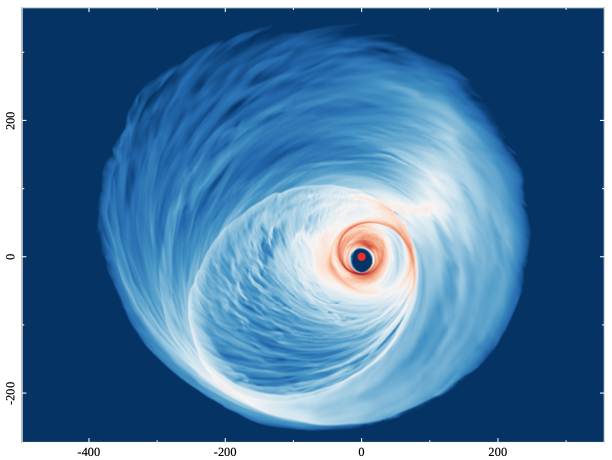
Collision between eccentric flow due to differential precession causes state changes in AGN as observed in hydrodynamic simulations. (Image by SHAO)
The framework also provides a mechanical trigger for "changing-look" events. Precession of the innermost eccentric orbits causes periodic collisions with the slower-moving outer gas. These shocks first enhance optical emission before disrupting the X-ray core, reproducing the observed sequence in well-known changing-look AGNs such as 1ES 1927+654. The model further accounts for the characteristic "red noise" power spectrum of X-ray variability as a natural outcome of the precessing eccentric core.
By analyzing distinct velocity components of broad emission lines, astronomers may leverage this model to map 3D geometry of accretion flows and measure black hole masses with greater precision—potentially establishing AGNs as more reliable cosmic standard candles.
