Newsroom


A study published in ZooKeys on May 20 reports the first discovery and photographic documentation of a species of the family Glomeridae (order Glomerida) during biodiversity surveys and monitoring in Dinghushan National Nature Reserve in South China's Guangdong province. Through morphological comparison, genetic distance analysis, and phylogenetic verification, the species was confirmed as a new member of the genus Rhopalomeris, named Rhopalomeris dinghushan after its type locality.
The study was led by a research team from the South China Botanical Garden (SCBG) of the Chinese Academy of Sciences, South China Agricultural University (SCAU), Sun Yat-sen University, and several other institutions.
Pill millipedes, belonging to the order Glomerida and class Diplopoda, are soil invertebrates of significant ecological and taxonomic importance. As key detritivores in forest ecosystems, they play an irreplaceable role in nutrient cycling and soil formation. With limited dispersal ability, pill millipedes are highly dependent on forest and woodland habitats, making them valuable indicators for assessing habitat integrity and environmental change.
Taxonomically, the order Glomerida comprises only three families: Glomeridae, Protoglomeridae, and Glomeridellidae, with Glomeridae being the most species-rich. Globally, Glomerida is primarily distributed in the Holarctic region. The genus Rhopalomeris, newly recorded in this study, is endemic to the Oriental Realm, with 14 previously documented species across the Indochinese Peninsula, ranging from northern Vietnam to the Malay Peninsula and Myanmar.
Although China is one of the world's most biodiverse countries, research on its Glomerida fauna has long lagged behind. To date, only 39 species have been recorded in China: 37 species of Hyleoglomeris (Glomeridae), one species of Mauriesia (Glomeridae), and one species of Tonkinomeris (Glomeridellidae).
As China's first nature reserve and one of the earliest sites to join UNESCO's Man and the Biosphere Programme, Dinghushan has been systematically surveyed for vascular plants, mammals, birds, reptiles, amphibians, butterflies, and macrofungi—but the species composition and distribution of its millipede fauna remain poorly understood.
On September 14, 2025, FAN Zongji, a senior engineer at Dinghushan National Nature Reserve, led a research monitoring team to conduct wildlife surveys in the reserve's core zone. Around 3 am, they discovered and photographed a brightly colored millipede in the leaf litter of a montane evergreen broad-leaved forest at 708 meters above sea level.
The millipede measured 15.0–21.0 mm in body length, with a blackish-brown body featuring distinctive yellowish-brown marbled patterns. Key diagnostic features included roughly 12 superficial transverse striae on the thoracic shield, a triangular apicolateral process on each coxa of male legs 4–16, and a median syncoxital lobe of the telopods notably lower than the lateral horns.
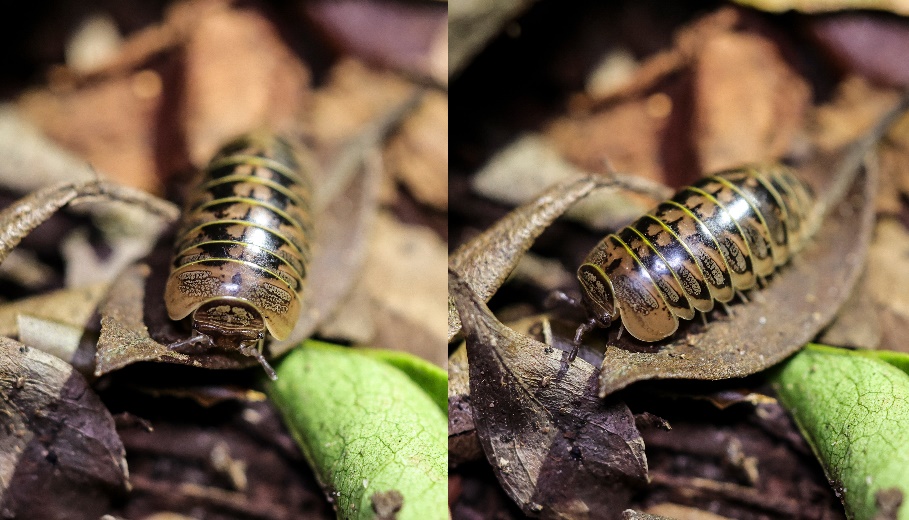
Rhopalomeris dinghushan. (Photo by FAN Zongji)
Using an integrative taxonomic approach that combined traditional morphological examination and mitochondrial COI gene barcoding, the team confirmed that the specimen represents a new, previously undescribed species of Glomeridae. The study provides a detailed morphological description of the new species, its male reproductive structures, and a COI-based phylogenetic tree clarifying its systematic position within the genus.
This first formal record of the genus Rhopalomeris in China extends its known range northward and eastward from the Indochinese Peninsula to southern China. It fills a critical zoogeographic gap for this Oriental endemic genus and provides important evidence for understanding its biogeographic evolutionary history.
Moreover, the discovery raises the total number of Glomerida species recorded in China to 40, significantly advancing knowledge of the country's pill millipede fauna. It also highlights the conservation value of Dinghushan National Nature Reserve as a biodiversity hotspot.
The study further challenges current genus-level classifications. Molecular phylogenetic analyses suggest that Rhopalomeris is likely polyphyletic as currently defined. Rhopalomeris dinghushan forms a strongly supported monophyletic clade with the Vietnamese species Peplomeris magna, rather than with other Rhopalomeris species, indicating the need for a comprehensive revision of the genus and raising new scientific questions for high-level taxonomic research in Glomeridae.
The paper's co-first authors are FAN Zongji, a senior engineer at SCBG, and HUANG Hengjie, a graduate student at SCAU. The corresponding author is LIU Weixin, an associate professor at SCAU.
This research was supported by the Central Forestry and Grassland Ecological Protection and Restoration Fund Project of the Guangdong Forestry Bureau: "Assessment of Ecosystem Service Functions and Construction of Bird Song Background Monitoring in Dinghushan National Nature Reserve."
The team received strong support from experts at the Institute of Biology of the Vietnam Academy of Science and Technology, the Institute of Ecology and Evolution of the Russian Academy of Sciences, and from staff and volunteers at Dinghushan National Nature Reserve.
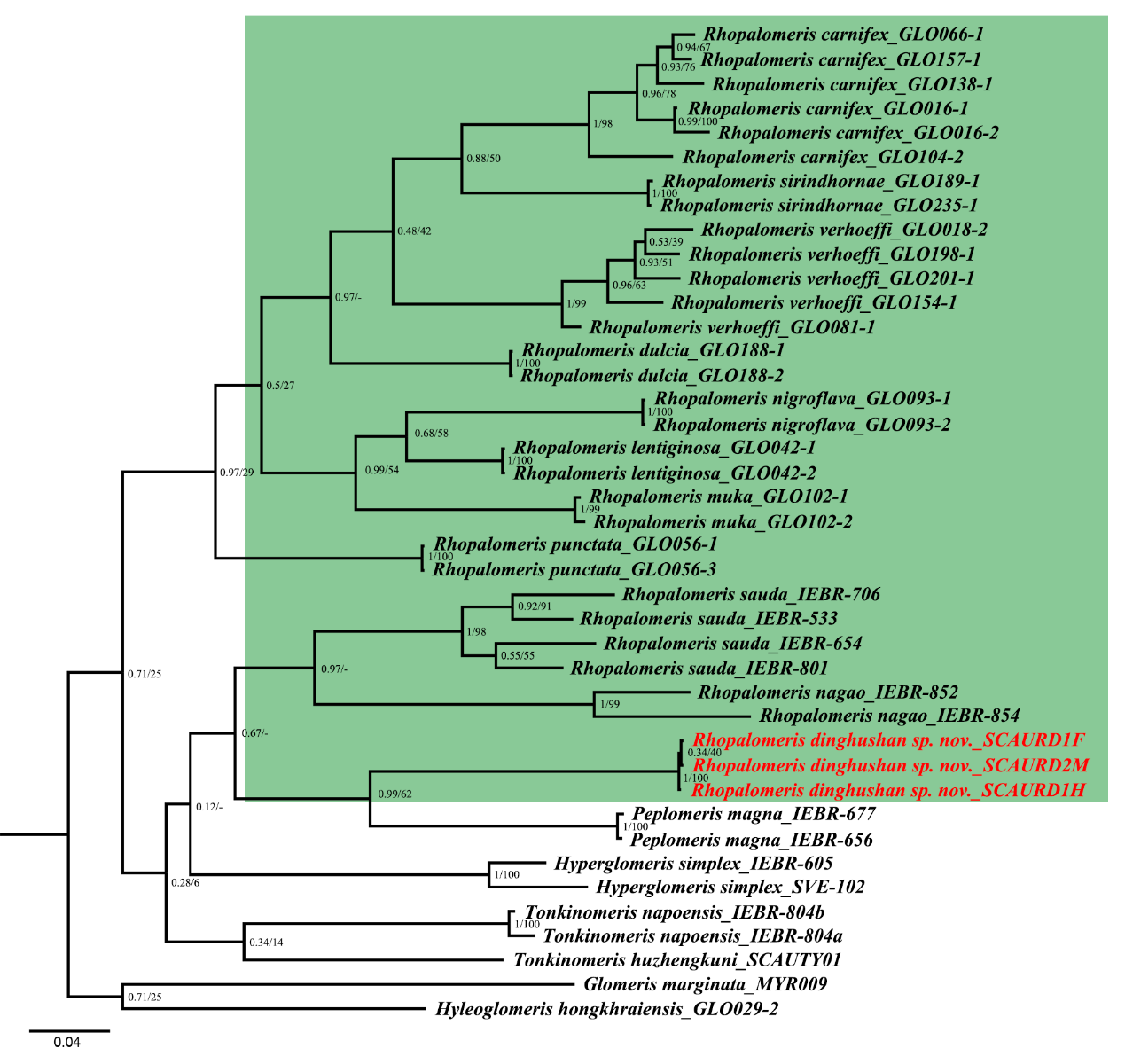
Phylogenetic tree of pill millipedes. (Image by LIU Weixin)