Newsroom


Road construction is widely believed to have negative impacts on wildlife, including creating barriers to animal migration, increasing the risk of roadkill, and reducing habitat connectivity. These threats are further exacerbated in ecologically sensitive arid regions. However, a research team led by Prof. YANG Weikang from the Xinjiang Institute of Ecology and Geography (XIEG) of the Chinese Academy of Sciences has found that desert highways and shelterbelts can enhance habitat and connectivity for the Xinjiang ground-jay, a bird species endemic to the Taklimakan Desert.
The findings were recently published in the journal Transportation Research Part D.
The research team developed two scenarios for comparison. Scenario 1 (1985–2004) represents the early stage of road construction before the shelterbelt was fully established, while Scenario 2 (2005–2024) includes six highways and the completed shelterbelt system. Using Species Distribution Models and the Equivalent Connectivity Area index, the team assessed the impacts of these scenarios on habitat changes for the Xinjiang ground-jay.
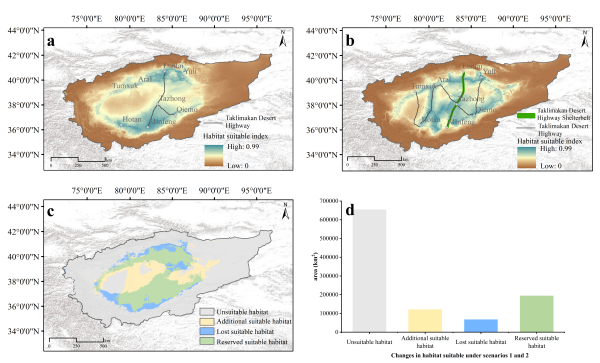
Habitat suitability distribution for the Xinjiang ground-jay under Scenario 1 and Scenario 2, and the corresponding changes in suitable habitat. (Image by XIEG)
The results showed that suitable habitat expanded from 261,963 km² to 315,028 km², a net increase of 53,065 km² (20.25%). Suitable habitat became primarily concentrated in the desert hinterland (120,788 km²), which compensated for the loss of 67,695 km² of edge habitat caused by agricultural expansion.
Habitat connectivity also improved significantly. For every 1 m/km² increase in road density, connectivity rose by 34,683 units.
The study reveals that infrastructure designed for economic development can, under specific conditions, yield ecological benefits by functioning as wildlife corridors. The researchers recommend integrating such corridors into road planning and establishing long-term monitoring mechanisms.
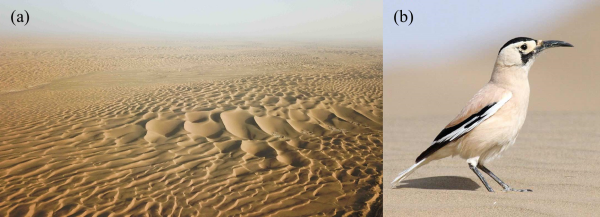
Habitat of the Taklimakan Desert and morphological characteristics of the Xinjiang ground-jay. (Image by XIEG)