Newsroom


Double fertilization in angiosperms is a highly specialized reproductive process. Precise recognition, adhesion, and fusion of male and female gametes are at the core of this process. Understanding the molecular mechanisms that govern gamete recognition and fusion has implications for both basic reproductive biology and agricultural innovation.
Doubled haploid (DH) technology which combines haploid induction with chromosome doubling generate completely homozygous DH lines within only two generations, significantly shortening the breeding cycle. Identifying highly efficient and broadly applicable haploid induction genes is therefore of great importance for accelerating crop improvement.
In two back-to-back studies both published online in Plant Communications, the teams of Prof. LI Hongju and Prof. YANG Weicai from the Institute of Genetics and Developmental Biology of the Chinese Academy of Sciences uncovered key molecular mechanisms underlying gamete adhesion and fusion in flowering plants, and reported a new technology in haploid induction with higher efficiency.
Researchers identified GEX3, a sperm surface protein containing an extracellular β-propeller domain, as a key factor controlling gamete adhesion and fusion.
Loss-of-function mutations in GEX3 caused severe silique abortion. Although pollen viability, pollen tube growth, and pollen tube targeting to the embryo sac were unaffected in the gex3 mutant, sperm cells became arrested within the embryo sac because double fertilization failed. Further analyses showed that GEX3 depletion impaired both gamete adhesion and fusion, with a stronger effect on adhesion.
Through genetic and biochemical assays, researchers showed that GEX3 interacts with another adhesion protein, GEX2, through their extracellular domains to form a complex that mediates male-female gamete adhesion, and GEX3 cooperates with the sperm membrane proteins DMP8/9 to promote the translocation of the fusogen HAP2 from the cytoplasm to the sperm plasma membrane, enabling gamete membrane fusion.
In Arabidopsis, researchers showed that the disruption of GEX3 produced haploids at a haploid induction rate (HIR) of 0.57%. Combining the gex3 mutation with mutations in DMP8/9 significantly increased the HIR to 3.13%. Besides, researchers found that mutations in GEX3 orthologs in rice, tomato, and soybean also induced haploid production, with the HIR reaching up to 8.99% in soybean.
Notably, researchers showed that the loss of OsGEX3 in rice also generated 9.82% triploid offspring, suggesting that GEX3-mediated fertilization is both evolutionarily conserved and species-specifically persified.
The two studies identify GEX3 as a central sperm surface protein that coordinates gamete adhesion, membrane fusion, and haploid induction, which not only deepens our understanding of the molecular basis of double fertilization in flowering plants but also provides valuable genetic resources for advancing DH technology and synthetic apomixis in crops.
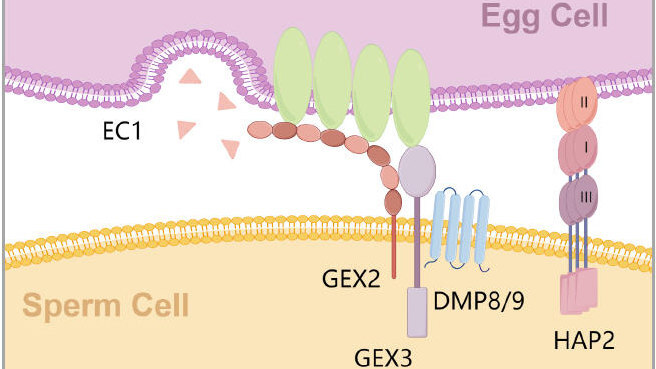
Model of GEX3-mediated gamete adhesion and fusion. (Image by LI Hongju's team)