A research team led by Prof. ZHANG Daoyuan from the Xinjiang Institute of Ecology and Geography (XIEG) of the Chinese Academy of Sciences has found that a gene from the desert moss Syntrichia caninervis can boost cotton's resistance to Verticillium wilt (VW).
The gene, ScALDH21, is an ancient stress-tolerance gene not found in flowering plants. It comes from Syntrichia caninervis, a desert moss that thrives in the harsh arid environment of the Gurbantonggut Desert in Xinjiang, China. Researchers successfully transferred this gene into cotton, creating transgenic lines with stable inheritance.
The findings were recently published in Plant Biotechnology Journal.
The team carried out multi-year, multi-location field trials to test the VW resistance of transgenic ScALDH21 cotton. They also used transcriptomics, metabolomics, and CUT&Tag technology to explore the molecular regulatory mechanisms of ScALDH21, aiming to clarify its role in balancing plant growth and stress resistance.
Findings from the research indicate that transgenic cotton has two key advantages: significantly improved resistance to VW and reduced yield loss. Under pathogen infection, its yield is approximately 20% higher than that of non-transgenic cotton.
Further analysis revealed the molecular mechanism of ScALDH21. It enhances cotton’s disease resistance by activating the antioxidant defense system to clear reactive oxygen species, reinforcing cell walls through lignin and callose deposition, and regulating jasmonic acid signaling to optimize the expression of defense-related genes.
This research not only provides high-quality genetic resources for VW-resistant cotton breeding, but also offers a feasible strategy to improve crop biotic resistance by leveraging functional genes from extreme environmental organisms.
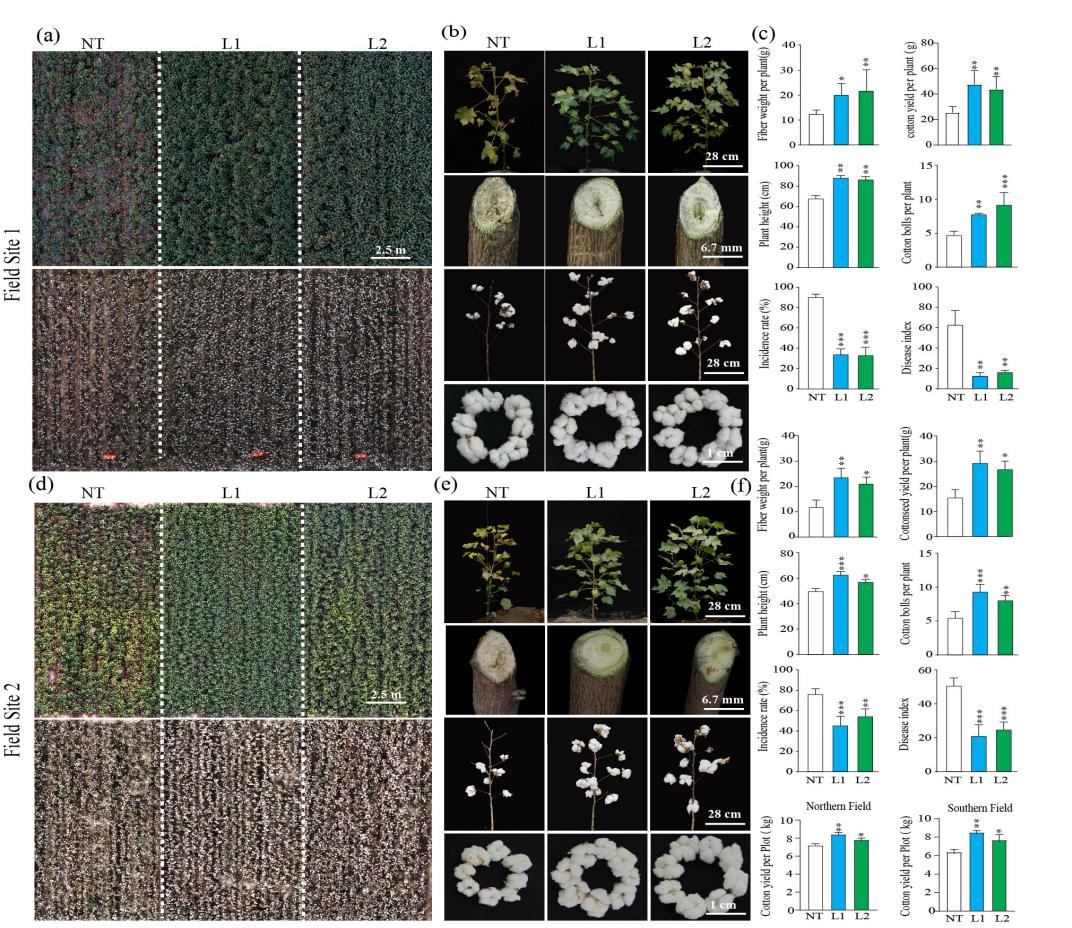
The performance of ScALDH21-transgenic cotton in disease nursery by V. dahliae infected in two sites. (Image by XIEG)