Newsroom


Chinese scientists have discovered a universal mechanism governing volatile alkali behavior during lunar impact events. By analyzing impact glass beads returned by the Chang'E-6 (CE-6) mission from the far-side South Pole-Aitken (SPA) Basin, they identified a distinct geochemical fingerprint of atomic sodium (Na) and potassium (K) vapor condensation.
Published in Earth and Planetary Science Letters on April 1, the study demonstrates that this process is not influenced by target rock composition and represents a fundamental phenomenon on airless bodies.
A joint research team from the Center for Lunar and Planetary Sciences and the State Key Laboratory of Critical Mineral Research and Exploration, both at the Institute of Geochemistry (GYIG) of Chinese Academy of Sciences, conducted this work.
During the research, scientists found that hypervelocity impacts generate transient temperatures exceeding 2000 K, vaporizing lunar surface materials. Under such extreme conditions, oxygen molecules dissociate into atoms that preferentially escape the vapor plume due to their low mass, creating a localized oxygen-depleted atmosphere.
In this environment, atomic Na and K condense directly onto molten droplet surfaces, where they drive a redox reaction: 2Na/K (gas) + FeO (melt) → Na₂O/K₂O (melt) + Fe⁰ (melt). This process leaves a diagnostic signature in the glass beads, specifically a distinct rimward enrichment of Na₂O and K₂O coupled with FeO depletion and the formation of nanophase metallic iron (npFe⁰).
Numerical diffusion modeling of the study indicates that these beads cooled extremely rapidly, at rates up to approximately 10³–10⁴ °C/s, which was essential to preserve the transient chemical gradients and maintain the observed geochemical zoning.
Researchers found that this impact-driven pathway stands in stark contrast to the behavior observed in lunar volcanic glasses (e.g., Apollo 74220), which form at lower temperatures (<1800 K). Under these cooler conditions, oxygen remains molecular and stable, preserving an oxidizing vapor environment in which alkali metals condense directly as oxides without reducing FeO or producing npFe⁰.
Notably, the CE-6 impact beads studied (G01 and G17) are feldspathic in composition, contrasting sharply with the mare basaltic glasses previously analyzed from Chang'E-5. Their MgO/Al₂O₃ and CaO/Al₂O₃ ratios fall within the "highland-mare mixed" field of CE-6 impact glasses, confirming a provenance dominated by feldspathic crustal materials. Despite this compositional difference, both sample suites exhibit identical geochemical zoning. The convergence of evidence from two distinct lunar terrains confirms that atomic alkali condensation is a generic consequence of impact physics rather than a peculiarity of local rock chemistry.
This research redefines our understanding of volatile processing during lunar impacts and provides a critical framework for interpreting surface geochemical evolution on the Moon and other airless planetary bodies.
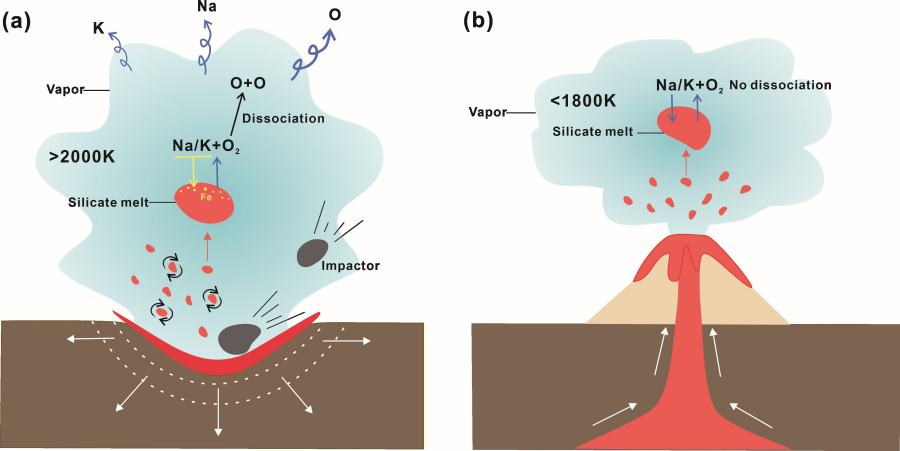
Schematic illustration of the contrasting behavior of volatile alkali metals during lunar hypervelocity impacts (>2000 K) versus volcanic eruptions (<1800 K). (Image by GYIG)