
Newsroom


Acute myeloid leukemia (AML) is one of the most aggressive blood cancers and is characterized by the rapid growth of immature myeloid precursor cells. It predominantly affects elderly people, and current treatment options are largely limited to chemotherapy, with a five-year survival rate of only about 30%. However, chemotherapy may fail to eliminate chemotherapy-resistant leukemia-initiating cells (LICs), which frequently leads to disease relapse. For this reason, novel therapies to eliminate LICs without compromising normal blood cell production are urgently needed.
In a study published in Science Translational Medicine on May 6, researchers led by Dr. WANG Lan from the Shanghai Institute of Nutrition and Health (SINH) of the Chinese Academy of Sciences, along with their collaborators, uncovered a critical role for the RNA binding protein with multiple splicing (RBPMS) in driving AML progression. They also proposed a potential therapy involving the pathway between RBPMS and the FOXO1 protein.
Specifically, the researchers found that RBPMS was upregulated in AML patients, and its high expression correlated with poor overall survival. Functional studies also showed that RBPMS sustained the self-renewal of leukemia stem cells and promoted the development of leukemia. However, the researchers also found that ablation of the gene Rbpms in mouse models had little effect on the self-renewal of normal blood-forming stem cells, their differentiation into multiple mature blood cell types, or their long-term ability to rebuild and maintain the blood system. This finding suggested that RBPMS represents an effective and safe therapeutic target.
In exploring the role of RBPMS in AML, the researchers found that RBPMS recognized and bound specific motifs on FOXO1 mRNA through its RNA recognition motif (RRM) domain. It recruited the m6A reader IGF2BP3 to enhance FOXO1 mRNA stability in an m6A-dependent manner, leading to the upregulation of FOXO1 protein. Moreover, the researchers found that RBPMS facilitated FOXO1-mediated transcriptional activation of key glycolytic enzymes, thereby boosting glycolysis in AML cells.
Based on the structure of the RBPMS RRM domain, the researchers then designed and screened a small-molecule inhibitor that disrupts RBPMS-driven activation of FOXO1. Using multiple models including AML mouse models, patient-derived AML cells, and patient-derived xenograft mouse models, they validated the therapeutic efficacy of the RBPMS inhibitor against AML, offering prospects for the clinical treatment of AML.
In summary, this study reveals the molecular mechanism by which RBPMS drives the progression of AML, uncovers a link between RNA regulation and metabolic reprogramming in AML, and suggests a new strategy for precision therapy.
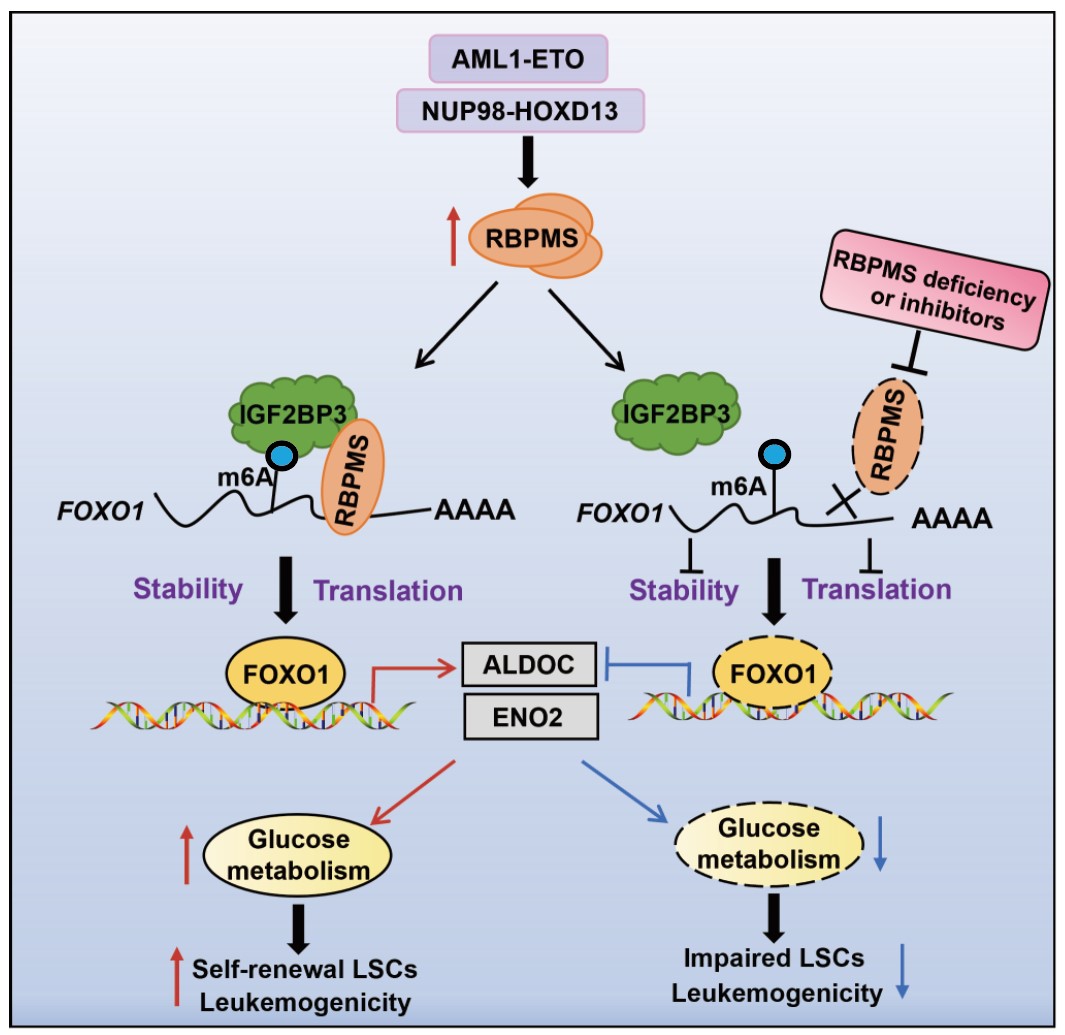
Molecular Mechanisms and Targeted Strategies for RBPMS Regulation of Acute Myeloid Leukemia Onset and Progression. (Image by Dr. WANG Lan's team)
