
Newsroom


Optogenetics uses light to precisely control biological processes. Infrared-based systems such as MagRed are particularly suitable for deep tissue applications because of their strong penetration capability and low phototoxicity. MagRed consists of photosensitive protein DrBphP and its binding partner Aff6. It remains unclear how Aff6 distinguishes between different light-induced states of DrBphP, limiting further optimization of the system.
In a study published in Journal of Photochemistry and Photobiology B: Biology, a research team led by Prof. WANG Junfeng and Assoc. Prof. ZHU Lei from the Hefei Institutes of Physical Science of the Chinese Academy of Sciences uncovered the structural basis by which the affibody Aff6 specifically recognizes different photoexcitation states of the photosensitive protein DrBphP in the red/far-red optogenetic system MagRed.
Using surface plasmon resonance, researchers demonstrated that the monomeric photosensory core module of DrBphP alone is sufficient to drive light-induced heterodimerization with Aff6. Notably, they found an approximately 23-fold difference in binding affinity between the Pfr and Pr states.
Through nuclear magnetic resonance titration and chemical shift perturbation analysis, researchers mapped the interaction interface which showed that Aff6 primarily binds to the phytochrome-specific domain and the C-terminal region of the helical spine of DrBphP. Molecular docking and site-directed mutagenesis revealed that key aromatic interactions play a central role in this state-specific recognition.
In addition, researchers found that Aff6 binding stabilizes the Pfr state through an allosteric effect, thereby slowing its dark reversion to the Pr state.
This work provides guidance for developing more precise and efficient red/far-red optogenetic tools.
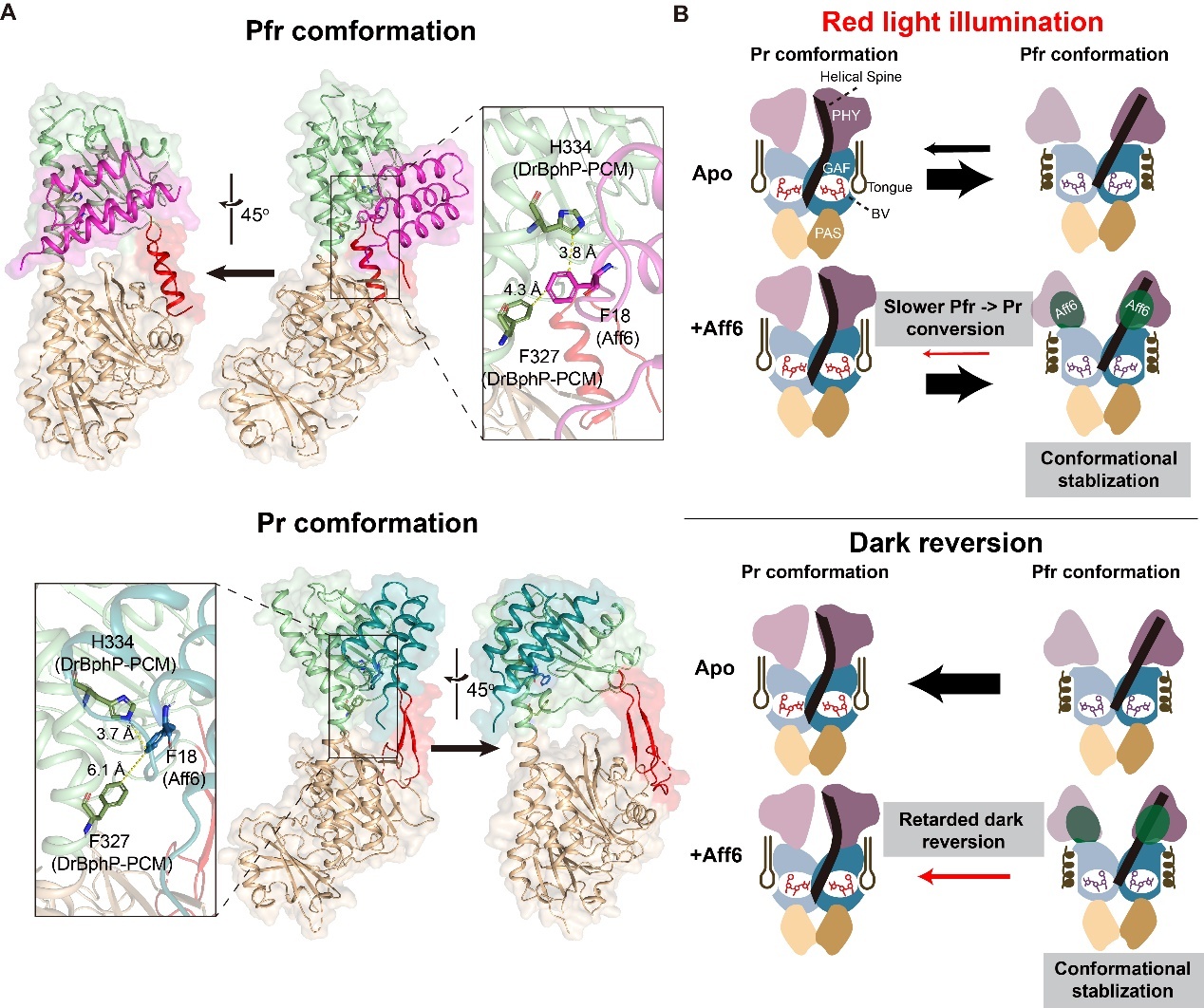
Molecular mechanism of the photo-state-dependent interaction between DrBphP and Aff6. (Image by ZHU Lei)
