Newsroom


Nosocomial infections remain a major challenge for healthcare systems, posing significant risks to patient safety and increasing medical burdens. Rapid identification of key pathogens, timely control of infection sources, and effective evaluation of prevention strategies are essential tasks for hospital infection control.
In a study published in Analytical Chemistry, a research team from the Hefei Institutes of Physical Science of the Chinese Academy of Sciences, along with collaborators from Anhui No. 2 Provincial People's Hospital, developed a microfluidic chip that integrates molecular and immunological diagnostic techniques for the rapid on-site detection of pathogenic bacteria.
The researchers designed an integrated microfluidic chip which combines loop-mediated isothermal amplification with dual-mode immunochromatographic detection using both colorimetric and fluorescence signals. The chip features a fully enclosed design, effectively minimizing the risk of amplicon leakage and cross-contamination.
The chip significantly enhanced detection sensitivity and reliability, which enables the entire testing process to be completed within 30 minutes. It requires only a single operational step after sample loading, making it highly suitable for point-of-care applications. Besides, the cost per test is kept below 2 USD.
The chip demonstrated detection sensitivities ranging from 82 to 140 CFU/mL for representative pathogens, including Staphylococcus aureus, Legionella pneumophila, and Klebsiella pneumoniae.
This work highlights the potential of the microfluidic chip as a rapid, affordable, and user-friendly solution for on-site pathogen screening, with important implications for infection control and patient safety in healthcare settings.
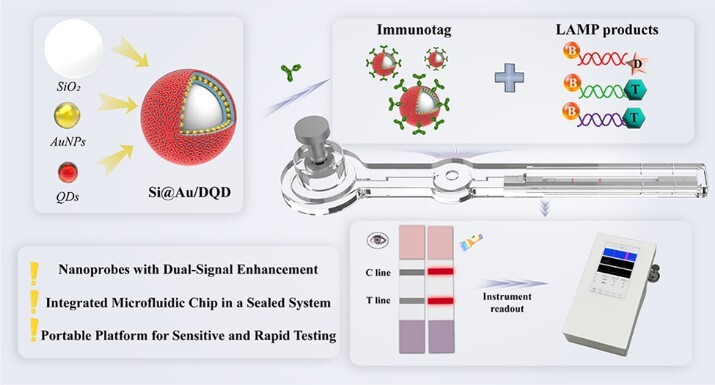
Integrated "Isothermal Amplification–Immunochromatography" Detection Platform. (Image by DAI Liping)