
Newsroom


Photovoltaic energy is a promising source of renewable and sustainable power, but developing efficient, stable, and low-cost solar cells remains a challenge. Chalcogenide materials, such as CuInS2, are attractive candidates due to their high light absorption, suitable band gaps, and good stability. However, their development has stalled for nearly three decades since achieving 12.2% efficiency in high-temperature-processed devices in 1996.
In a study published in Joule, Prof. WANG Mingtai's team from Hefei Institutes of Physical Science of the Chinese Academy of Sciences developed a low-temperature solution-processing strategy for fabricating CuInS2 thin-film solar cells, and achieved a CuInS2 solar cell with an efficiency up to 12.28%.
Researchers developed a low-temperature solution-processing strategy. They designed an interdigitation architecture in an indium-rich CuInS2 absorber layer at temperatures below 300 °C, overcoming the limitations of bilayer structures caused by short charge diffusion lengths, and enhancing both photon absorption and charge generation.
In addition, researchers introduced a sulfur anion-induced gradient phase transformation (S2--GPT) process at 180 °C, effectively reducing shallow- and deep-level defects to reduce non-radiative recombination, and creating an internal electric field that improves the transport of photogenerated charges.
The CuInS2 solar cell reached an efficiency of 12.28% and an open-circuit voltage of 0.83 V, indicating a strong power-generating capability. Even without encapsulation, the device retained 86.3% of its initial efficiency after 500 days under ambient conditions, demonstrating that low-temperature processing can produce both efficient and durable solar cells.
This study offers a promising way to chalcogenide solar cells and the application of CuInS2 devices, providing a promising alternative to perovskite solar cells.
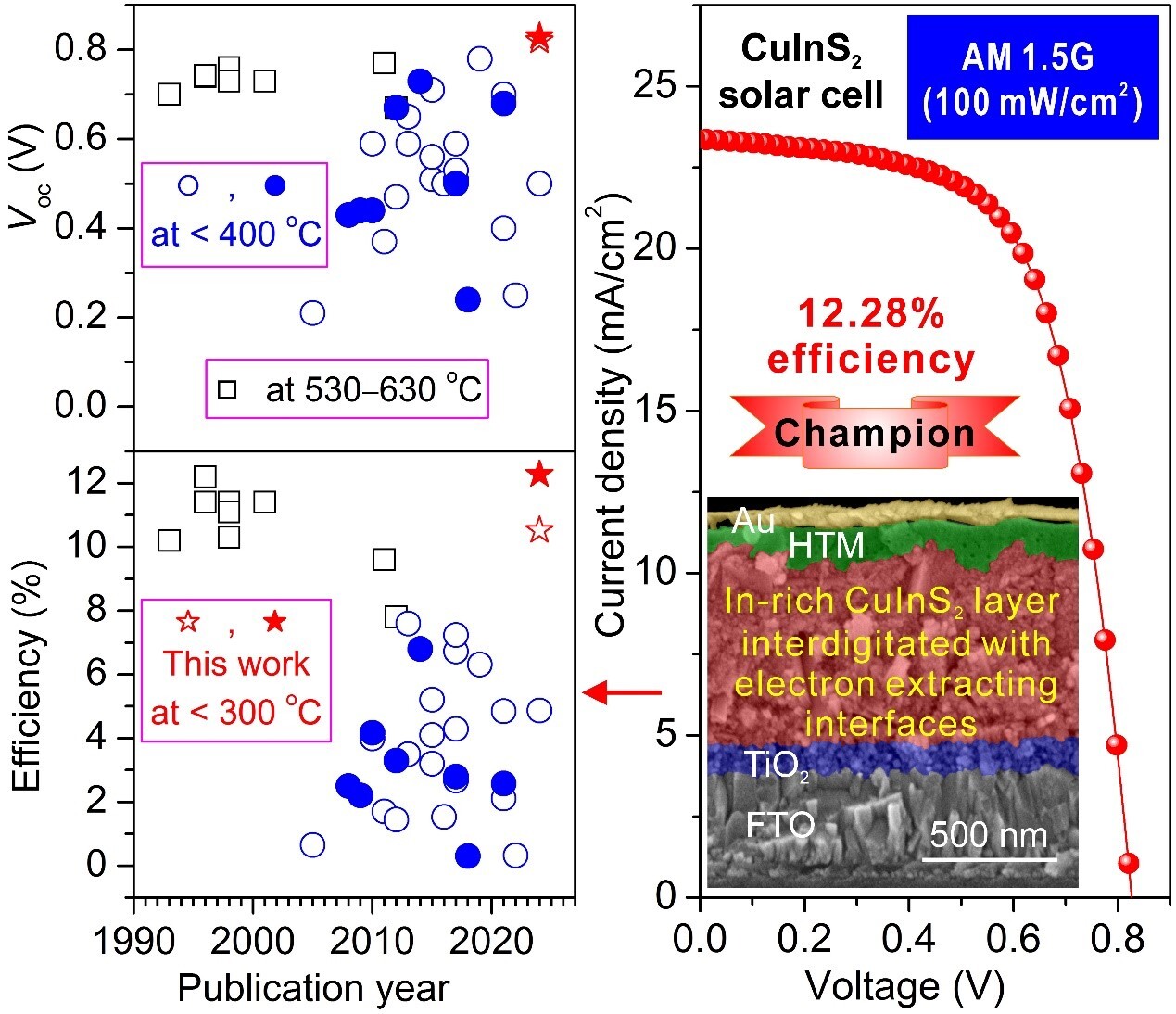
CuInS2 thin-film solar cell fabricated by low-temperature solution-processing strategy delivers new records of efficiency and open-circuit voltage. (Image by ZHANG Chaofan)
