Soil salinization affects over one billion hectares of farmland worldwide, threatening food and forage production. Alfalfa (Medicago sativa), a high-protein and high-biomass forage crop, is moderately sensitive to salt stress. Salinity suppresses plant growth, inhibits nodulation and nitrogen fixation, and ultimately reduces yield and quality.
Dr. FENG Jian from the Institute of Genetics and Developmental Biology (IGDB) of the Chinese Academy of Sciences published an OPINION article in
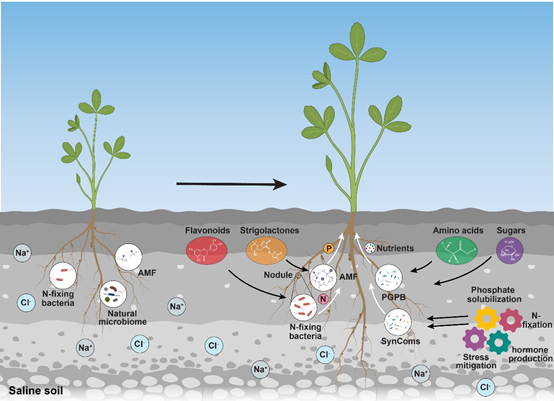
Plant, Cell & Environment. He outlined a microbiome-informed framework for improving salinity tolerance in alfalfa and other crops, providing new insights for sustainable agriculture in salt-affected soils.The study highlights that conventional strategies, such as breeding, genetic engineering, and soil amendments, have delivered limited and often unstable gains under complex field conditions; in contrast, root-associated microbiomes function as a critical interface between plants and soil. It showed that under saline stress, alfalfa reshapes its rhizosphere microbiome through altered root exudates, selectively recruiting beneficial microbes.
Moreover, the study highlights the synergistic roles of salt-tolerant nitrogen-fixing bacteria, arbuscular mycorrhizal fungi, and plant growth-promoting bacteria (PGPB), and emphasizes the potential of synthetic microbial communities (SynComs) to deliver multifunctional benefits. It proposes three strategic directions: understanding host-driven microbiome assembly under salt stress, designing stable SynComs, and incorporating microbiome responsiveness into breeding programs.
This article underscores a promising framework for harnessing microbiome-based strategies to improve plant performance under saline conditions
Beneficial root-associated microbiomes enhance plant growth and symbiotic performance under saline conditions. (Image by IGDB)