Newsroom


Transcranial magnetic stimulation (TMS) is a widely used non-invasive neuromodulation technique applied in psychiatry, neurology, and rehabilitation. However, the procedures often rely on manual operation, which has limited accuracy, poor consistency, and reduced treatment stability.
Recently, a research team led by Prof. HUANG Xuan from the Hefei Institutes of Physical Science of the Chinese Academy of Sciences, along with researchers from Anhui Medical University, developed an intelligent TMS medical robot, enabling high-precision, image-guided neuromodulation therapy. The system is already been used in clinics.
The researchers integrated visual positioning navigation with three-dimensional reconstruction of magnetic resonance images, achieving "visualized precision navigation" for TMS therapy. The system enabled rapid registration between virtual and real environments, allowing high-precision spatial tracking and real-time visualization of the relationship between brain regions and treatment targets.
The core of the system is a binocular vision-based navigation technology which enables millimeter-level target localization and ensures accurate alignment between the stimulation coil and the intended brain region. Clinical results showed that this precise targeting reduced unintended stimulation of surrounding areas, thereby minimizing side effects and shortening treatment cycles.
The researchers are now working closely with clinicians to further improve the system by using big data modeling and artificial intelligence, with the goal of identifying individual symptom patterns and enabling personalized treatment strategies. TMS therapy is expected to be more precise, patient-specific care.
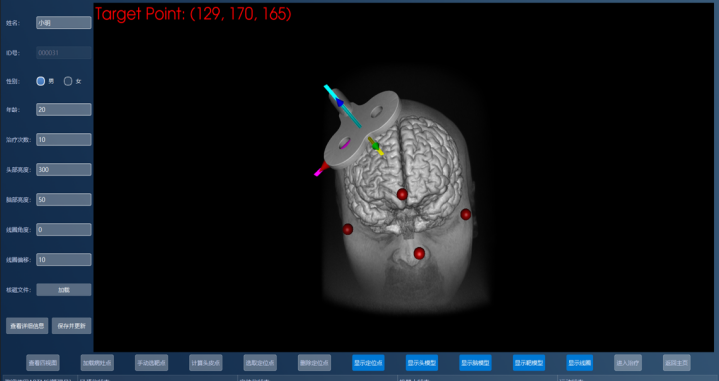
TMS Robot Work Interface (Image by HUANG Xuan)