Newsroom


In a study published in Journal of the American Chemical Society, Prof. ZHANG Jian's team from Hefei Institutes of Physical Science of the Chinese Academy of Sciences (CAS), along with Prof. XIAO Chong from the University of Science and Technology of China of CAS and Prof. ZHANG Yongsheng from Qufu Normal University, achieved a peak of 2.03 at 873 K in chalcopyrite-based thermoelectric materials using a novel dual antisite defect strategy.
The researchers developed a new silver/indium (Ag/In) alloying strategy to introduce dual antisite defects in the Cu0.7Ag0.3Ga1-xInxTe2 thermoelectric system. These defects occurred when certain atoms swapped positions in the crystal lattice, and they helped decouple the thermal and electrical transport processes. This allowed the material to conduct electricity more efficiently while blocking heat, overcoming a common challenge in thermoelectric design.
Moreover, the researchers optimized the material composition to stabilize these defects. They showed that Ag and In not only promoted defect formation but also reduced lattice distortion and encouraged a uniform solid solution, preventing phase separation. These structural modifications increased carrier concentration, maintained high carrier mobility, and enhanced the Seebeck coefficient, while scattering heat-carrying vibrations (phonons) to significantly reduce thermal conductivity.
As a result, the optimized material Cu0.7Ag0.3Ga0.6In0.4Te2 achieved a peak ZT of 2.03 at 873 K and an average ZT of 0.61 over 300–873 K, representing roughly a 59% improvement compared with the CuGaTe2.
This work demonstrates a new way to engineer high-performance thermoelectric materials, and shows that carefully designed defects can overcome typical trade-offs and enable more efficient energy conversion.
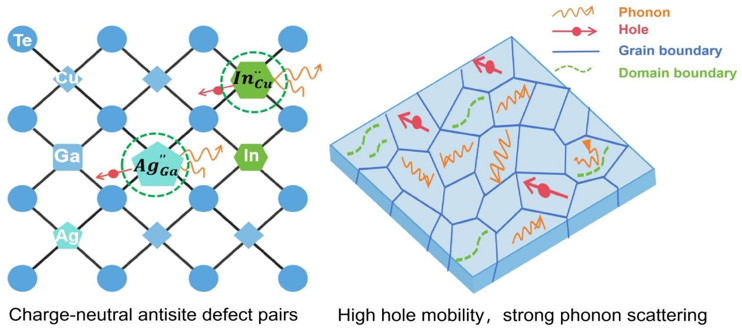
Charge-neutral antisite defect pairs for decoupled electron-phonon Transport. (Image by XU Ting)