
Newsroom


A research team from the Shanghai Astronomical Observatory (SHAO) of the Chinese Academy of Sciences has proposed a new mechanism driving prograde equatorial jets—where wind direction aligns with a planet's rotation—for the first time. The mechanism reveals the direct regulatory role of magnetohydrodynamic waves in the deep interior on atmospheric circulation, offering a new perspective for understanding the atmospheric dynamics of gaseous giants.
Their findings were published in The Astrophysical Journal Letters on March 27.
Planetary science has long grappled with two fundamental unsolved puzzles regarding gas giants such as Jupiter and Saturn, known as Jupiter-like planets: what sustains the prograde direction of their equatorial atmospheric jets, and how these jets initially form within their atmospheres.
Theoretically, such jets require a continuous supply of momentum transported to the equator. Building on an analytical model for equatorial Magneto-Archimedes-Coriolis (eMAC) waves they published previously, the team applied this analytical solution for magnetohydrodynamic waves to the study of gas giants' deep interiors for the first time. The resulting theoretical results are consistent with actual observations.
The study suggests that the "low-latitude wind fields and jets" observed on Jupiter and Saturn are likely a manifestation of magnetohydrodynamic wave signals generated in the planet's internal stable stratified layer—specifically, the hydrogen-helium immiscible layer, also known as the "helium rain" layer. Confined to the equatorial region, these waves have low phase velocities, and their perturbations can propagate upward to the weather layer, creating a specific thermal structure that efficiently transports momentum toward the equator.
This mechanism is closely linked to the evolutionary process of gas giants. As a planet's interior gradually cools, hydrogen and helium separate within a certain pressure range, with helium precipitating to form "helium rain." This process establishes a stable stratified region maintained by a compositional gradient, sandwiched between two convective layers. The team confirmed that this stable layer is the key site for the generation of equatorial eMAC waves.
To further validate the mechanism, the team used the internationally recognized MITgcm atmospheric model to conduct high-precision atmospheric dynamics simulations of equatorial wave disturbances. The results show that the azimuthal inhomogeneity in the equatorial region induced by these waves can excite Matsuno-Gill modes in the atmosphere. These modes can efficiently transport angular momentum from off-equatorial regions to the equator, ultimately leading to the formation of a stable prograde equatorial jet.
This study offers a new theoretical explanation for the origin of equatorial jets on gas giants and provides key insights into the distinct circulation patterns between gas giants and ice giants. It also identifies a universal physical mechanism, whereby magnetohydrodynamic waves in stratified bodies drive low-latitude jets, establishing a new framework for understanding atmospheric dynamics on gas giants.
This work was supported by the National Key Research and Development Program of China, the National Natural Science Foundation of China, and other funding sources.
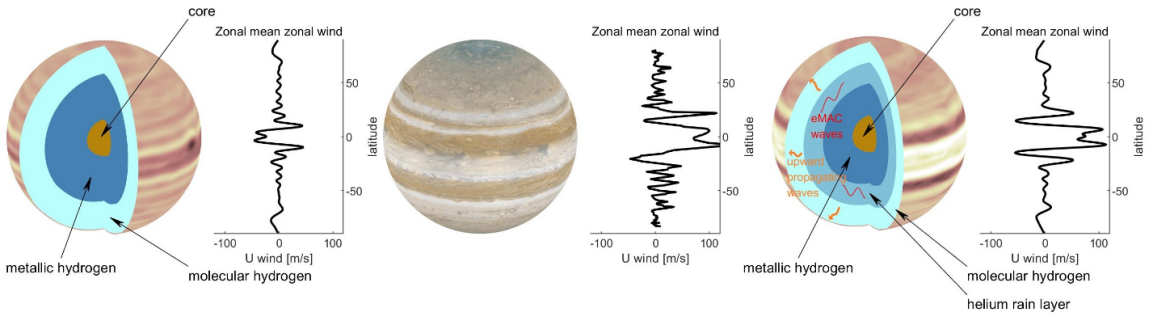
Schematic of the analytical eMAC wave model explaining the origin of Jupiter's low-latitude wind field. (Image by SHAO)
