Newsroom


A research team led by Prof. WANG Shudong from the Aerospace Information Research Institute of the Chinese Academy of Sciences (AIRCAS), has proposed a novel integrated framework combining remote sensing observations, deep learning technologies, and Earth System Models (ESMs). The framework is designed to reconstruct long-term variations in global surface soil moisture and enhance the accuracy of future projections.
The study was recently published in Earth's Future.
Surface soil moisture plays a critical role in agricultural production, drought monitoring, heatwave and wildfire risk assessment, as well as the characterization of land-atmosphere interactions. However, due to gaps in remote sensing observations and inadequate representation of land-atmosphere feedback processes in ESMs, considerable uncertainty and debate persist regarding the long-term changes and future trends of global surface soil moisture.
To address this challenge, the team adopted deep learning algorithms to fill data gaps in global surface soil moisture datasets derived from microwave satellites spanning 1983 to 2020. This effort generated a more complete and temporally consistent global observational record. Using the optimized observational record as constraints, the researchers integrated output data from 23 CMIP6 ESMs, established a nonlinear mapping relationship between observations and model simulations, reconstructed historical soil moisture evolution from 1901 to 1980, and calibrated and predicted future scenarios for 2021 to 2100.
This method breaks the reliance of traditional statistical bias correction on linear relationships and fixed distribution assumptions, providing a new technical pathway for predicting hydrological variables under complex land–atmosphere coupling processes.
The study revealed that this new framework has enhanced the availability of remote sensing data by approximately 15%, with the coefficient of determination reaching around 0.9 on the independent test dataset. Data collected from 465 in-situ monitoring sites worldwide also confirmed strong consistency with the reconstructed satellite-derived datasets. Moreover, model simulations constrained by real observational data demonstrated far better alignment with satellite measurements across most global regions, compared with raw, unadjusted model outputs. This improvement boosts the credibility of both historical soil moisture reconstructions and long-term future projections.
Additionally, the study delivers novel insights into the evolutionary trends of global soil moisture. Over the past four decades, nearly half of the world's land areas have experienced gradual drying. However, observation-calibrated simulations indicate that drying trends in climate transition zones and marginal monsoon regions are less severe than previously estimated by conventional models. This suggests that current mainstream climate models tend to overpredict the intensification of future droughts, due to their inadequate representation of two-way feedbacks between soil moisture and the atmosphere.
Notably, the study challenges the widely recognized "dry gets drier, wet gets wetter" climatic paradigm. The study found that merely one-third of global land areas strictly follow this classic pattern, while numerous regions exhibit more complex hydrological changes or even reverse trends.
These findings provide new observational evidence for the scientific community to understand and analyze global soil moisture dynamics amid ongoing climate change.
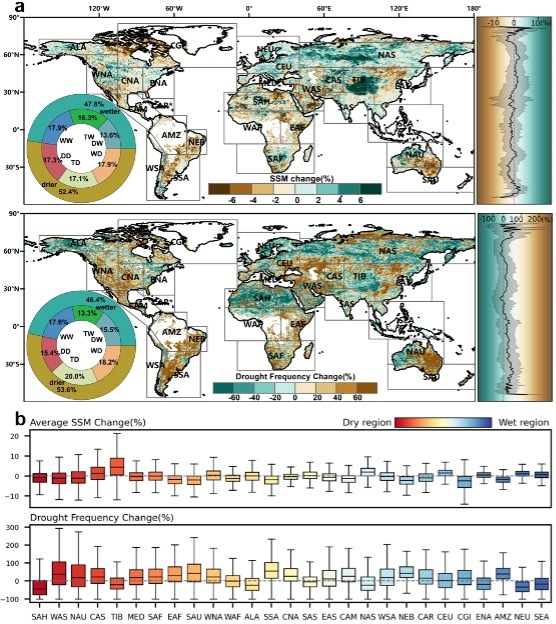
Changes in surface soil moisture and drought frequency during the past four decades. (Image by AIRCAS)
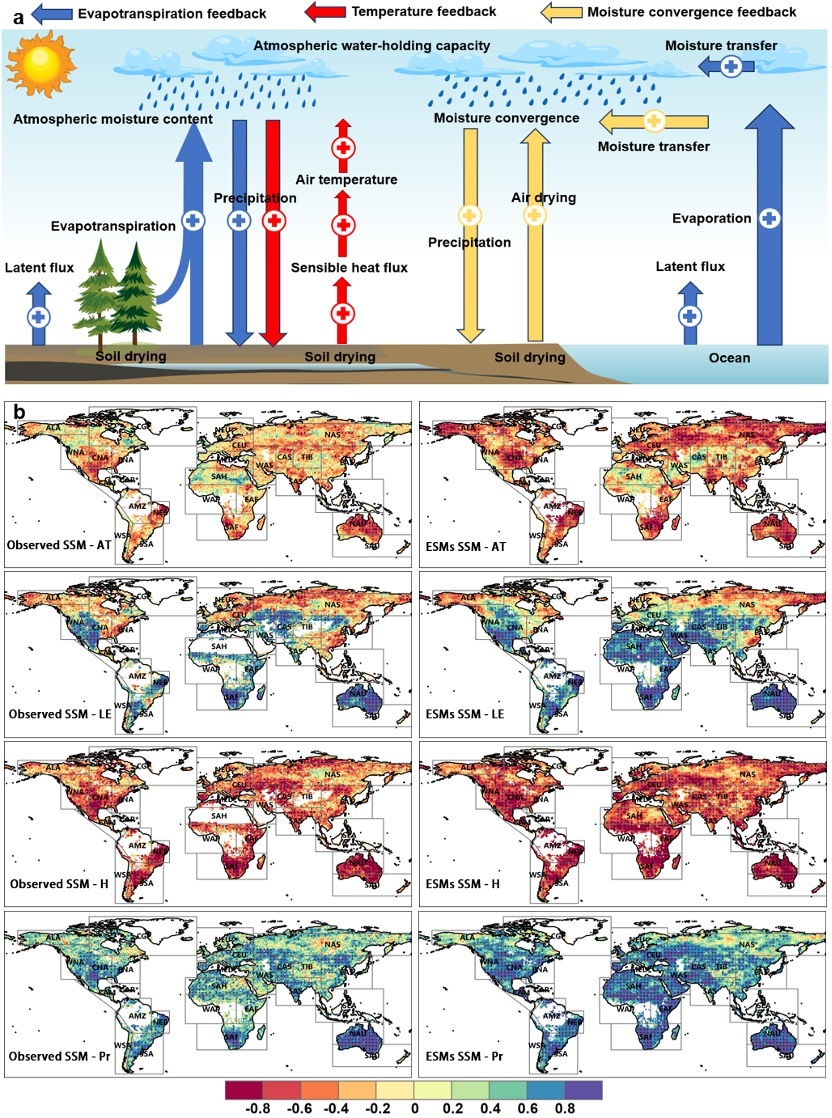
Mechanism and interpretation of soil moisture-atmosphere feedback. (Image by AIRCAS)