
Newsroom


Antarctica is often viewed as a remote and pristine wilderness, yet several studies have confirmed the presence of per- and polyfluoroalkyl substances (PFAS) across the continent. Existing research, however, has been largely limited to episodic coastal sampling, creating critical knowledge gaps regarding how PFAS reach the continent's arid interior and how their deposition patterns relate to interhemispheric transport processes.
To address these knowledge gaps, a research team from the Research Center for Eco-Environmental Sciences of the Chinese Academy of Sciences, in collaboration with the Polar Research Institute of China and Stockholm University, has carried out field surveys along a roughly 1,200-kilometer transect in East Antarctica. Their findings were recently published in Science Advances.
The team found rising PFAS concentrations in surface snow along the route from Zhongshan Station to Dome A. Inland levels were shaped by snow accumulation rates and the degradation of perfluoroalkyl acid (PFAA) precursors. The researchers also identified distinct seasonal deposition patterns in coastal zones: PFAS deposition is driven mainly by sea-spray aerosols in winter, while precursor degradation dominates in summer.
Additionally, the study reconstructed the deposition histories of ultrashort-chain perfluoroalkyl carboxylic acids (PFCAs), PFAAs, and their alternatives at Dome A. It offers evidence that global regulatory actions—including the Montreal Protocol and the Stockholm Convention on Persistent Organic Pollutants (POPs)—along with changes in industrial production, have successfully altered the environmental composition of PFAS, demonstrating the effectiveness and timeliness of such controls. Notably, concentrations of trifluoroacetic acid (TFA) have risen continuously in Antarctica since 1976, representing an emerging potential hazard that demands high-priority attention.
By establishing a precise chronological record of PFAS deposition in Antarctic ice, the study resolves earlier constraints that prevented quantitative comparisons with other regions worldwide. This breakthrough connects PFAS contamination in Antarctica to emissions from distant sources across the globe, providing new insight into the hemispheric and interhemispheric transport of these persistent compounds to the Antarctic continent.
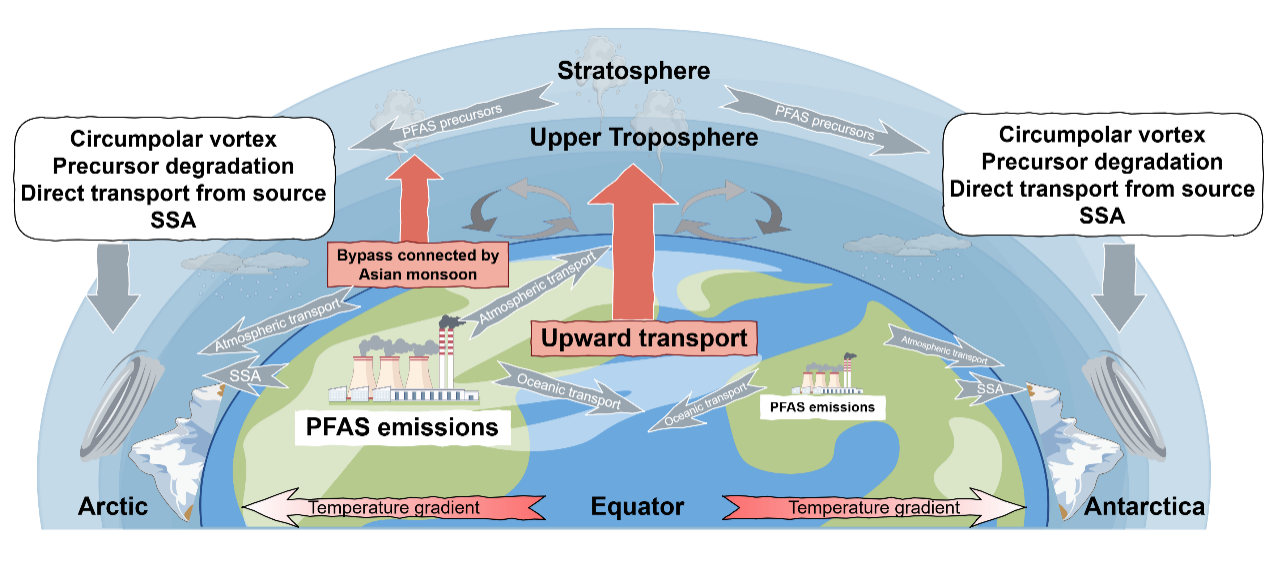
Global transport processes of PFAS to the Antarctica and Arctic. (Image by LI Xiaotong)
