Newsroom


Researchers have developed a new strategy to construct a heterogeneous microstructure in α + β titanium (Ti) alloys by precisely controlling the transformation of metastable phases, achieving an excellent balance between strength and ductility. This work, published in Acta Materialia on March 15, provides a new paradigm for the microstructural design of high-performance Ti alloys for critical applications in aerospace and deep-sea engineering.
Ti alloys are essential structural materials for strategic sectors. Among them, TC16 alloy (Ti–3Al–5Mo–4.5V, wt.%), as one of the α + β Ti alloys, is widely used for aviation fasteners. In the early 2000s, researchers from the Institute of Metal Research (IMR) of the Chinese Academy of Sciences tackled a key processing bottleneck: cracking during the cold heading of TC16 wires. By inducing the β → α″ → α + β transformation, they produced an ultrafine α microstructure that withstood 80% cold deformation without cracking, enabling the successful fabrication of cold-headed fasteners.
Building on this foundation, a research team led by Profs. MA Yingjie and YANG Rui has now developed a more advanced microstructural optimization strategy. They used controlled metastable ω/α″ phases to induce α nucleation and construct heterogeneous structures. By precisely controlling β phase stability through quenching from α + β phase region, multiply metastable phases can be precipitated. Subsequent multi-step aging treatments activate metastable phase-induced α nucleation, enabling the construction of multi-scale heterogeneous microstructure and overcoming the strength-ductility trade-off.
The researchers identified three key mechanisms underlying the enhanced performance. First, they elucidated the mechanism of ω-assisted αs nucleation by combining theoretical calculations with advanced characterization. This demonstrated that isothermal ω particles effectively nucleate secondary α (αs) through the interplay of concentration fields, stress fields, and ω/β interface characteristics. Second, the researchers used transmission Kikuchi diffraction to reveal that αs refinement promotes Type B variant pair formation—a phenomenon attributed to ω-assisted nucleation amplifying elastic interactions and driving autocatalytic nucleation.
Furthermore, the researchers constructed a four-scale heterogeneous α (FSH-α) microstructure comprising micron-scale αp and three distinct αs morphologies (micron-scale αs, nanoscale αs, and ladder-like αs) by synergistically activating ω/α″ regulation pathways through quenching from the α + β phase region combined with multi-stage aging treatments. The FSH-α microstructure exhibits superior yield strength without sacrificing ductility compared to conventional annealed and two-scale heterogeneous α (TSH-α) microstructures.
The enhanced performance arises from a multi-tiered network of hetero-interface, where plastically deformable micron-scale αs domains act as mechanical buffers, generating additional hetero-deformation-induced (HDI) stress while coordinating strain to maintain ductility.
This work establishes a multiscale framework of "metastable phase regulation–multiscale heterostructure fabrication–deformation behavior/mechanism properties optimization," providing important theoretical guidance for the design of microstructures and the engineering application of Ti alloys with excellent strength and high ductility.
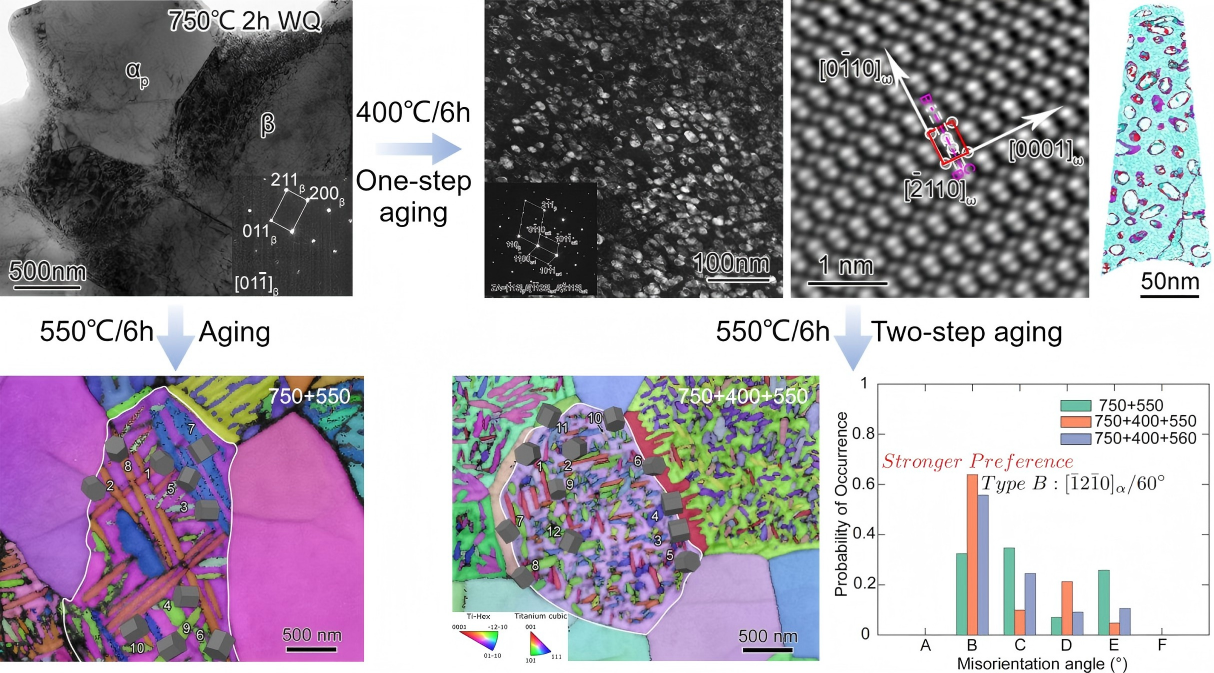
Nanoscale αs lamellae and their variant distribution formed by the ω-assisted nucleation mechanism. (Image by IMR)
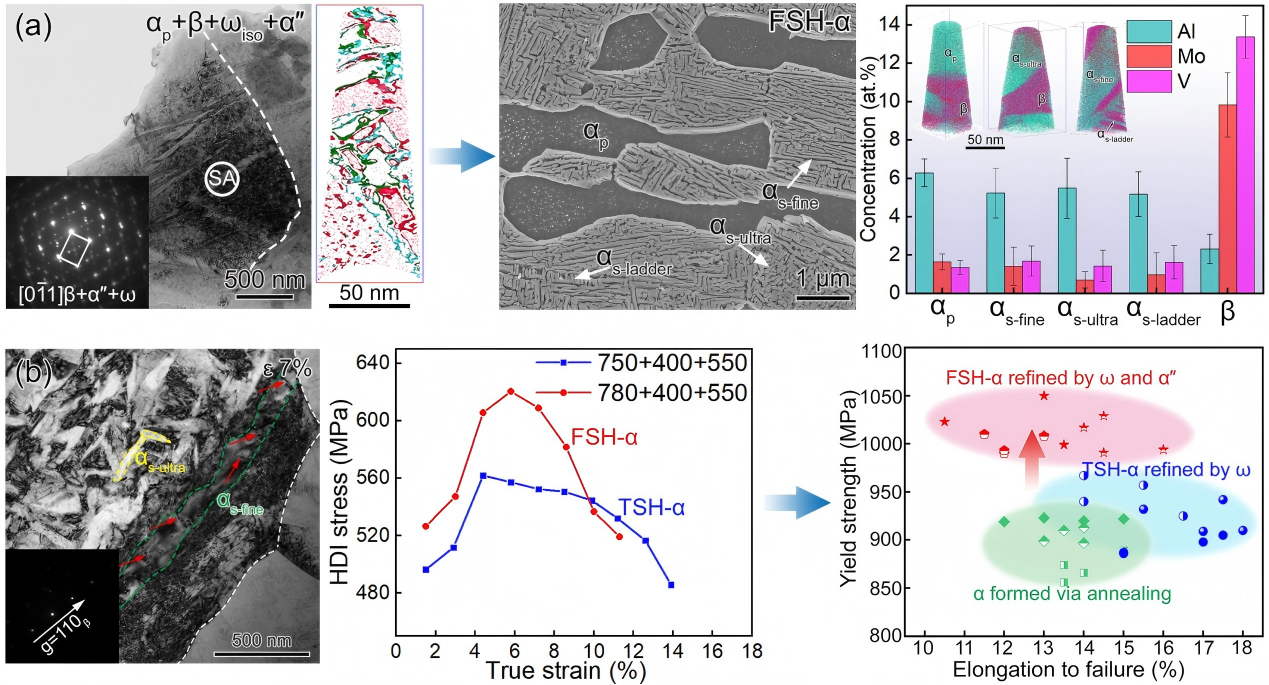
Fabrication strategy and mechanical behavior of the four-scale heterogeneous α (FSH-α) microstructure: (a) FSH-α fabricated by synergistically activating ω/α″ regulation pathways; (b) Multi-tiered network of hetero-interface promoting synergistic enhancement of strength and ductility. (Image by IMR)