
Newsroom


A research team from the Institute of Metal Research (IMR) Chinese Academy of Sciences has developed a novel ferroelectric valve, a multilayer device that enables non-volatile, multi-state modulation of electrical resistance by switching the polarization orientation of adjacent ferroelectric layers. This innovation paves the way for multifunctional, low-power information devices in the post-Moore era.
The study, published in Advanced Materials on March 19, introduces a new device paradigm that extends the functional potential of ferroelectrics in next-generation information technology.
Spin valves, which modulate resistance by controlling spin orientations in ferromagnetic layers, have been instrumental in advancing spintronic technologies such as magnetic memory and sensors. Inspired by the conceptual analogy between ferroelectricity and ferromagnetism, the researchers led by Prof. CHEN Chunlin from IMR designed a structurally analogous system in which resistance is tuned through polarization switching in neighboring ferroelectric layers.
Using pulsed laser deposition, the researchers fabricated a sandwich-structured ferroelectric valve consisting of two ferroelectric LaTiO3.5 layers separated by an ultrathin conductive m-LaTiO3 layer, with the middle layer precisely controlled to a thickness of just three to six atomic layers.
Combining aberration-corrected scanning transmission electron microscopy with first-principles calculations, the researchers discovered that when the polarizations of the two ferroelectric layers are antiparallel, the bandgap of the conductive layer significantly narrows and carrier concentration increases, leading to markedly higher conductivity compared to the parallel configuration. Moreover, the antiparallel polarization configuration induces charge redistribution and orbital hybridization that lift the degeneracy of Ti 3d t2g orbitals, resulting in pronounced in-plane electrical anisotropy.
By tuning the polarization orientation of the ferroelectric layers via external fields, the resistance state and the easy conduction axis of the central LaTiO3 layer can be flexibly switched, to achieve non-volatile multi-state resistance modulation.
Notably, LaTiO3.5 exhibits a Curie temperature exceeding 1,500 K and excellent lattice matching with LaTiO3, ensuring high structural quality, atomically sharp interfaces, and strong thermal stability. These properties make the ferroelectric valve particularly promising for high-temperature electronics and other demanding environments.
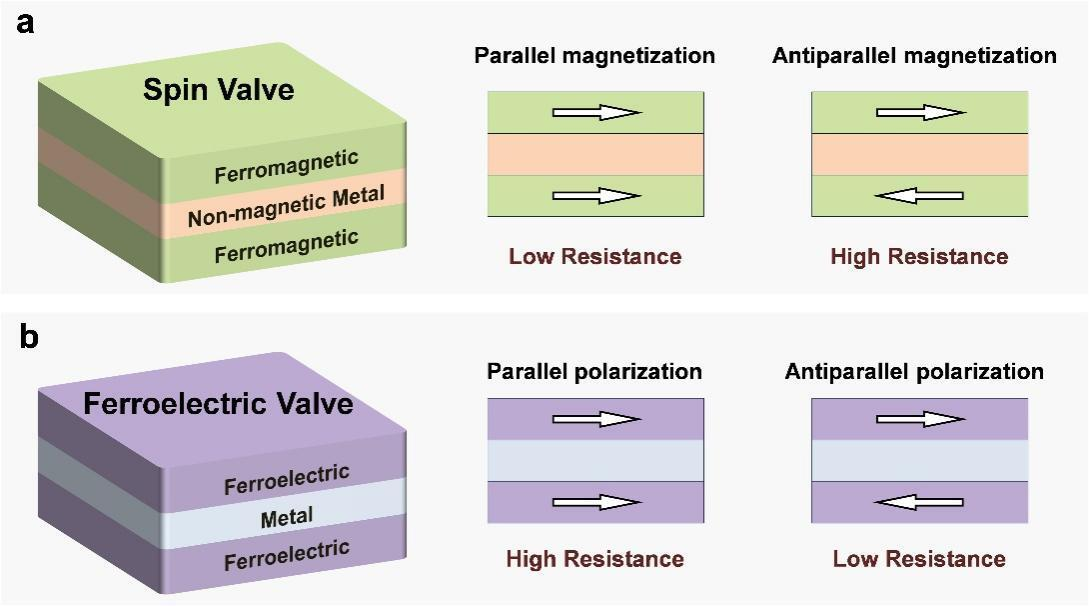
Design concept of the ferroelectric valve. (Image by IMR)
