Newsroom


The Antarctic stratospheric polar vortex—a massive circulation of cold air swirling high above the continent—plays a crucial role in shaping Southern Hemisphere weather and influencing polar ozone levels. When the vortex weakens, it can disrupt weather patterns across the mid-latitudes and affect the Antarctic ozone hole. However, predicting these changes months in advance remains a challenge.
In a study published in Atmospheric Chemistry and Physics, researchers from the Institute of Atmospheric Physics of the Chinese Academy of Sciences (CAS), the University of Science and Technology of China of CAS, Dalhousie University, and the Bedford Institute of Oceanography, showed that warming sea surface temperatures (SSTs) near the tropical central Pacific in boreal winter can trigger a delayed response in the Antarctic stratosphere, helping improve predictions of Southern Hemisphere climate patterns.
The researchers analyzed the climate data from 1980 to 2024, and discovered a telling pattern: when SSTs in the tropical central Pacific (a region known as Niño4) warmed during December-February, the Antarctic stratosphere consistently showed warming and a weakened polar vortex the following July-September.
The tropical Pacific Ocean and Antarctica are separated by more than 10,000 kilometers. "We're seeing a clear cross-seasonal connection. What happens in the tropical Pacific during boreal winter leaves a fingerprint in the Antarctic stratosphere half a year later. This opens a window for longer-range predictions," explained Prof. XIAO Ziniu, one corresponding author of this study.
The researchers traced the chain of events linking these distant regions. Warm SSTs in the tropical central Pacific during boreal winter enhanced convection, pumping energy into the atmosphere. This triggered a Pacific-South American (PSA) teleconnection: an atmospheric wave train that arced southeastward across the Pacific, carrying the tropical signal toward Antarctica.
As these waves reach the Amundsen and Ross Seas, they drove sea ice loss in these critical regions, and the reduced ice cover persisted into austral winter. The open water continued to release heat into the atmosphere, strengthening planetary waves that ultimately propagated upward and disturbed the stratospheric polar vortex, causing it to warm and weaken.
Statistical analysis revealed that combining the winter Niño4 SST index with the PSA circulation index can explain approximately 32% of the variability in Antarctic stratospheric temperature the following winter, which is a significant predictive signal. "32% is substantial for a cross-seasonal connection spanning thousands of kilometers and multiple months. It's a physically based pathway that could be incorporated into seasonal forecasting systems," said Prof. XIAO
Moreover, the researchers noted that when the polar vortex weakens, ozone concentrations in the polar stratosphere tend to increase—likely due to reduced chemical ozone depletion under warmer conditions and altered transport patterns. This adds another dimension to understanding Antarctic ozone variability.
Improved predictions of Antarctic stratospheric variability would benefit seasonal weather forecasts for the Southern Hemisphere mid-latitudes, which are influenced by polar vortex strength. Antarctic operations and logistics, which depend on understanding regional climate conditions, could also see improvements. For ozone layer monitoring and prediction, understanding the vortex's role in ozone depletion chemistry offers additional insight.
The study raises an open question worthy of further in-depth investigation: In the context of global warming, does the continued warming of the tropical central Pacific significantly increase the likelihood and intensity of Antarctic stratospheric polar vortex anomalies, including rare Sudden Stratospheric Warming events?
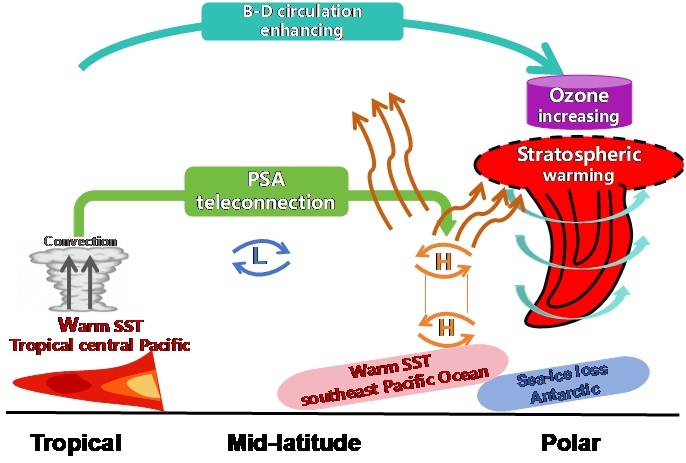
Diagram illustrates the proposed physical mechanism linking boreal winter Niño 4 SST anomalies to Antarctic stratospheric warming in the subsequent austral winter. (Image by ZI Yucheng)