
Newsroom


Magnetic materials with noncollinear spin structures and exotic topological textures have long been a focal point in condensed matter physics and spintronics. Curved magnetic materials are particularly intriguing, as the direct coupling between geometric curvature and spin configurations can stabilize complex spin textures that are difficult to realize in planar systems—an advantage that provides an ideal platform for developing next-generation spintronic devices.
In recent years, with the discovery of two-dimensional van der Waals magnets and advances in the synthesis technology of transition-metal chalcogenide nanotubes, it has become possible to fabricate intrinsically magnetic nanotubes. Compared with planar magnets, nanotubes possess circumferential periodic boundary conditions, well-defined geometric phases, and a helical winding structure, making them ideal model systems for studying curvature–spin coupling.
A research team led by Prof. ZHANG Jin from the National Center for Nanoscience and Technology of the Chinese Academy of Sciences (CAS), in collaboration with researchers from the CAS Institute of Theoretical Physics and the University of Chinese Academy of Sciences, has uncovered high-order vortex states and magnon orbital-angular-momentum hybridization in VSe2 single-walled nanotubes. Their findings were recently published in Physical Review Letters.
Using comprehensive density-functional theory and Landau-Lifshitz-Gilbert dynamical calculations, the researchers demonstrated that the magnetic ground states of VSe2 nanotubes are highly sensitive to their geometric diameters. The formation of these high-order vortex states stems from the intricate diameter-dependent competition between nearest-neighbor ferromagnetic couplings and longer-range antiferromagnetic couplings.
Furthermore, the team revealed a novel hybridization mechanism between magnon modes carrying different orbital angular momenta. They confirmed that, in the presence of magnetic anisotropy, these high-order vortex states enable a unique magnon-mode hybridization governed by specific orbital-angular-momentum selection rules.
Magnetic vortex states with high orbital angular momentum can carry significantly richer information and exhibit remarkable robustness against external perturbations, making them advantageous for information storage and processing.
This study not only highlights the critical role of geometry in reshaping microscopic magnetism but also opens a new high-order regime for exploring topological spin textures in curved magnets.
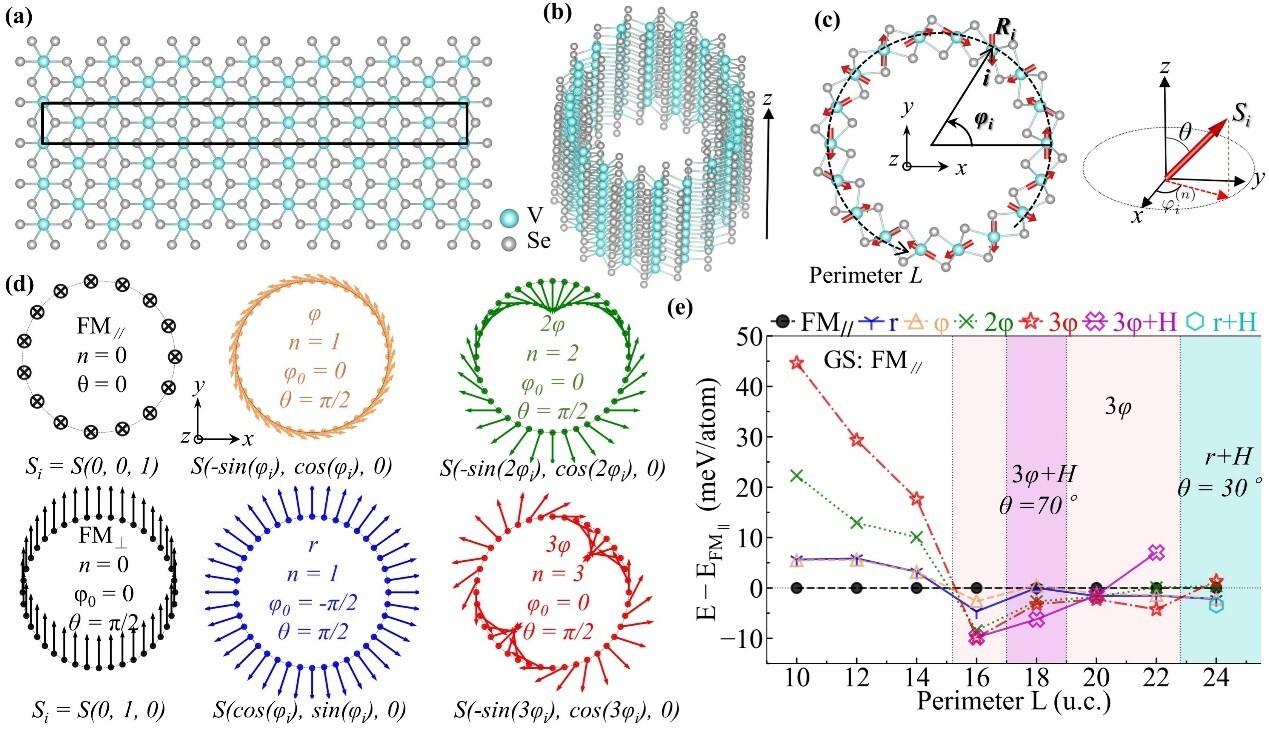
Schematic illustration of high-order magnetic vortex states in magnetic nanotubes and the evolution of the magnetic ground state of VSe2 nanotubes with diameter. (Image by LI Jiawen et al.)
