Newsroom


A research team from the National Center for Nanoscience and Technology (NCNST) of the Chinese Academy of Sciences has developed a novel artificial intelligence (AI) model for optimizing ionizable lipids, tackling two long-standing bottlenecks in messenger RNA (mRNA) drug delivery: low efficiency and the absence of precise organ targeting.
Their findings were recently published in Nature Biomedical Engineering.
Traditionally, lipid nanoparticle (LNP) design has focused mainly on the two-dimensional (2D) chemical structures of ionizable lipids, frequently ignoring their dynamic three-dimensional (3D) spatial conformations under physiological conditions.
To tackle this issue, the team integrated 3D spatial conformation as a core predictive parameter into its AI framework.
The researchers first constructed a library of ionizable lipids and employed molecular dynamics (MD) simulations to capture the dynamic conformation of each lipid structure. After translating these 3D conformational data into 2D density maps to train the AI model, the AI-driven screening successfully identified a candidate lipid known as P1.
Compared with the clinically approved lipid ALC-0315, lipid P1 showed a 14.8-fold enhancement in mRNA delivery efficiency. Notably, the distinctive 3D structure of lipid P1 enables it to selectively bind immunoglobulin M (IgM) in the bloodstream, thereby supporting precise spleen-targeted delivery.
Using this spleen-targeted LNP, the team developed an mRNA cancer vaccine that demonstrated significant therapeutic efficacy in a mouse melanoma model. The vaccine effectively triggered robust T-cell immune responses and elicited high levels of antigen-specific antibodies, achieving dual activation of humoral and cellular immunity. As a result, the vaccine markedly regressed established tumors and conferred long-term immune protection in the animal subjects.
This study establishes a new design paradigm for ionizable lipids, shifting from empirical screening based on 2D chemical structures to AI-enabled precision engineering using 3D spatial conformations. Additionally, the research reveals the molecular mechanism by which ionizable lipids facilitate lysosomal escape during mRNA delivery.
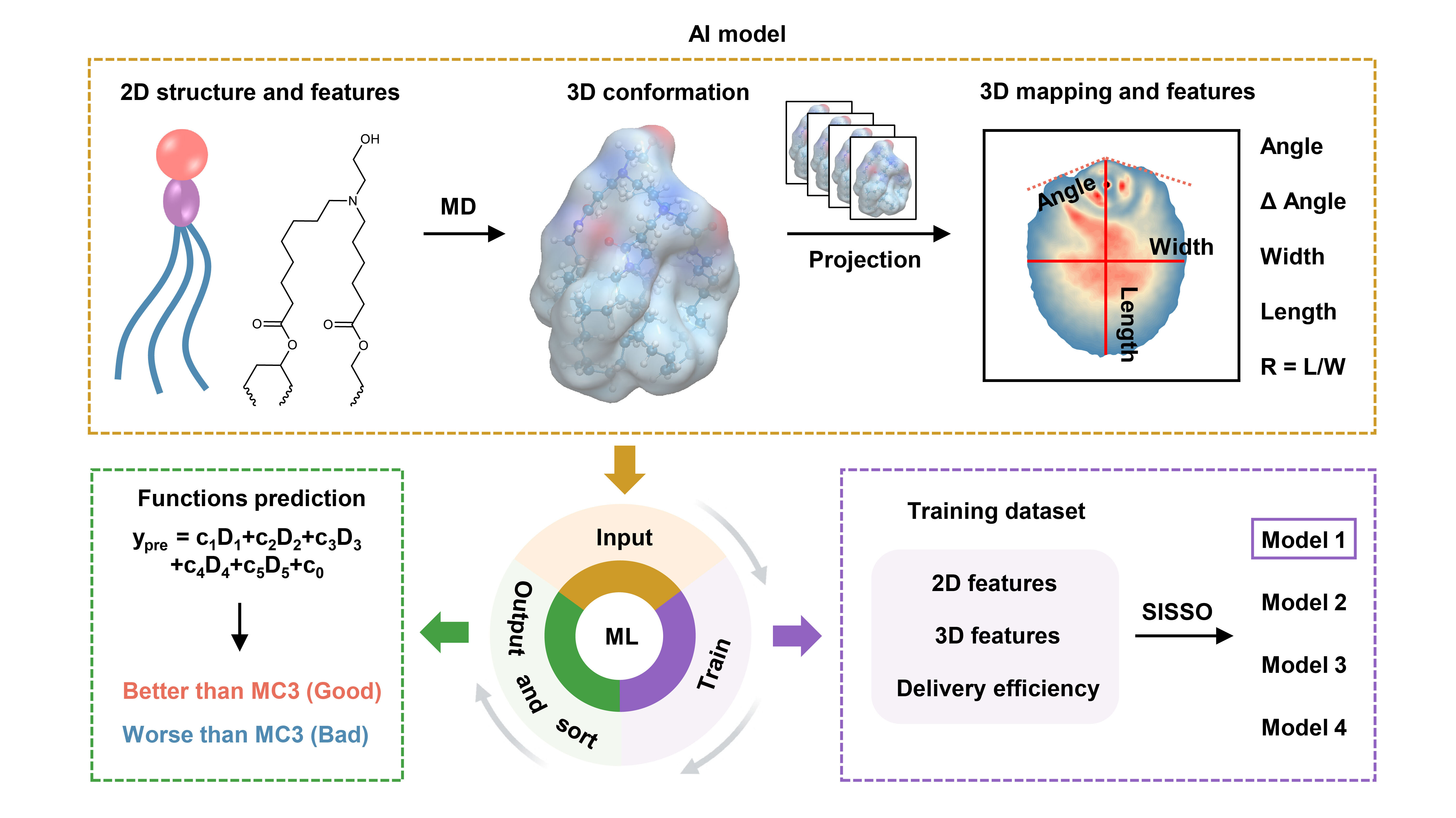
Schemetic illustration for the development of an AI model for LNP optimization. (Image by SU Linjia et al.)