Newsroom


A new study has found that the recent increase in precipitation across northwest China is driven primarily by local evapotranspiration, rather than by strengthened external moisture inflow.
In recent decades, the climate in northwest China has shifted significantly towards warmer and wetter conditions. This trend has attracted extensive attention, particularly regarding the question of where the additional precipitation originates.
Climatologically, precipitation in this area has long been considered to depend primarily on external moisture transport. However, researchers now report that while this remains true of the long-term climatological mean the increase in rainfall since the late 20th century has been driven by enhanced local evapotranspiration.
The study, conducted by a research team from the Northwest Institute of Eco-Environment and Resources (NIEER) of the Chinese Academy of Sciences in collaboration with Lanzhou University and the Lanzhou Institute of Arid Meteorology, was published in Advances of Atmospheric Sciences on February 7.
Using a Dynamic Recycling Model, the researchers quantified the contributions of different moisture sources to precipitation. Their analysis shows that from 1998 to 2020, annual evapotranspiration increased by 10.42 mm (approximately 9.12%), closely matching a 10.62 mm (approximately 9.18%) rise in annual precipitation compared to the period from 1961 to 1997.
Notably, about 78% of the recent increase in precipitation can be attributable to locally recycled moisture, while only about 22% is due to enhanced external moisture transport.
The researchers also revealed pronounced spatial heterogeneity in summer precipitation changes across northwest China. The regional pattern can be summarized as "increasing in the west and decreasing in the east." Precipitation increased significantly more in the western subregion than in the eastern part of the region, especially in areas around the Tianshan and Altun mountains.
From a temporal perspective, the late 20th century represents a clear turning point in regional precipitation variability. Around the end of the 1990s, summer precipitation shifted from a long-term downward trend to an upward trend, marking a critical phase in the humidification of northwest China.
These findings indicate that although more than half of the climatological mean precipitation in northwest China comes from external water vapor input, the recent increase in precipitation since the late 20th century is primarily due to intensified local land-atmosphere interactions. Enhanced evapotranspiration has consequently emerged as a key driver of the recent humidification trend in Northwest China.
The study also suggests that intensified local evapotranspiration is associated with rising temperatures, increased meltwater input from glaciers and snowpack, and vegetation recovery.
However, these processes are still constrained by the availability of water resources. As glacier and snow reserves continue to decline due to ongoing warming, meltwater-supported evapotranspiration may weaken, which could reduce the persistence of the current humidification trend.
The study also highlights the influence of large-scale oceanic variability on regional precipitation changes. Changes in the phase of the Atlantic Multidecadal Oscillation (AMO) may modulate regional precipitation patterns, thereby introducing additional uncertainty into future projections.
"This work fundamentally refines our understanding of the regional hydrological cycle," said Professor YU from NIEER. "From a climatological perspective, precipitation in northwest China has long been considered heavily dependent on external moisture transport. However, our findings show that since the late 1990s, the dominant contributor to increased precipitation has been local moisture recycling. This highlights the critical role of land–atmosphere coupling in the region's wetting trend."
"This study provides quantitative evidence that local hydrological feedbacks have become the dominant mechanism driving recent precipitation increases in northwest China. It advances the theoretical understanding of arid-region climate change and has significant implications for drought monitoring, prediction, and water-resource management," said Professor ZHANG Qiang from the Lanzhou Institute of Arid Meteorology of the China Meteorological Administration.
Professor HUANG Jianping from Lanzhou University added that the warm-wet shift in northwest China is not solely a circulation-driven phenomenon. It reflects an integrated response of the regional water cycle to warming, cryospheric changes, and ecosystem recovery. Understanding the sustainability of these drivers is essential for projecting future climate trajectories.
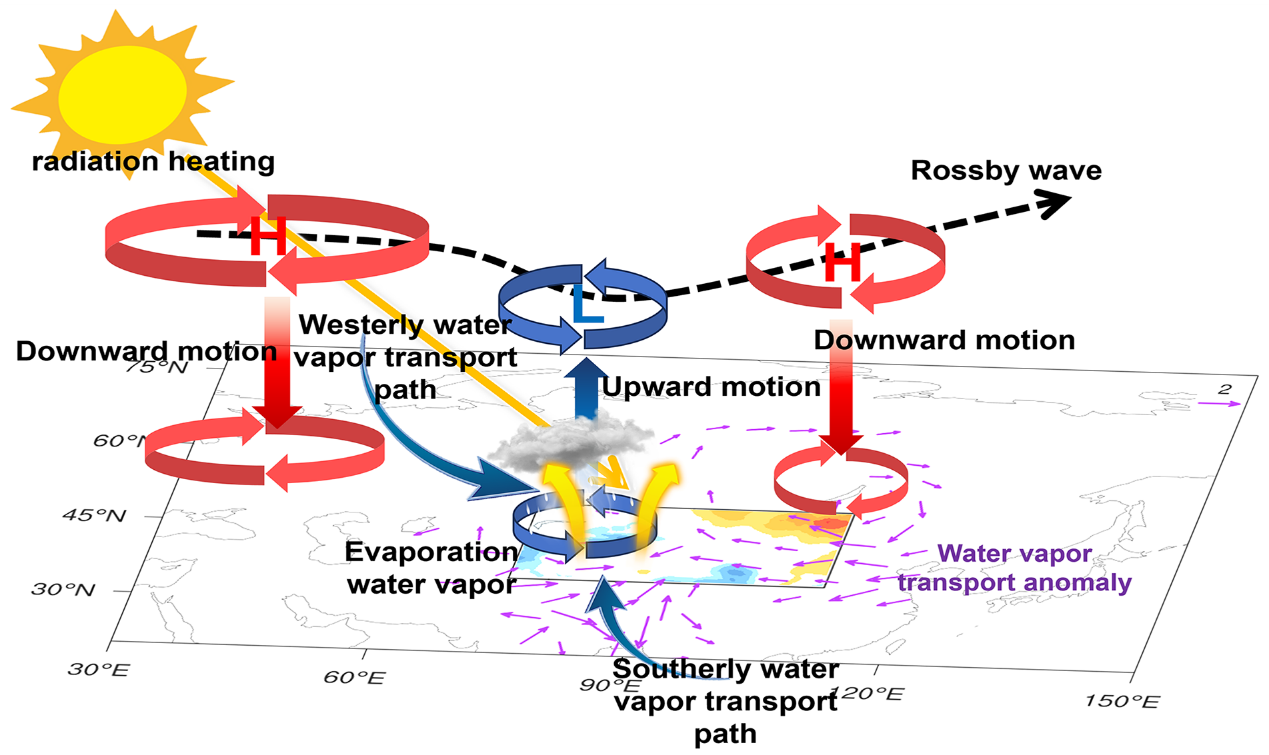
Schematic illustration of the mechanisms responsible for the humidification in Northwest China (Image by NIEER)