
Newsroom


Flowers represent one of the most extraordinary evolutionary innovations in angiosperms. Among the diversity of floral hues, turquoise stands out as one of the rarest pigments in nature. The evolution of floral pigmentation not only mediates the co-evolutionary interactions between plants and their pollinators but also plays a pivotal role in shaping terrestrial biodiversity.
Strongylodon macrobotrys A. Gray, commonly known as the jade vine, is a leguminous woody climber endemic to tropical rainforests. Renowned for its spectacular turquoise racemes, where individual florets resemble birds in mid-flight. Yet, the molecular underpinnings of its distinctive turquoise coloration have remained enigmatic for decades.
For nearly two decades, the jade vine has been cultivated at the South China Botanical Garden (SCBG) of the Chinese Academy of Sciences (CAS). To bridge this knowledge gap, a research team from SCBG assembled a high-quality, haplotype-resolved, telomere-to-telomere (T2T) genome of the jade vine. By integrating multi-omics datasets including transcriptomics and metabolomics, the team systematically decoded the formation of this rare floral color from genomic, metabolic, and transcriptional regulatory angles.
Their findings were recently published in Journal of Integrative Plant Biology.
The study revealed that the jade vine's turquoise phenotype does not stem from a single pigment; instead, it arises from the synergistic co-pigmentation between the anthocyanin malvin (malvidin-3,5-O-diglucoside), and the flavonoid co-pigment saponarin (isovitexin-7-O-glucoside). Malvin belongs to the delphinidin branch of the anthocyanin biosynthetic pathway, which typically produces blue-to-violet pigments. In contrast, saponarin, which appears pale yellow or nearly colorless, amplifies the visual intensity of malvin through intermolecular interactions, shifting the perceived hue to the iconic turquoise.
Temporal metabolite profiling further uncovered dynamic changes in pigment levels across flower development. As flowers mature and senesce, malvin concentrations decline steadily, while saponarin continues to accumulate. This delicate balance between the two pigments is thus critical for sustaining the jade vine's signature turquoise color throughout its flowering period.
Through population demographic reconstruction and multi-omics evolutionary analyses, the researchers also identified population expansion events linked to historical environmental shifts, alongside a burst of long terminal repeat (LTR) retrotransposon activity. These genomic dynamics likely contributed to the restructuring of floral pigment regulatory networks and may have enhanced the jade vine's adaptive capacity in the face of fluctuating environmental conditions.
This study offers comprehensive insights into the genetic and metabolic basis of turquoise pigmentation in nature, shedding new light on floral color innovation and the dynamic evolutionary processes that shape plant genomes.
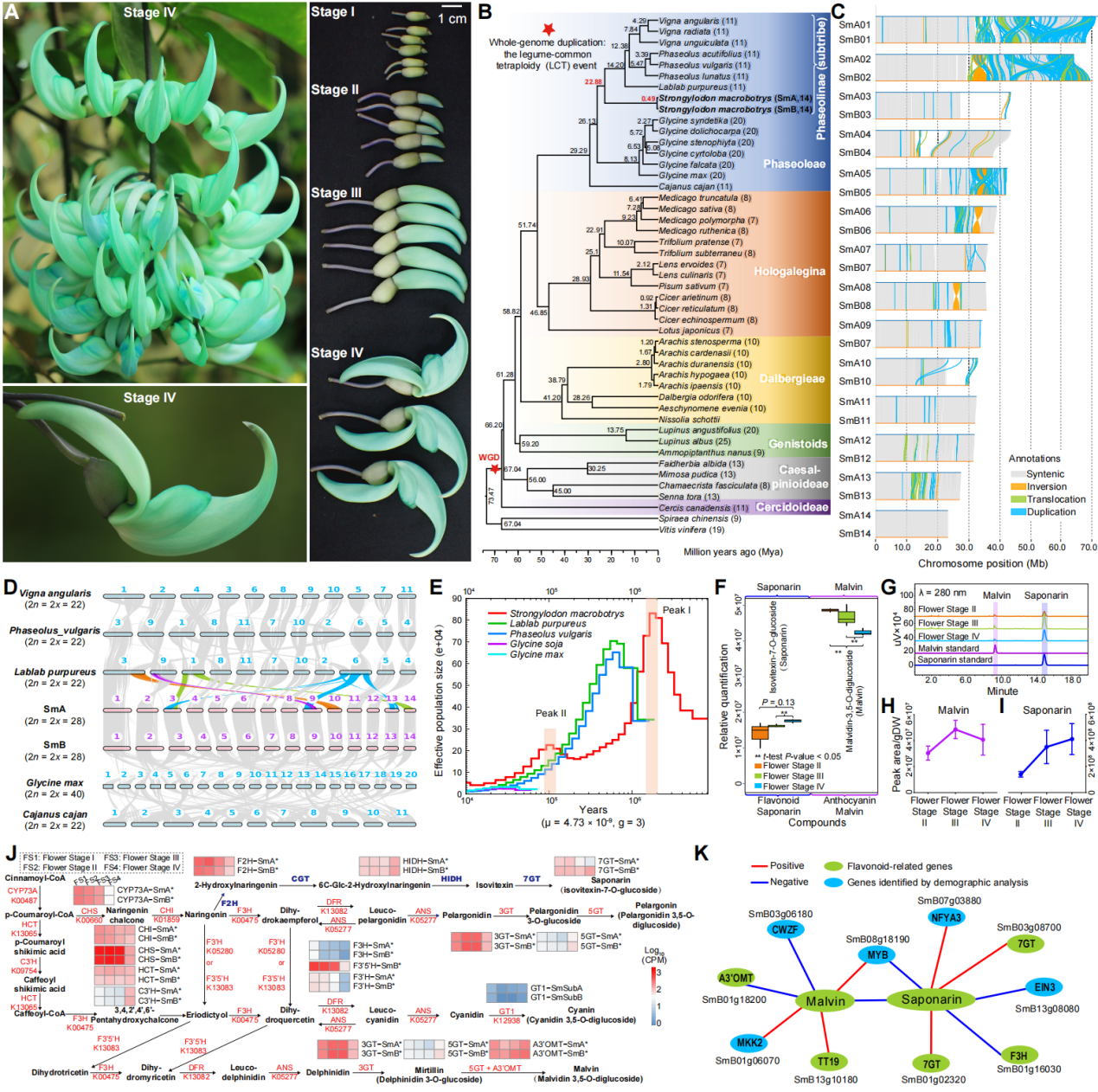
Morphological characteristics of the turquoise inflorescence of jade vine and its genomic and metabolic basis. (Image by YAN Haifei et al.)
