Newsroom


In a new study published in Matter on March 4, a research team has developed a novel electron tomography method that can quantitatively reveal the three-dimensional (3D) morphology and crystallographic features of grain boundaries in nanostructured metals, providing a powerful tool for understanding the stability and performance of these advanced materials.
Grain boundaries are crucial defects that determine a material's strength, thermal stability, and how atoms diffuse through it. As grain size decreases to the nanometer scale, the number of grain boundaries increases to the point that their structure and behavior largely dictate the material's properties. However, directly analyzing their true 3D geometry and crystal orientation has been a longstanding challenge because traditional microscopes only provide flat, two-dimensional projections.
To overcome this, Prof. LI Xiuyan and Prof. DU Kui from the Institute of Metal Research (IMR) of the Chinese Academy of Sciences developed a technique called Dark-Field Electron Tomography for Nanograins (DFET-Nano).
Using a transmission electron microscope, the researchers captured a series of dark-field images as the sample is tilted. By analyzing how the image intensity changes, they simultaneously reconstructed the 3D shape of each nanograin and its crystal orientation. This enabled them to calculate the crystallographic plane and curvature of the grain boundaries with an impressive spatial resolution of about 0.3 nanometers.
The researchers validated DFET-Nano using a nanocrystalline nickel sample with a specific "five-fold twin" structure. They reconstructed the grain shape and identified its boundary as the characteristic {111} plane. They then applied DFET-Nano to study nanocrystalline platinum, revealing how grain boundary structures evolve during heating.
As the annealing temperature increased, the researchers observed a growing proportion of low-energy boundaries, a decrease in average boundary curvature, and a trend toward more correlated orientations between next-nearest neighbor grains. These observations visually confirm theoretical predictions about the stability of nanocrystalline structures.
This study provides the first direct experimental evidence of how grain boundary networks evolve in nanometals with extremely fine grains. The DFET-Nano method opens a new avenue for 3D structural characterization of nanomaterials, offering critical insights for designing more stable and higher-performance nanocrystalline materials for future applications.
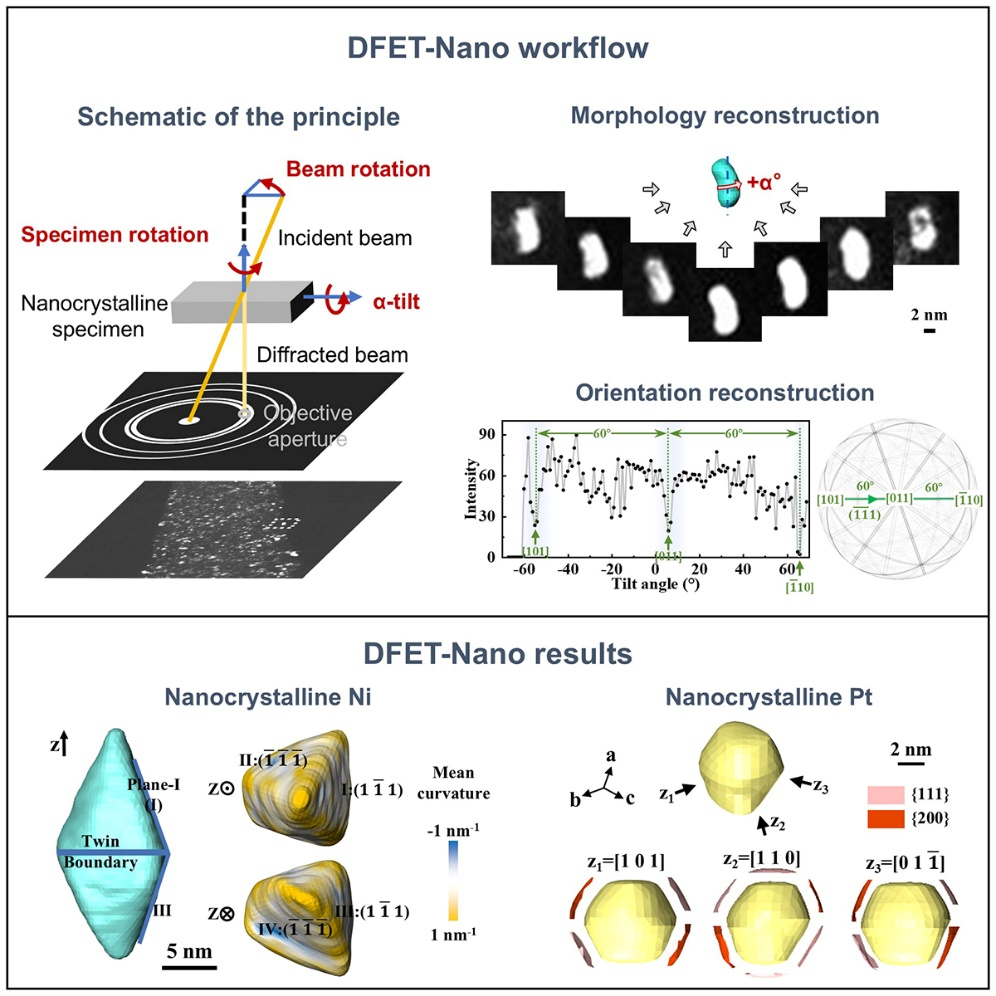
Experimental workflow of DFET-Nano and 3D reconstruction results of nanocrystalline Ni and Pt. (Image by IMR)