Newsroom


Climate warming can increase plant growth in permafrost regions by lengthening the growing season, speeding up plant metabolic processes, and allowing deeper root penetration as permafrost thaws.
However, the capacity for additional vegetation to offset the carbon released during permafrost thawing depends on nitrogen supply.
Until now, scientists have had a limited understanding of the nitrogen supply-demand balance in permafrost regions under climate warming scenarios. A new study now reveals that nitrogen fixation by microbes associated with mosses is a previously underestimated yet critical factor in sustaining plant growth in permafrost ecosystems under warming conditions.
The study, led by Prof. YANG Yuanhe from the Institute of Botany of the Chinese Academy of Sciences (IBCAS), provides the first direct evidence that the moss-associated biological nitrogen fixation responds much more sensitively to warming than do conventional soil nitrogen transformations.
These findings were published in the journal PNAS on February 18.
In their study, the researchers conducted a whole-ecosystem warming experiment in alpine permafrost regions of the Tibetan Plateau. They quantified 43 indicators related to plant nitrogen demand, nitrogen-use strategies, and soil nitrogen supply. This comprehensive assessment allowed them to disentangle how nitrogen supply–demand dynamics shift under climate warming scenarios and to identify their key drivers.
The results show that while warming significantly increases plant nitrogen demand, it does not alter leaf nitrogen resorption efficiency, indicating that plants primarily rely on soil nitrogen uptake to satisfy their elevated requirements under warming. Using 15N isotope tracing techniques, the researchers found that soil nitrogen transformations remained largely unchanged, whereas moss-associated biological nitrogen fixation significantly increased. Notably, this warming-induced enhancement accounted for approximately 48% of the additional nitrogen required by vegetation, underscoring the pivotal role of moss-associated nitrogen fixation in supporting plant growth under warming.
Further analyses using quantitative stable isotope probing (qSIP) uncovered the mechanisms behind this enhanced response. Warming significantly increased both the diversity and nitrogen-assimilation capacity of active diazotrophic microorganisms—the microbes that fix nitrogen—living in association with the mosses. These microbial changes are closely linked to warming-induced changes in moss functional traits, suggesting a coordinated plant–microbe response.
Together, these findings reveal how nitrogen supply and demand are restructured in permafrost ecosystems under climate warming and provide critical experimental evidence for better understanding carbon–nitrogen interactions in these climate-sensitive regions.
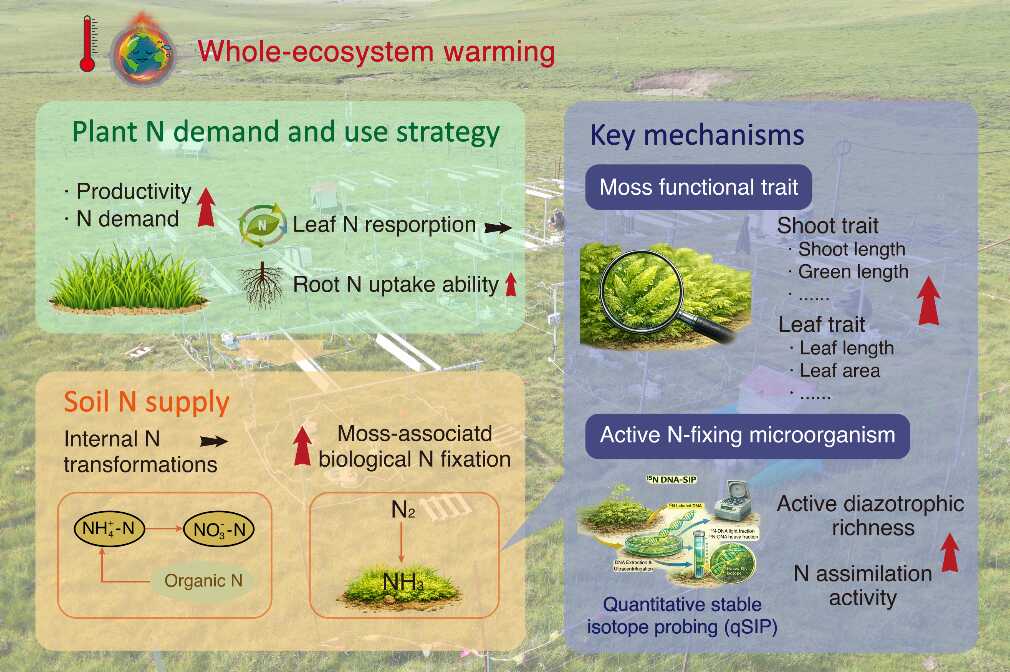
Whole-ecosystem warming experiment shows that moss-associated biological nitrogen fixation is a key pathway supporting vegetation growth in permafrost ecosystems under climate warming. (Image by BAI Yufei)