Newsroom


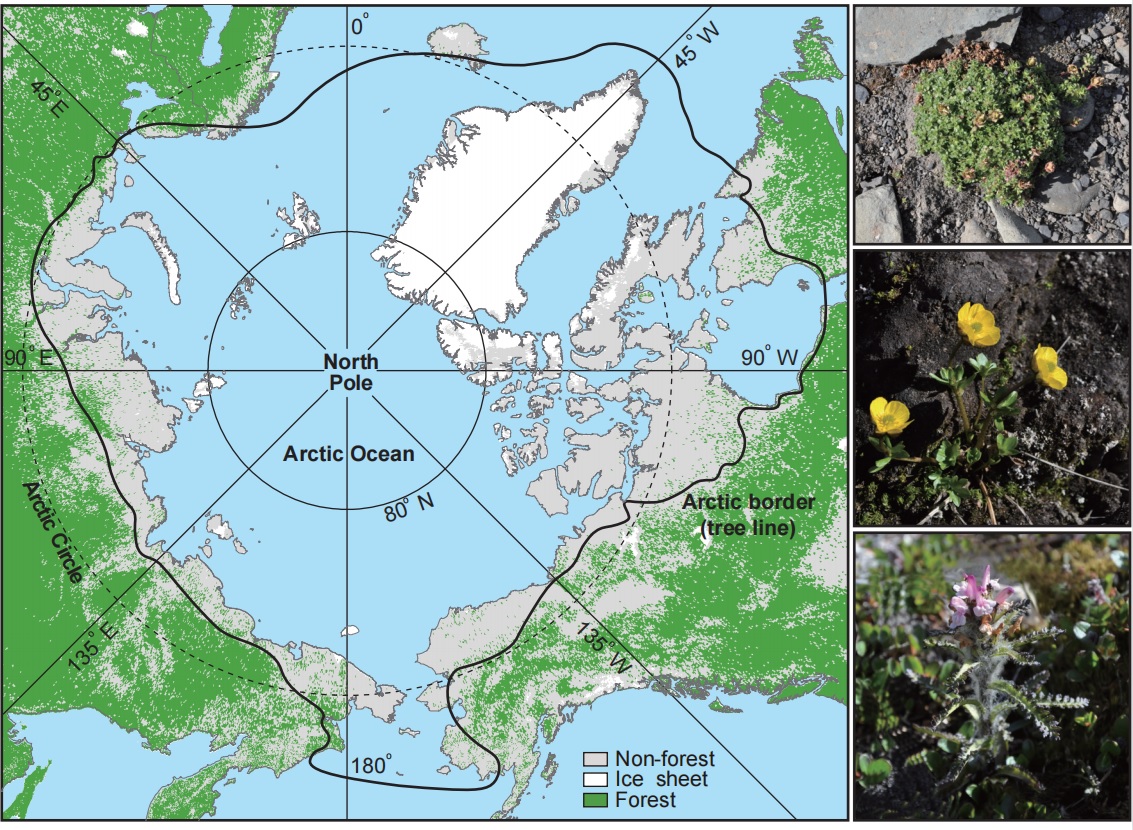
The Arctic tundra, to the north of the natural tree line, harbors a unique and fragile flora. As it is undergoing an unprecedented rate and magnitude of climate change, there is an urgent need to predict the responses of the Arctic flora to future warming for conservation and landscape management, including how the Arctic flora will develop, spatially and temporally.
A research team led by Prof. WANG Wei from the Institute of Botany of the Chinese Academy of Sciences (IBCAS) predicted quantitatively the potential dynamic changes of the entire Arctic flora from now until 2100 under four greenhouse gas emission scenarios based on an ensemble modelling approach. The findings were published in National Science Review.
Researchers made the predictions of potential floristic changes of 1,187 species, covering about 58% Arctic vascular plant species. They generated 20,179 potential distribution maps capturing the changes of the mean species area of habitat and mean species richness for the entire Arctic, as well as within each of five component sectors, and calculated the direction and magnitude of the mean distributional centroid in each floristic sector.
Researchers demonstrated widespread, but heterogeneous changes in the Arctic flora throughout the 21st century with surprising trends reversing in some circumstances.
The Beringia sector and Arctic coastal regions will experience the most rapid biodiversity loss, warranting urgent attention. Around the 2070s, possibly earlier, the mean species area of habitat and mean species richness of the Arctic flora may decline, with northward migration decelerating in Canada and potentially halting in Eastern Siberia and North Atlantic sectors. This implies that to avoid irreversible loss of the Arctic flora and its ecosystem functions, time is running out.
Under different emission scenarios, the potential responses of the Arctic flora are temporally displaced, highlighting the considerable benefits of controlling greenhouse gas emissions to limit global warming to below 2 °C.
This study highlights that both global and regional actions are required to drastically reduce greenhouse gas emissions and mitigate the detrimental effects on the Arctic flora.