
Newsroom


From the rice paddies of South Asia to the wheat fields of northern China, summer monsoon rains sustain the livelihoods of billions. Yet these vital rains fluctuate dramatically from decade to decade — a variability that has long puzzled climate scientists.
To address this knowledge gap, a new study led by researchers from the Institute of Atmospheric Physics of the Chinese Academy of Sciences has revealed that volcanic eruptions can trigger rainfall patterns remarkably similar to those produced by natural climate variability, effectively "projecting" their influence onto the ocean-driven cycles scientists have long studied.
Their findings were recently published in Geophysical Research Letters.
The study helps untangle a longstanding question: When Asian monsoon rainfall shifts from one decade to the next, are those changes driven by forces outside the climate system — such as volcanic aerosols — or by natural oscillations within it?
The answer, it turns out, is both — and the interplay is more complex than previously understood.
Using paleoclimate reconstructions and model simulations covering the past millennium, the researchers identified a distinct "tripolar" pattern of summer rainfall variability across Asia. In this pattern, when South Asia becomes wetter, Southeast Asia tends to grow drier, while rainfall in northern East Asia aligns with that of South Asia.
The study confirms this large-scale pattern is primarily driven by a natural climate phenomenon known as the Interdecadal Pacific Oscillation (IPO) — a long-lived counterpart of El Niño that redistributes heat and moisture across the Pacific Ocean, with ripple effects extending deep into Asia.
When the team analyzed periods following major volcanic eruptions, they found similar rainfall patterns emerging. Volcanic aerosols injected into the stratosphere can trigger sea-surface temperature changes that mimic an IPO-like pattern, effectively prompting the climate system to produce the same tripolar rainfall response.
"Volcanic forcing can 'project' onto the internal variability mode that naturally drives these precipitation patterns," explained Dr. MAN Wenmin, the study's first author. "This means that even when the IPO itself is not active, large eruptions can create conditions that mimic its influence on Asian rainfall."
Despite these similarities, the researchers found volcanic-driven and IPO-driven patterns remain distinguishable — with important implications for understanding past climates and planning for future conditions.
The key difference lies in symmetry. IPO-related temperature anomalies tend to be roughly symmetric around the equator. Volcanic forcing, by contrast, produces a distinctly asymmetric pattern, with cooling more pronounced in one hemisphere depending on the eruption's location and timing.
These subtle but systematic differences give scientists a way to separate how much of any given decadal shift in Asian rainfall stems from internal variability versus external forcing.
The findings carry particular relevance as scientists explore climate intervention strategies — deliberate efforts to cool the planet by injecting aerosols into the stratosphere, mimicking the effects of volcanic eruptions.
The study was supported by the National Natural Science Foundation of China.
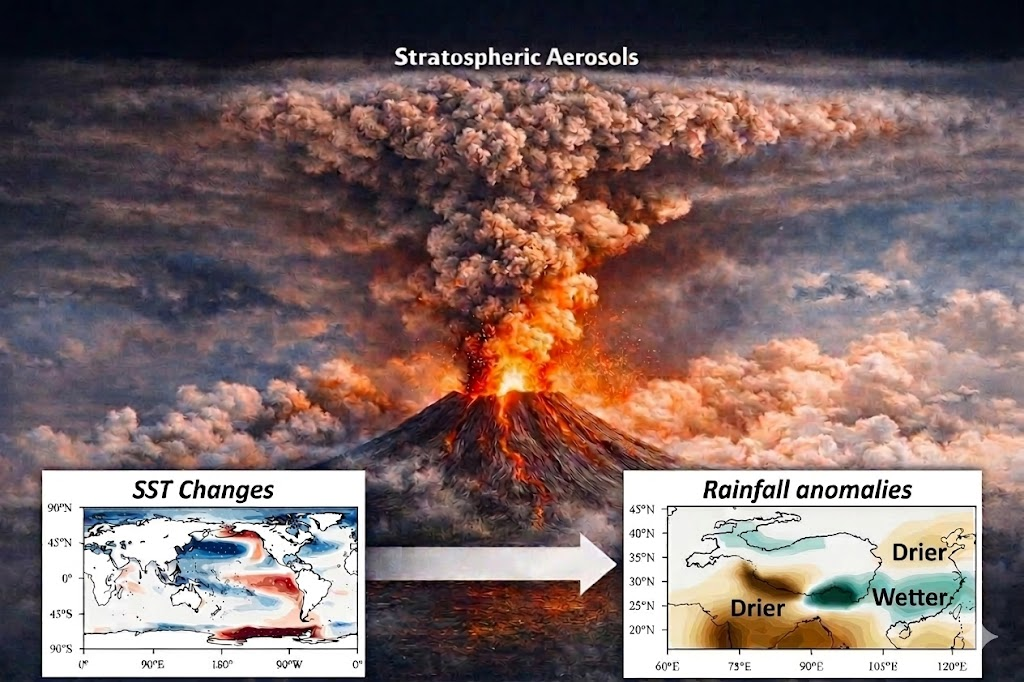
Major volcanic eruptions inject aerosols into the stratosphere, triggering sea surface temperature changes that can mimic natural climate cycles and reshape monsoon rainfall patterns across Asia. (Image by MAN Wenmin)
