
Newsroom


A research team led by Prof. WANG Baichen at the Institute of Botany of the Chinese Academy of Sciences has identified the regulatory mechanisms of photoprotection and normal chloroplast development in maize. They discovered a "magical" phenomenon in maize, where the leaves exhibit stripes that change with the day-night cycle and unveiled the molecular secrets behind it. This phenomenon occurs due to a malfunction in an internal "quality control system" within the chloroplast, known as the Clp protease complex.
In the model plant Arabidopsis, mutations in key genes of this system often result in seedling death. However, the role of this system in maize, a C4 crop with higher photosynthetic efficiency, has remained unclear.
To investigate this, the researchers used chemical mutagenesis to create a maize mutant with a consistent pattern of green and yellow stripes on its leaves. They found that the formation of these stripes is tightly linked to light–dark cycles: green stripes develop at night and yellow stripes emerge during the day. This leaf pattern, which "beats" with the circadian rhythm, strongly suggests the existence of a biologically regulated process that is finely tuned by light.
To identify the genetic "brush" that paints this "zebra pattern", the researchers used genetic mapping and ultimately pinpointed the ZmClpP6 gene, which is located on chromosome 5 of maize, as the target. The protein encoded by this gene is a core catalytic subunit of the chloroplast Clp protease complex, making it a crucial "functional part" of the "quality control center." Sequencing revealed a specific point mutation in this gene in the mutant, leading to the replacement of the 187th amino acid. Using CRISPR–Cas9 gene editing, the researchers knocked out ZmClpP6 in maize and observed similar phenotypes, including leaf chlorosis, confirming the gene's essential role in chloroplast function.
Why does a single amino acid change trigger such dramatic chain reactions? The researchers found that this critical mutation (at position 187) severely disrupts the connection between the ZmClpP6 protein and another core subunit, ZmClpP4. This is akin to the teeth of a precision gear being worn down, causing instability in the assembly of the entire complex and the subsequent failure of its quality control function. When the "quality control recycling center" halts, "metabolic waste" that should be promptly cleared accumulates abnormally.
Proteomic analysis confirmed that a photoprotective protein named ZmELIP2 accumulates dozens of times more in the mutant. This protein is usually expressed transiently under stress conditions such as strong light, acting like a "sunscreen" to help plants resist light damage, and must be degraded in a timely manner after its task is completed. Further experiments demonstrated that ZmELIP2 can directly bind to ZmClpP6, likely making it a direct target for Clp protease.
The deeper significance of this study lies in its first revelation of how the Clp protease system dynamically balances photoprotection and normal chloroplast development in maize. Under strong light, plants need to rapidly activate photoprotective mechanisms such as ZmELIP2. However, once the stress is relieved or the protective task is completed, these proteins must be promptly cleared by the Clp protease system. Otherwise, their excessive retention interferes with the normal construction and functioning of chloroplast structures, leading to inhibited chlorophyll synthesis, abnormal thylakoid membrane structures. Ultimately, it results in reduced photosynthetic efficiency and leaf chlorosis.
This study systematically elucidates the core function of the maize protein ZmClpP6 in regulating chloroplast development under strong light, filling a research gap regarding this mechanism in C4 crops, clarifying a new strategy for maize to cope with high light stress, and providing a potential key molecular target for genetic improvement aimed at enhancing the photosynthetic efficiency and environmental adaptability of crops such as maize.
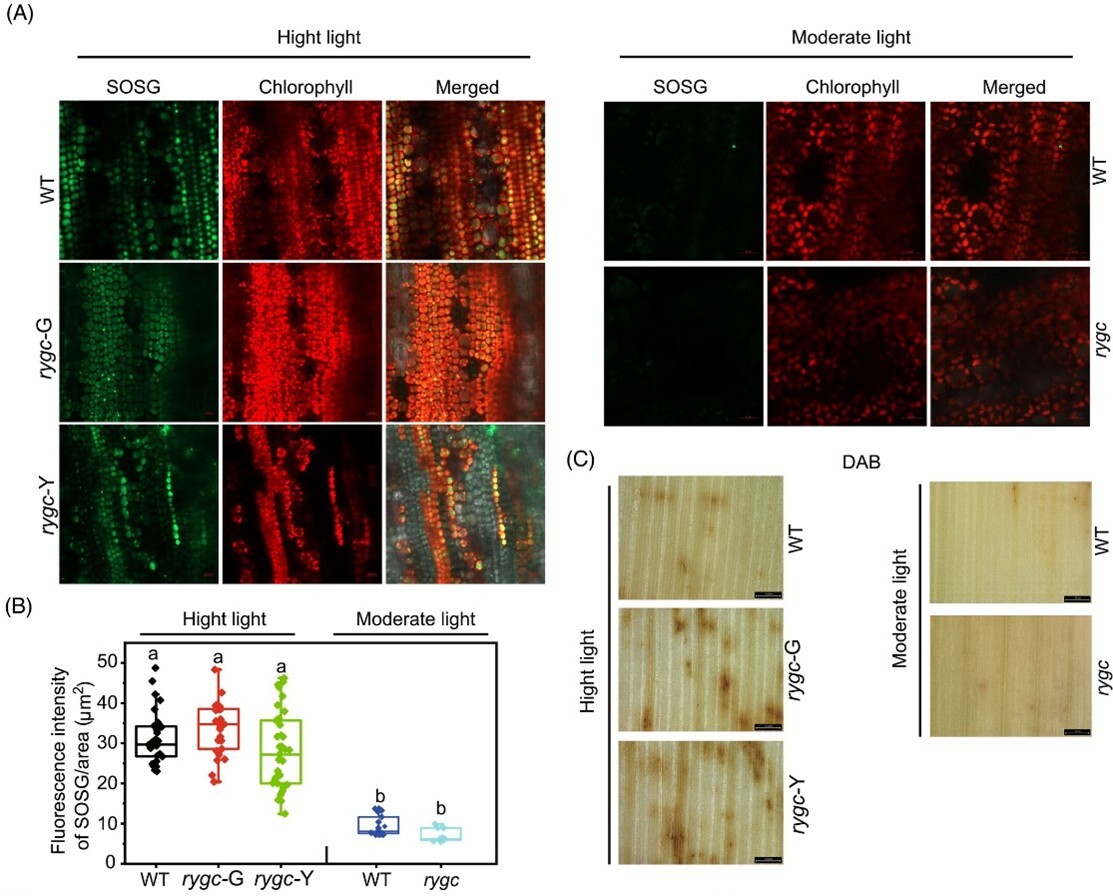
Accumulation of reactive oxygen species in the mutant under different light conditions (Image by CHAO Qing)
