
Newsroom


A research team led by Prof. LIU Yuechen from the Institute of Vertebrate Paleontology and Paleoanthropology of the Chinese Academy of Sciences, collaborating with international scientists, has provided new insights into the genetic origin, migration routes, and dispersal patterns of Austronesian-speaking populations in Remote Oceania.
Their findings were published in the journal Cell on March 10.
Austronesian peoples are widely distributed across Taiwan, China, Southeast Asia, the Pacific Islands, and Madagascar. As the Austronesian family is the world's second-largest language family, it encompasses more than 1,300 languages.
The Palau Archipelago ranks among the earliest islands in Remote Oceania with documented evidence of modern human activity. Approximately 3,200 years ago, modern humans first settled on the Rock Islands—composed primarily of limestone—and Babeldaob, an island dominated by volcanic rock. The origins of these early settlers, as well as their genetic and cultural connections to present-day Palauan populations, have long been a focal point of academic inquiry.
In 2022, while studying modern Palauan populations, Prof. LIU discovered that contemporary Palauans trace their ancestry to two distinct sources: one closely linked to the expansion of Austronesian peoples, and the other primarily from New Guinea in Near Oceania. This finding raised a new scientific question: Where exactly did the earliest people to reach the Palau Archipelago come from, and what was their genetic makeup?
To address this question, the research team analyzed 37 skeletal samples unearthed from four Palau archaeological sites: Ngermereues Ridge burial cave, Ucheliungs Rock Island burial cave, Omedokl Rock Island burial cave, and the Ngkeklau area in northeastern Babeldaob. They successfully retrieved ancient genome data from 21 individuals.
The study reveals that approximately 60% of the genetic ancestry of early Palauan inhabitants derives from East Asia (i.e., Austronesian peoples), and 40% from New Guinea (i.e., Papuan peoples)—a proportion highly consistent with the genetic background of modern Palauans. Isotopic dating indicates that two of these individuals lived 2,900–2,500 calibrated years before present (cal BP), placing them in the early period of modern human settlement in Palau. This establishes Palau as the earliest known case of long-term population genetic continuity in Remote Oceania to date.
Since all 21 ancient human samples exhibit significant Papuan ancestry, the researchers infer that Papuan genetic components were likely integrated into the ancestral gene pool before the first settlers arrived in Palau. Estimates of the admixture time further support this hypothesis: around 3,900–3,200 years ago, prior to the large-scale Austronesian expansion into Remote Oceania, the ancestors of Palau's first settlers already carried both Austronesian and Papuan genetic heritage.
This discovery provides important revisions and supplements to the long-accepted Express Train Model in academia. The Express Train Model posits that Austronesian peoples dispersed to Remote Oceania via a relatively direct and rapid route during the early phase of their expansion, without admixture with Papuan populations in Near Oceania. In contrast, this study reveals that the two major lineages—Austronesian and Papuan—had already intermixed before reaching the Palau Archipelago during the early settlement of Remote Oceania, painting a far more complex picture of prehistoric human migration and interaction.
Additionally, the team found that the ancestral components of early Palauans are highly similar to those of prehistoric populations in eastern Indonesia. This result suggests that Palau and eastern Indonesia may share a comparable population evolutionary history, offering new clues to uncover the early dispersal routes of Austronesian peoples and their interaction networks.
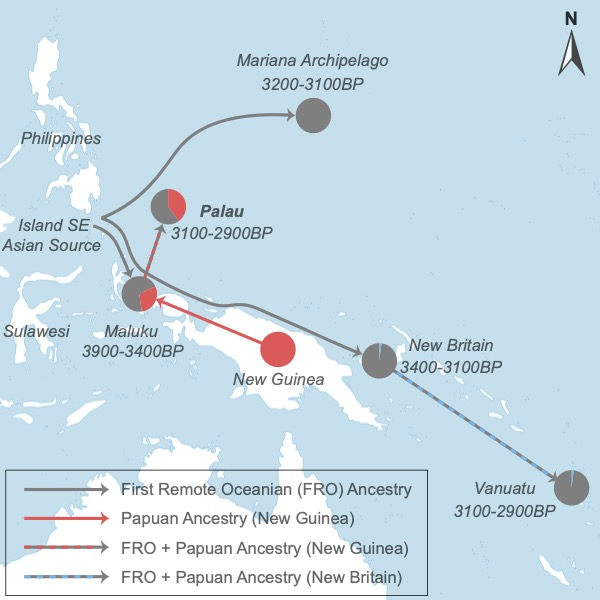
Palauan ancestry from East Asian and Papuan admixture. (Image by LIU Yuechen)
LIU Yuechen
Institute of Vertebrate Paleontology and Paleoanthropology
E-mail: liuyuechen@ivpp.ac.cn
