
Newsroom


Alzheimer's disease (AD) affects nearly 57 million people worldwide and is characterized by the accumulation of amyloid-β (Aβ) plaques in the brain. Antibody therapies targeting Aβ can slow disease progression, but they frequently trigger brain inflammation and amyloid-related imaging abnormalities (ARIA), including microhemorrhages. Safely eliminating Aβ without inducing immune-related side effects has remained a major challenge.
To tackle this challenge, a team led by researchers from the Institute of Zoology of the Chinese Academy of Sciences has developed a novel therapeutic strategy termed synthetic peptide-programmed lysosome-targeting chimeras (SPYTACs). Their findings were published in the journal Cell on March 4.
SPYTAC is a fully synthetic peptide platform engineered to cross the blood–brain barrier (BBB) and facilitate Aβ degradation in both the brain and peripheral tissues. Its key feature is a modular design that links an Aβ-binding peptide to a peptide targeting low-density lipoprotein receptor-related protein 1 (LRP1). LRP1 is highly expressed in BBB endothelial cells and neurons, and it naturally mediates molecular transport and lysosomal degradation of Aβ. By bridging Aβ to LRP1, SPYTAC promotes cellular uptake of Aβ and directs it to lysosomes for degradation. Meanwhile, it enables transport across the BBB, supporting coordinated Aβ clearance from both the central nervous system and the periphery.
In the 5xFAD mouse model of AD, SPYTAC significantly reduced Aβ levels in plasma and brain tissue. It also directly targeted mature amyloid plaques and improved learning and memory performance. Since SPYTAC contains no Fc fragments, it avoids Fc receptor-mediated immune activation. The study showed reduced neuroinflammation and a lower risk of microhemorrhage compared with antibody-based therapies.
Beyond AD, SPYTAC serves as a programmable platform with broader applications. By replacing the disease-targeting peptide module, the system can potentially be adapted to degrade other pathogenic proteins, such as tau or α-synuclein. Its fully synthetic structure also confers advantages for scalable manufacturing and cost-effectiveness.
This work establishes a new paradigm for targeted protein degradation in the central nervous system. By integrating efficient BBB penetration, lysosomal degradation, and an enhanced safety profile, SPYTAC offers a promising strategy for treating AD and potentially other protein-driven neurological disorders.
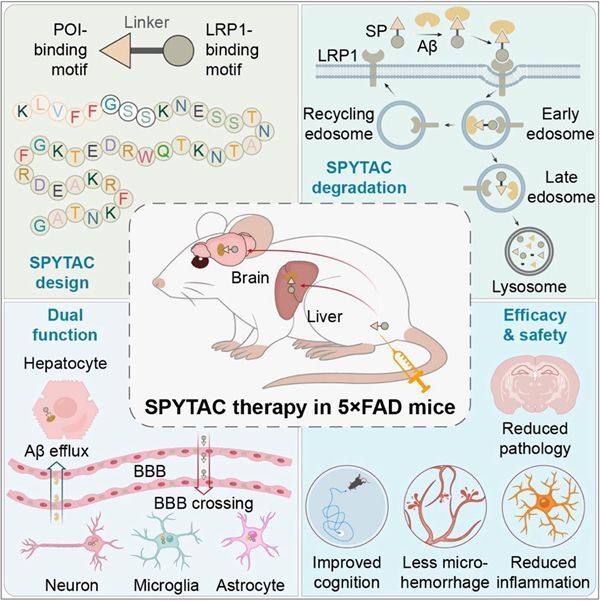
SPYTAC therapy in 5xFAD mice. (Image by LI Wei's Lab)
