
Newsroom


A research team led by Prof. WANG Hui from the Hefei Institutes of Physical Science of the Chinese Academy of Sciences, in collaboration with Prof. ZHAO Yanli's group from Nanyang Technological University, constructed a novel urchin-like copper single-atom nanozyme (UCCSE). They revealed that the length of the needles plays a critical role in enhancing cellular uptake and the efficiency of chemodynamic tumor therapy.
The study was published in ACS Nano.
Single-atom nanozymes, with well-defined atomic structure and highly efficient atom utilization, can efficiently decompose overexpressed hydrogen peroxide (H₂O₂) in the tumor microenvironment into highly cytotoxic hydroxyl radicals (•OH), thereby holding great promise for tumor chemodynamic therapy. However, their therapeutic performance is still hampered by limited cellular uptake and insufficient accumulation at tumor sites.
In this study, the researchers used a self-developed organic molecule carbonization-reduction strategy to synthesize a sea urchin-like copper single-atom nanozyme (UCCSE) in a one-step solvothermal process. By precisely tuning the length of the surface needles, they were able to optimize the catalytic performance of UCCSE.
The UCCSE exhibited both peroxidase- and glutathione peroxidase-like activities. It catalyzed endogenous H₂O₂ to continuously generate highly reactive •OH, while simultaneously consuming intracellular reductive glutathione. This suppresses •OH scavenging and amplifies oxidative stress, enhancing chemodynamic therapy.
Furthermore, the researchers investigated the relationship between the structure and activity of the nanozyme and its cellular uptake behavior. They found that UCCSE primarily entered tumor cells via endocytosis and that intracellular accumulation and the associated tumor-cell killing effect increased markedly with longer needle structures.
Further experimental evaluations showed that UCCSE achieved excellent antitumor efficacy at the cellular and animal levels. Specifically, long-needle UCCSE exhibited a longer blood circulation time and higher tumor accumulation, resulting in the strongest tumor growth inhibition.
"Our findings provide an innovative, morphology-engineering perspective for enhancing the chemodynamic performance of single-atom nanozymes," said WANG Hui.
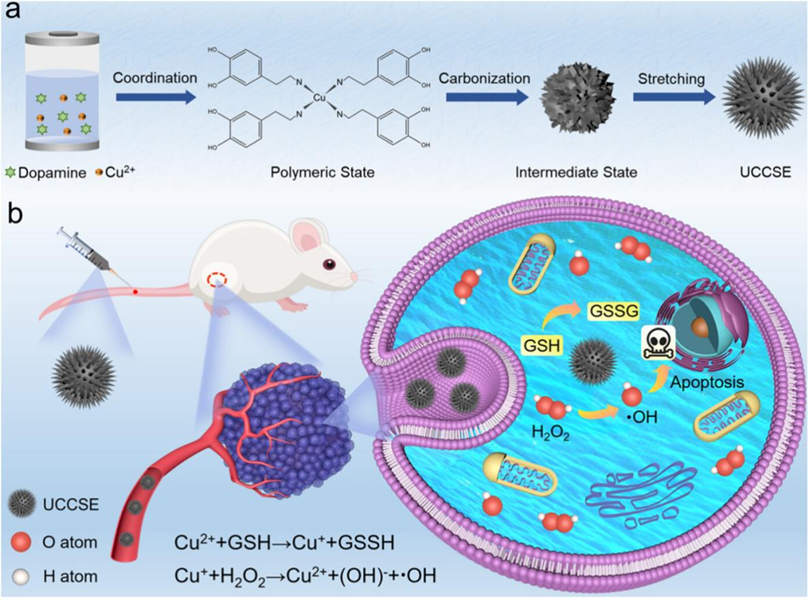
Schematic illustration of the synthesis of UCCSE and its tumor catalytic therapy. (Image by SHI Xinyi)
