Newsroom


A research team led by Prof. WANG Zhenyang from the Hefei Institutes of Physical Science of the Chinese Academy of Sciences has developed two interfacial regulation strategies to improve the stability of silicon-carbon composite anodes in lithium-ion batteries.
The researchers proposed two strategies: a laser-directed covalent bonding strategy and a hierarchical dual-coating regulation strategy. Both strategies effectively suppressed interfacial failure induced by volume expansion, significantly enhancing the batteries' cycling stability and electrochemical performance.
The results were published in Advanced Composites and Hybrid Materials and Composites Part B: Engineering.
Silicon-based anodes are promising candidates for next-generation lithium-ion batteries due to their high theoretical capacity, but their practical application is limited by severe volume expansion and unstable interfaces during cycling.
To address this challenge, the researchers proposed two interface-engineering strategies. One strategy involves using a laser to create strong Si–N–C bonds between silicon suboxide nanoparticles and nitrogen-doped laser-induced graphene. This significantly improves interfacial stability and long-term cycling performance. The other strategy is a hierarchical dual-coating approach using polyaniline and laser-induced graphene. This strategy enhances the stability of the solid electrolyte interphase and relieves mechanical stress simultaneously.
As a result, the optimized silicon–carbon composite anodes exhibited greatly improved cycling stability and electrochemical performance, maintaining high capacity after 1,000 charge–discharge cycles at high current density.
These studies offer new strategies for developing long-life, high-energy-density lithium-ion batteries, according to the researchers.
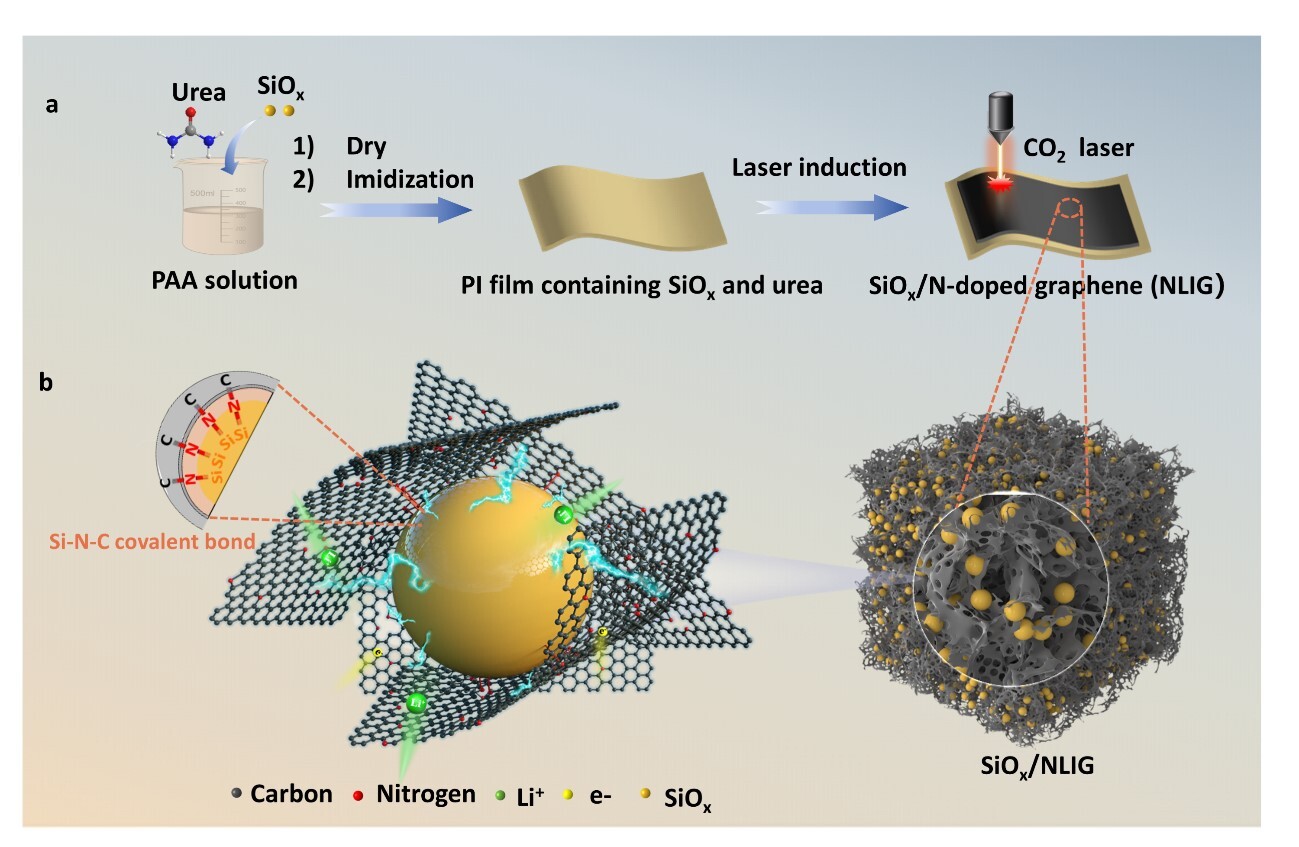
Schematic illustration of the preparation process and lithium storage mechanism of SiOx/nitrogen-doped laser-induced graphene composite materials. (Image by LI Nian)