Newsroom


A research team from the Hefei Institutes of Physical Science of the Chinese Academy of Sciences has discovered a high-energy-density barocaloric effect in the plastic superionic conductor Ag2Te1-xSx.
"This material exhibits a volumetric barocaloric performance far beyond that of most known inorganic materials," said Prof. TONG Peng, who led the team, "Its high energy density makes it ideal for smaller and lighter cooling devices."
The findings were published in Advanced Functional Materials.
Modern refrigeration relies primarily on vapor-compression systems that use greenhouse-gas refrigerants and are approaching their efficiency limit. Barocaloric refrigeration, which involves cooling by applying pressure to solid materials, offers a cleaner and potentially more efficient alternative. However, volumetric entropy change, a key factor for practical applications, has not been adequately addressed.
Through finite element simulation, the team found that reducing the container size enhances its pressure-bearing capacity under pressure, which allows for a reduction in wall thickness and secondary weight reduction. This underscores the necessity of high-energy-density materials, yet most known barocaloric materials fall short in this regard.
In this study, the researchers focused on the dense solid solution, Ag2Te1-xSx. Experiments showed that under a moderate pressure of only 70 MPa, the material produced a reversible volumetric entropy change of 0.478 J·cm-3·K-1—the highest value reported for an inorganic barocaloric material so far. Its barocaloric strength, 6.82 mJ·cm-3·K-1·MPa-1, also surpasses most inorganic systems and even outperforms well-known organic materials such as neopentyl glycol.
Neutron diffraction data reveal the cause of this unusually strong thermal response. When pressure is applied, the material undergoes a structural shift from a cubic phase to a monoclinic phase. This phase transition is accompanied by a 5.4% change in lattice volume. At the same time, the diffusion of silver ions within the structure changes sharply, further amplifying the caloric effect.
The material also has several practical advantages. It conducts heat relatively well and is highly deformable, allowing it to be shaped into millimeter-scale pellets or thin sheets that can efficiently exchange heat. Even after heavy deformation, rapid temperature changes, and repeated pressure cycling, the barocaloric performance remains stable—an important sign of reliability for future solid-state cooling technologies.
This work introduces a new material platform combining giant volumetric barocaloric effects, good mechanical processability, and relatively high thermal conductivity, offering fresh possibilities for next-generation green cooling technologies.
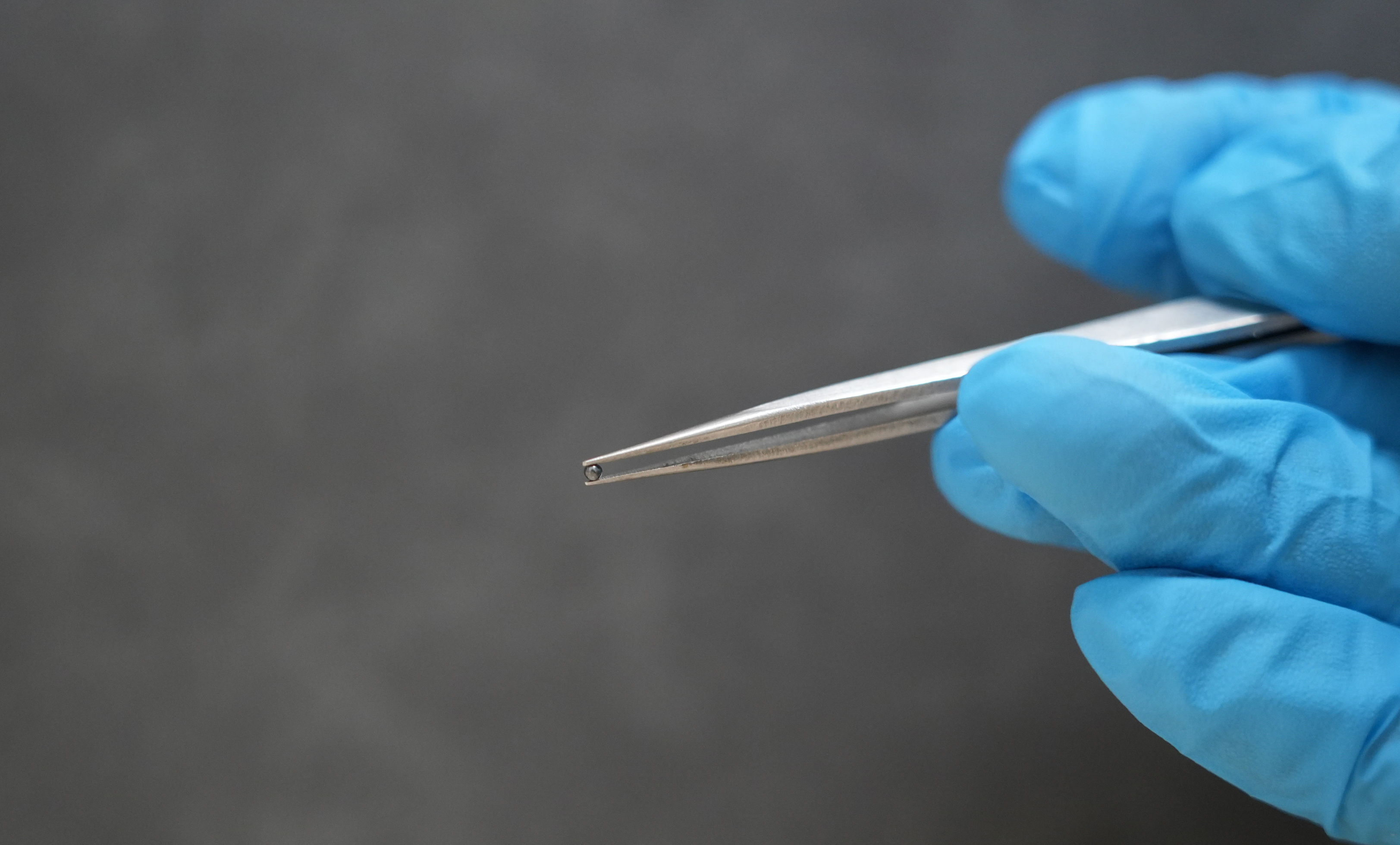
Plastic superionic conductor Ag2Te1-xSx (Image by ZHAO Weiwei)