Newsroom


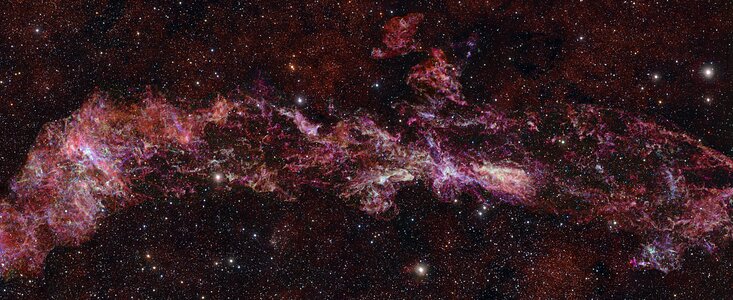
Largest ALMA image ever shows the molecular gas in the center of the Milky Way (Credit: ALMA (ESO/NAOJ/NRAO)/S. Longmore et al. Background: ESO/D. Minniti et al.)
Astronomers have unveiled the most extensive image ever captured by the Atacama Large Millimeter/submillimeter Array (ALMA), revealing the turbulent heart of the Milky Way in unprecedented detail. The new rich dataset maps more than 650 light-years across the galaxy's central region, exposing a dense web of cold gas—the raw material for star formation—next to the supermassive black hole at its center.
The observations, conducted as part of the ALMA CMZ Exploration Survey (ACES), provide the most comprehensive view yet of the Milky Way's Central Molecular Zone (CMZ). It is the first time the cold gas across this whole region has been explored in such detail.
"It's a place of extremes, invisible to our eyes, but now revealed in extraordinary detail," said Ashley Barnes, an astronomer at the European Southern Observatory in Germany and a member of the observing team. "It is the only galactic nucleus close enough to Earth for us to study in such fine detail."
The dataset reveals the CMZ like never before, from gas structures dozens of light-years across all the way down to small gas clouds around individual stars.
The gas that ACES—the ALMA CMZ Exploration Survey—specifically explores is cold molecular gas. The survey unpacks the intricate chemistry of the CMZ, detecting dozens of different molecules, from simple ones such as silicon monoxide to more complex organic ones like methanol, acetone or ethanol.
Cold molecular gas flows along filaments feeding into clumps of matter out of which stars can grow. In the outskirts of the Milky Way we know how this process happens, but within the central region the events are much more extreme.
"The CMZ hosts some of the most massive stars known in our galaxy, many of which live fast and die young, ending their lives in powerful supernova explosions, and even hypernovae," said ACES leader Steve Longmore, a professor of astrophysics at Liverpool John Moores University, UK. "By studying how stars are born in the CMZ, we can also gain a clearer picture of how galaxies grew and evolved," said Longmore. "We believe the region shares many features with galaxies in the early Universe, where stars were forming in chaotic, extreme environments."
To collect this new dataset, astronomers used ALMA in Chile's Atacama Desert. In fact, this is the first time such a large area has been scanned with this facility, making this the largest ALMA image ever. In the sky, the mosaic—obtained by stitching together many individual observations like putting puzzle pieces together—is as long as three full Moons side-by-side.
LU Xing, a research professor at the Shanghai Astronomical Observatory (SHAO) of the Chinese Academy of Sciences, serves as a core member of the ACES data reduction working group and leads one of the data release papers (Paper IV). In this study, he presented two intermediate-width spectral windows of ACES, including images of six representative molecular lines.
In addition, LU and colleagues examined morphological similarity between the continuum and a dozen of molecular lines and the line ratios between several pairs of isotologues and isotopomers. Their results reveal extraordinarily strong sulfur monoxide (SO) emission in the Sgr B2 cloud, highlight the potential of HC15N as a robust tracer of dense molecular gas, and suggest that the line ratio between HN13C and H13CN may serve as a molecular thermometer for the CMZ.
Taken together, the ACES data represent far more than an expanded view of the Galactic Center. They constitute a foundational dataset that effectively opens the Central Molecular Zone as a laboratory at the spatial and chemical fidelity needed to confront long-standing questions about star formation, feedback, and gas transport near a supermassive black hole. By revealing how filaments, clumps, and rich molecular chemistry are organized across the CMZ, the studies provide a new empirical baseline for testing whether the frameworks built in the Galactic disk remain valid in the most extreme environment of the Milky Way and, by extension, in the turbulent galaxies of the early universe.
The public release of the data products turns this into a community resource, inviting cross-comparisons with JWST, X-ray and radio surveys, and next-generation simulations that can follow gas from kiloparsec inflow to core-scale collapse.
In this sense, ACES marks the beginning of a new era of discovery. As follow-up analyses map magnetic fields, measure temperatures and isotopic ratios, and track time variability and feedback signatures, the Galactic Center is poised to yield many more surprises, and to become the benchmark against which our understanding of galactic nuclei and galaxy–black-hole co-evolution is refined.
Researchers and students from SHAO have contributed to the ACES project in different working groups. "We are running parallel projects in the K-band to observe key molecular lines to constrain the gas temperature in the ACES field. The Tianma 65-m telescope of SHAO and its new 7-beam K-band receiver will be crucial part of this effort," said LU.
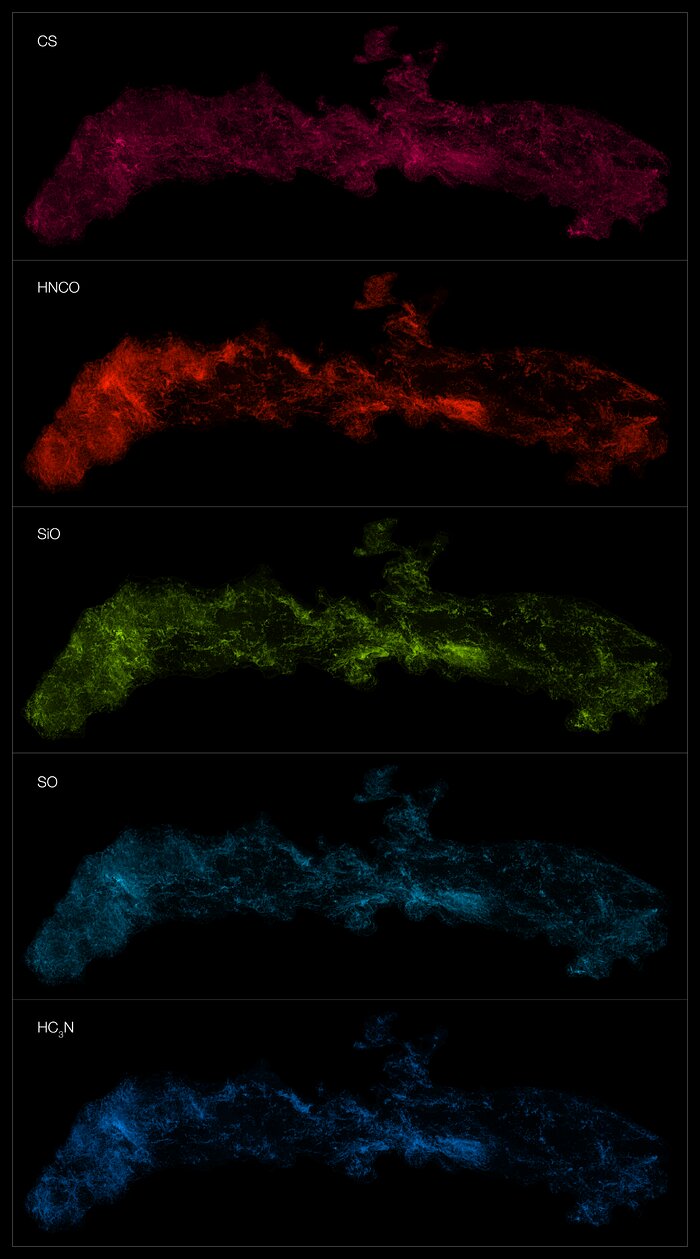
Different molecules in the centre of the Milky Way observed with ALMA: ACES has mapped the distribution of several dozen molecules at the centre of our galaxy. Here we show five of them, from top to bottom: carbon monosulphide, isocyanic acid, silicon monoxide, sulphur monoxide, and cyanoacetylene. (Credit: ALMA (ESO/NAOJ/NRAO)/S. Longmore et al.)