Newsroom


A research team led by Dr. ZHANG Tianshu from the Hefei Institutes of Physical Science of the Chinese Academy of Sciences has developed a fiber-solid hybrid single-frequency Innoslab amplification system that boosts single-pulse energy from the microjoule level to 1.8 mJ while maintaining excellent beam quality and polarization.
This achievement, published in Optics Express, provides a powerful new solution for high-performance pump sources used in OHx radical detection.
OHx radical detection requires a 308-nm single-frequency laser, which is typically generated through optical parametric amplification (OPA). However, current OPA pump sources have several limitations. These include power loss in continuous-wave seed sources after pulse modulation, nonlinear effects and low damage thresholds in all-fiber amplifiers, limited small-signal gain in traditional solid-state amplifiers, and bulky multi-stage architectures. These issues prevent the realization of compact, high-single-pulse-energy pump sources.
To address these issues, the researchers developed a fiber-solid hybrid architecture integrated with Innoslab beam-combining amplification, enabling the conversion of a single-frequency continuous-wave seed laser into a millijoule-level single-frequency pulsed laser.
In the setup, the seed laser was coupled into a polarization-maintaining fiber via a half-wave plate and fiber coupler. Then, ot was modulated into pulses by an Electro-Optic Modulator and amplified through a two-stage fiber amplifier. The output is collimated and injected into an Innoslab amplifier to boost the small-signal pulse to high energy.
Experiments showed that the system maintains high horizontal beam quality and enhances vertical beam quality, suggesting an optimized optical design. The amplified laser maintains a polarization extinction ratio of approximately 30 dB, and the Innoslab amplifier increases pulse energy from 5 μJ to 1.8 mJ in a single stage, demonstrating excellent gain performance. The system can also amplify nJ-level, single-frequency pulses to the μJ range. This offers a promising approach for amplifying extremely weak solid-state laser signals.
These results provide key enabling technology for advanced environmental monitoring instruments and support applications in air pollution analysis, greenhouse gas detection, and broader research on atmospheric protection and climate change.
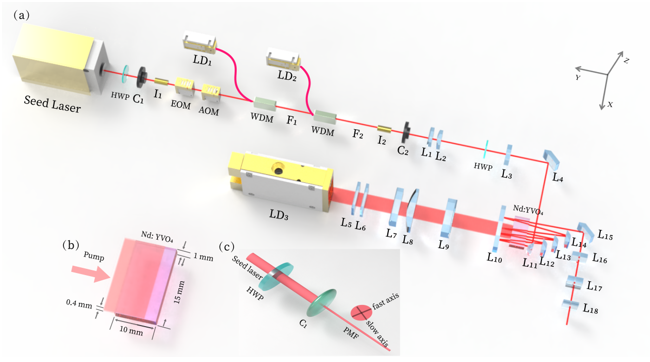
Schematic of the Innoslab fiber solid hybrid amplifier (Image by ZHANG Tianshu)