
Newsroom


A research team from the Hefei Institutes of Physical Science of the Chinese Academy of Sciences has achieved the first online isomer-specific differentiation of cigarette smoke aerosols, providing a new scientific basis for evaluating cigarette smoke exposure risk.
Their findings were recently published in Journal of Hazardous Materials.
Cigarette smoke aerosols pose a serious hazard to human health, and the central factors influencing exposure risk are their particle size distribution, concentration, and chemical composition.
In this study, the researchers used a fast-response analyzer to measure the particle size distribution of cigarette smoke as it was generated. They also used a model to predict how these particles settle in different parts of the respiratory system.
To reveal the chemical composition of cigarette smoke more fully, the researchers combined their Vacuum Ultraviolet Photoionization Aerosol Mass Spectrometer, which they developed themselves, with the Hefei Synchrotron Radiation Facility. This combination enabled them to identify and differentiate between different structures of toxic molecules in cigarette smoke for the first time.
Their results revealed that a single puff of cigarette smoke releases up to 10¹¹ particles, including 10⁹ particles smaller than 70 nanometers, which primarily deposit in the tracheobronchial region.
The researchers also detected a range of hazardous substances, including carbonyl compounds, alkaloids, polycyclic aromatic hydrocarbons, and organic acids.
"Our study provides new scientific insights into assessing the exposure risk of cigarette smoke,” said Prof. TANG Xiaofeng, corresponding author of the study.
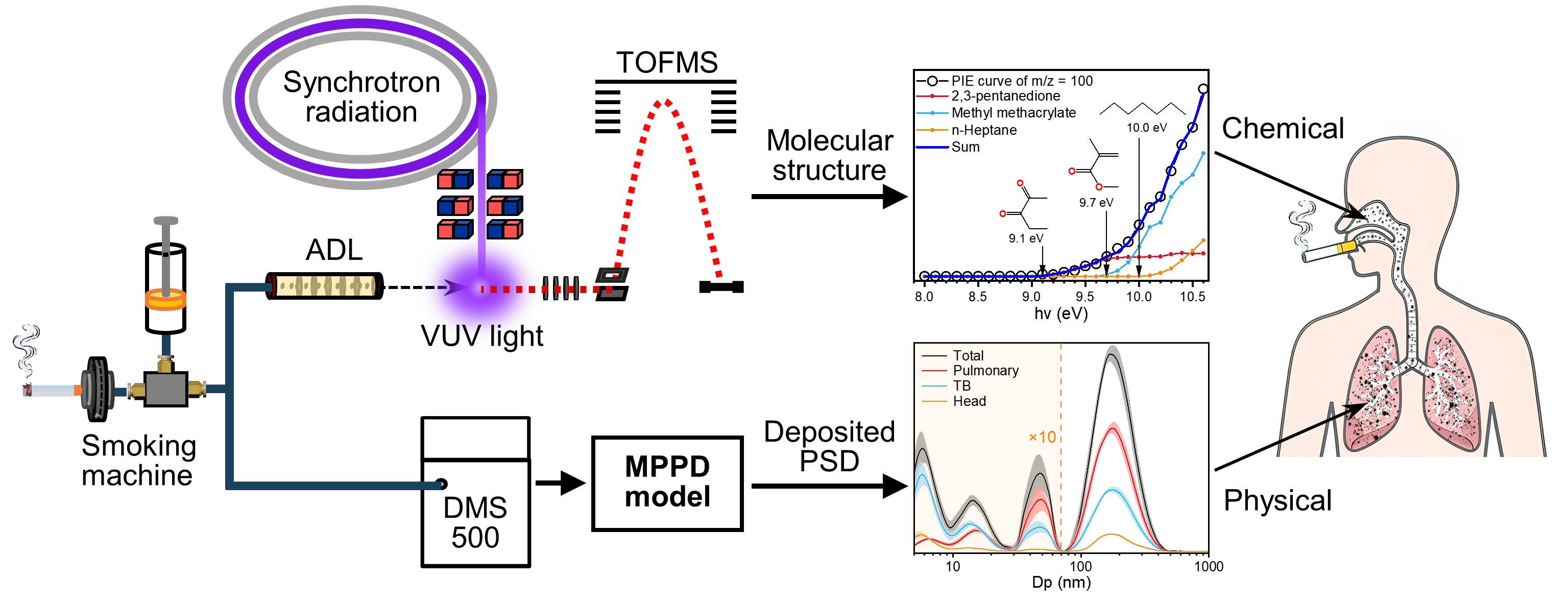
Online Characterization of Particle Size Distribution and Molecular Structure of Cigarette Smoke Aerosols. (Image by ZHAO Feng)
