
Newsroom


An international research team from the Shanghai Astronomical Observatory (SHAO) of the Chinese Academy of Sciences, in collaboration with institutions from China, South Korea, and Europe, has found that the traditional method of measuring temperatures of molecular clouds in massive star-forming regions may underestimate the true values under high-temperature conditions.
Using the Shanghai Tianma Radio Telescope (TMRT) and Spain's Yebes 40m radio telescope, the researchers demonstrated that methyl acetylene (CH₃CCH) is a more accurate tracer for the temperature variations of warm molecular gas than the traditionally used ammonia (NH₃) under conditions above 20 K.
Published in THE ASTROPHYSICAL JOURNAL on February 9, these findings provide critical observational evidence for characterizing the physical conditions within star-forming regions.
Gas temperature is a fundamental parameter in molecular clouds and plays a decisive role in understanding star formation processes and chemical evolution. It governs the balance between thermal pressure and gravity, determining whether a cloud will collapse to form stars. It also regulates chemical pathways and molecular evolution. Therefore, accurate temperature measurements are essential for understanding star formation efficiency, evolutionary stages, and their physical environments.
Due to the immense distances to molecular clouds, astronomers must rely on molecular spectral lines as indirect "thermometers". However, different molecules exhibit varying sensitivities to physical conditions, and some commonly used probes lose their sensitivity as temperatures rise. Therefore, evaluating the applicability of different molecular probes across diverse environments is essential for establishing reliable diagnostic methods.
In this study, the TMRT 65-meter telescope observed NH₃(1,1) and (2,2) spectral lines in the 23 GHz band. The researchers conducted high-sensitivity, high-spectral-resolution surveys of 37 massive star-forming regions and obtained high-quality data. The telescope's backend system, with its exceptional velocity resolution at 23 GHz, enabled precise fitting of the hyperfine structures of ammonia and reliable derivation of rotational temperatures.
CH₃CCH, observed in the millimeter waveband, is considered an ideal temperature probe for warm molecular gas. Statistical equilibrium analysis indicated that under typical warm gas densities (n > 10⁴ cm⁻³), the rotation temperature of CH₃CCH effectively reflected the gas's kinetic temperature. Furthermore, millimeter-wave observations allowed for the simultaneous acquisition of multiple CH₃CCH lines, reducing systematic errors from instrument calibration or changing conditions. Using high-quality NH₃ reference data from TMRT, the researchers systematically analyzed the reliability of different probes in warm environments.
The results showed that the rotation temperatures derived from the NH₃(1,1) and (2,2) lines tend to saturate above approximately 20 K, exhibiting a much narrower dynamic range than those provided by CH₃CCH. In contrast, CH₃CCH responds more sensitively to environmental changes, allowing for clearer differentiation of physical conditions among star-forming regions. This discrepancy does not stem from uncertainty, but rather from the distinct response mechanisms of the two molecules. Therefore, while NH₃(1,1) and (2,2) may underestimate temperatures in warm environments, CH₃CCH is better suited for such measurements.
TMRT played a vital role in this study, demonstrating the significant scientific value of China's large radio telescopes in molecular cloud physics. In the future, with expanded millimeter-wave capabilities and the commissioning of the KQW triple-frequency receiver, multi-molecular collaborative research will further clarify the mechanisms of star formation.
This study was supported by the National Key Research and Development Program of China, the National SKA Program of China, the Oriental Talent Plan, and the State Key Laboratory of Radio Astronomy and Technology.
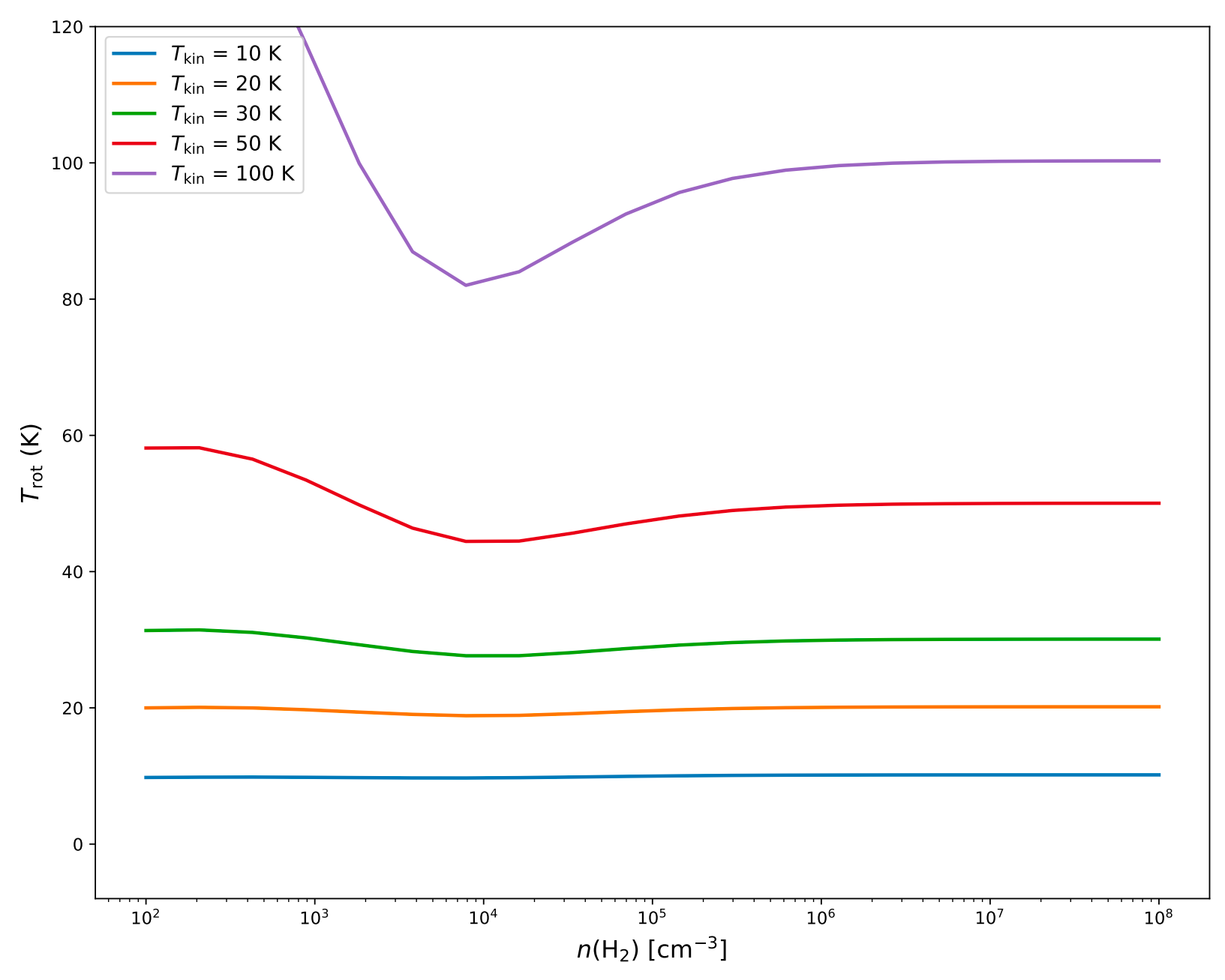
Statistical equilibrium calculation results for CH₃CCH. At densities above 10⁴ cm⁻³, the rotation temperature derived from CH₃CCH is essentially consistent with the gas temperature. (Image by SHAO)
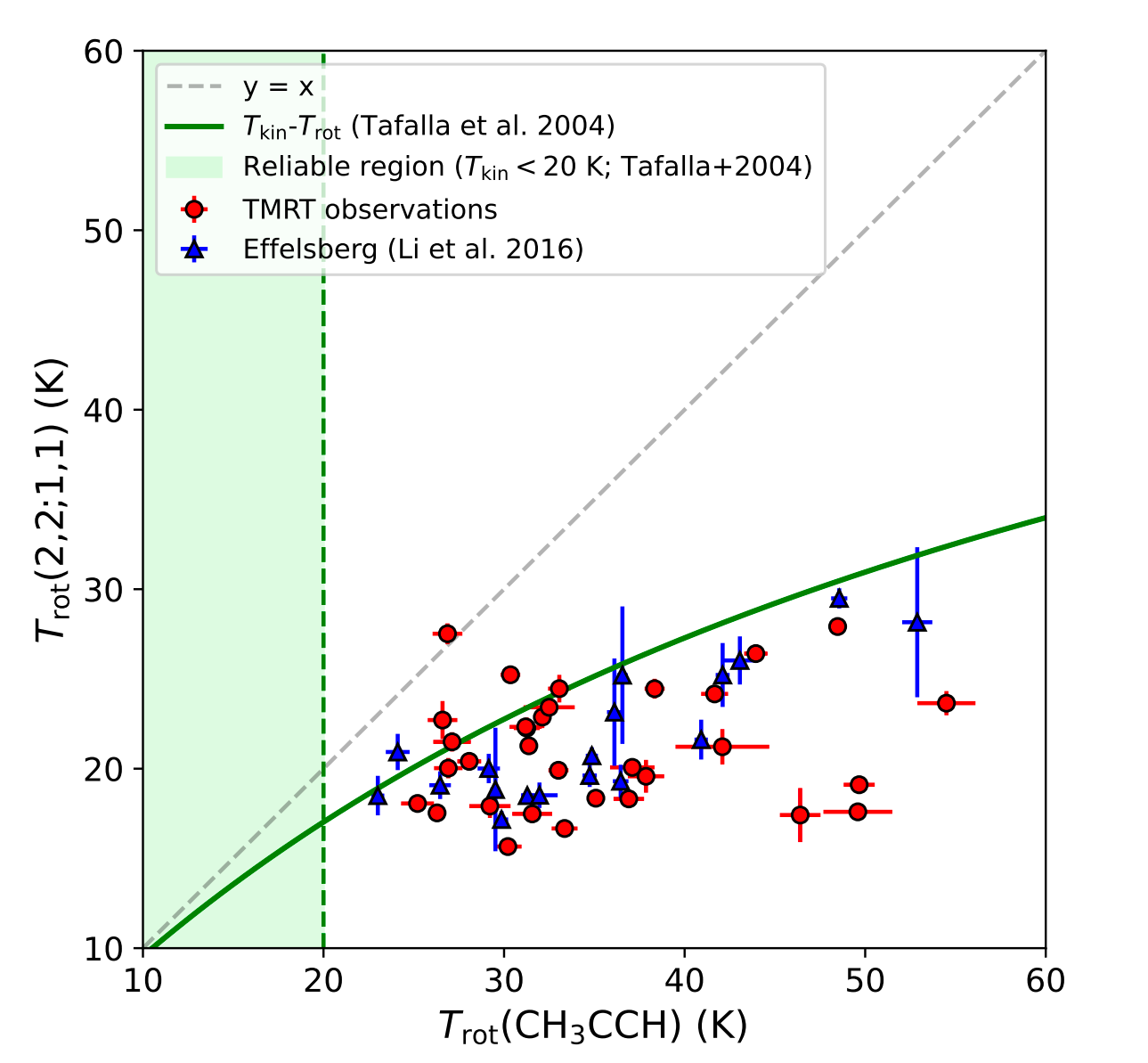
Comparison of rotation temperatures derived from CH₃CCH and NH₃. The rotational temperature obtained from NH₃ is significantly lower than that from CH₃CCH. (Image by SHAO)
