
Newsroom


The Hainan gibbon (Nomascus hainanus), one of the world's rarest primates, saw its population plummet beginning in the 1950s. By 2003, the species hovered on the brink of extinction, with only around 13 individuals remaining in the wild. Since then, its population has steadily recovered, reaching approximately 42 individuals by 2024.
While this rebound is commonly attributed to conservation initiatives, the role of genetic factors in the gibbon's recovery has remained unclear. A major obstacle has been the challenge of obtaining high-quality DNA samples without disturbing these elusive animals. Although fecal samples represent one of the few non-invasive alternatives, their application in genomic research has been limited by concerns over low quantity and degraded host DNA.
To address this issue, a new study led by Prof. ZHAN Xiangjiang from the Institute of Zoology of the Chinese Academy of Sciences has confirmed that fecal samples can yield reliable genomic data and uncover the genetic mechanisms driving the recovery of this critically endangered species.
The findings were recently published in Science Advances.
The study's key innovation lies in a rigorous workflow for fecal genomics that accurately quantifies errors in fecal genomic data. For the first time, the research demonstrates a low error rate, ensuring dependable downstream genetic analyses.
By analyzing high-quality fecal genomic data from 18 gibbons — roughly 40% of the entire Hainan gibbon population — the study reveals that the species' recovery is not solely the result of recent conservation efforts, but also stems from its evolutionary "genetic legacy." The researchers found that the species underwent population expansion over the past millennium, which helped buffer the genetic impacts of a prolonged bottleneck during the Last Glacial Maximum (LGM) and preserved sufficient genetic variation to withstand the sharp population decline in the late 20th century.
In addition, regions of high local recombination across the genome play a critical role in reducing genetic load and maintaining functional genetic variants essential for survival.
The study further uncovered the unexpected presence of two ancient genetic lineages within the current Hainan gibbon population, with individuals from these lineages already engaging in natural interbreeding. Modeling simulations suggest that if such natural crossbreeding continues, it will enhance population growth potential and reduce extinction risk in the future.
The research underscores the value of integrating demographic history, genome architecture, and behavioral dynamics into understanding the recovery of endangered species. The benchmark workflow and validated low error rate of fecal genomics establish a foundation for the broader, large-scale use of fecal samples in wildlife conservation.
This work was supported by the National Natural Science Foundation of China, the Hainan Tropical Rainforest Conservation Research Project, and the International Partnership Program of the Chinese Academy of Sciences.
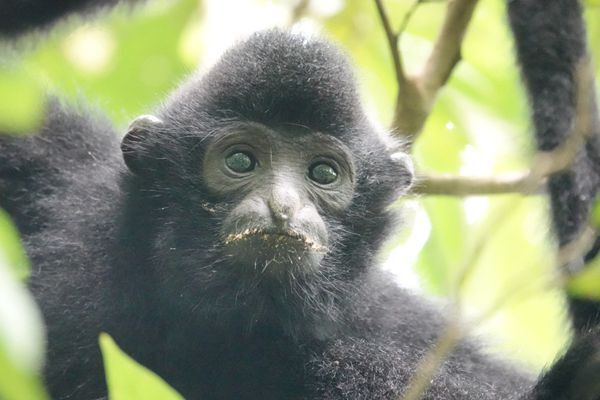
A male Hainan gibbon living in the rain forest. (Image by LI Ping)
