
Newsroom


Astronomers have uncovered compelling evidence that a collision between two molecular clouds is triggering star formation in G34, a molecular cloud.
The results were published in Monthly Notices of the Royal Astronomical Society.
The study was led by Ph.D. student SUN Mingke from the Xinjiang Astronomical Observatory (XAO) of the Chinese Academy of Sciences, under the supervision of Prof. Jarken Esimbek, in collaboration with colleagues. Using CO(J=1-0) data, the researchers revealed cloud-cloud collision phenomena in this region and their impact on star formation.
They systematically analyzed the structure and dynamics of the molecular gas in G34. Two molecular clouds in this region exhibit a high degree of spatial overlap and share an identical distance of 3.03 kpc, moving at velocities of 38–40 km/s and 58–60 km/s, respectively. The interface where these two clouds interact shows a U-shaped structure, a typical observational signature of cloud-cloud collisions.
Furthermore, the velocity dispersion within the U-shaped structure is significantly enhanced, indicating that the cloud-cloud collision has substantially influenced the local gas dynamics.
The researchers also examined the spatial distribution of various star formation tracers in G34 and found that approximately 80% of Class I young stellar objects, 78% of Class II young stellar objects, 92% of ATLASGAL clumps, 93% of 6.7 GHz methanol masers, and 83% of H ii regions are in the potential collision region. These results strongly suggest that the star formation activity in G34 is highly correlated with the ongoing cloud-cloud collision process.
The researchers performed a pixel-by-pixel modeling analysis of the physical conditions of the gas in the collision region using the non-Local Thermodynamic Equilibrium (LTE) radiative transfer code RADEX. They combined H2CO data at six and two cm, which was observed with the Effelsberg 100-m telescope in Germany and the Shanghai Tianma 65-m Radio Telescope (TMRT) in China, as well as NH3 data from the Nanshan 26-m telescope.
The analysis revealed that the hydrogen molecular column density in the collision region reaches 104–105 cm⁻³, with an average kinetic temperature of 17 K, which aligns well with the dense post-shock conditions predicted by cloud-cloud collision simulations. These conditions are ideal for massive star formation.
This study provides new observational evidence to understand the role of cloud-cloud collisions in triggering star formation, especially massive star formation. It also offers important clues to unravel the dynamical evolution mechanisms within giant molecular clouds in the Milky Way.
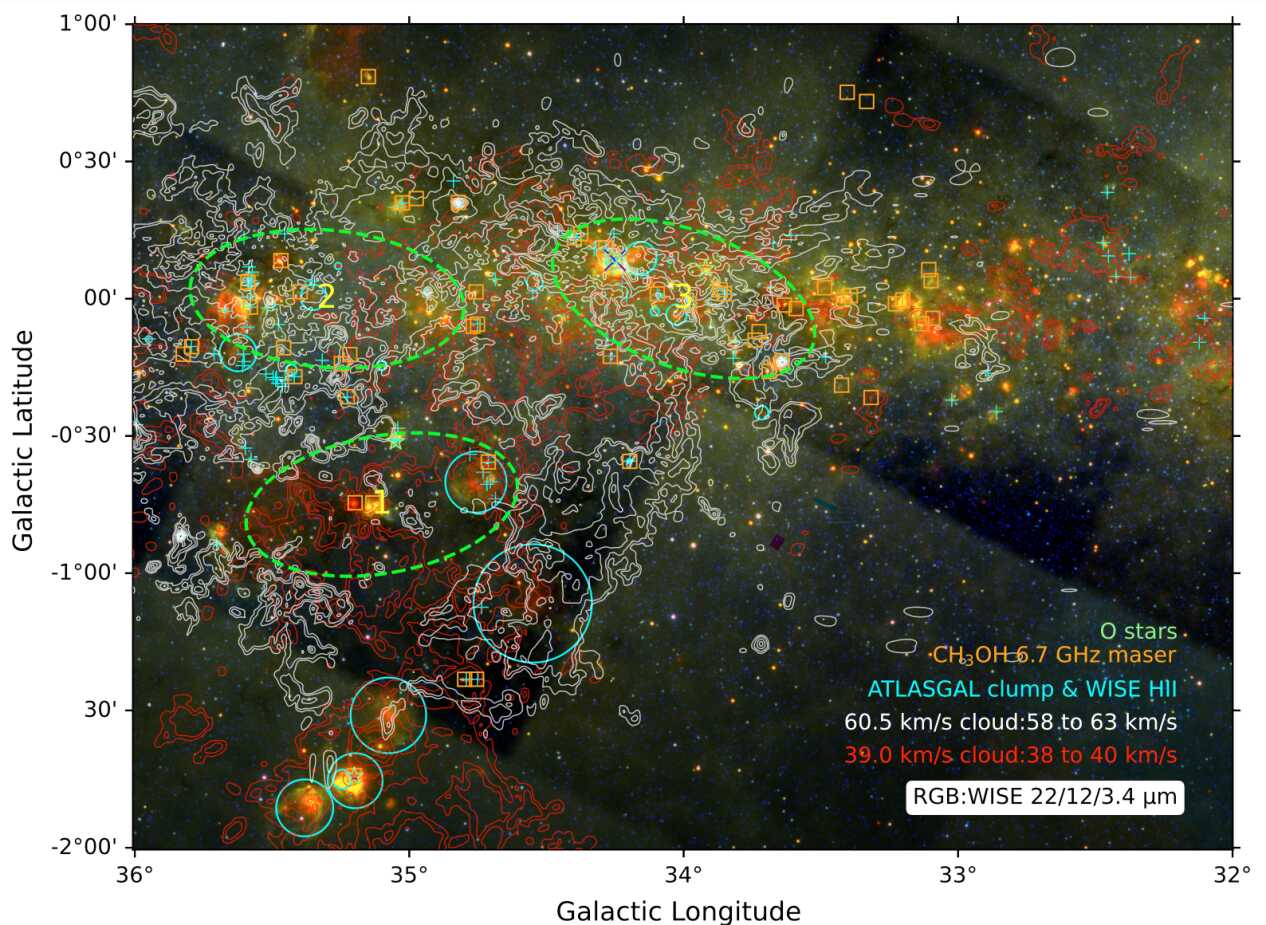
Red and white contours represent the integrated intensity of 12CO in the velocity intervals of 38–40 km s−1 and 58–63 km s−1, respectively. (Image by XAO)
