
Newsroom


A research team from the Hefei Institutes of Physical Science of the Chinese Academy of Sciences, in collaboration with researchers from Anhui University, ShanghaiTech University, and the University of New Hampshire, has demonstrated the first electrically controllable generation of hopfions, three-dimensional (3D) topological solitons, in a solid-state magnetic system.
The results were published online in Nature Materials on January 7.
First proposed in 1975, hopfions are 3D topological structures characterized by a Hopf charge. They are capable of forming rings, links, and knots. They are predicted to exist in a wide range of physical systems, from magnetic materials and plasmas to the early universe, but their complexity has largely confined them to theory with limited experimental realization and control.
In this study, the researchers used a chiral magnet as a laboratory testbed. By applying spin-transfer torque together with thermal excitation, they successfully generated magnetic hopfions in the chiral magnet FeGe.
Importantly, these hopfions are electrically controllable and remain stable in the absence of an external magnetic field, representing a significant improvement over previous static observations. To visualize their three-dimensional structure directly, the researchers combined angle-dependent quantitative electron holography with micromagnetic simulations. This enabled them to characterize the rotational magnetic phase in detail and confirm the 3D topological configuration of the hopfions experimentally.
In addition, in-situ electrical measurements revealed that electric currents can drive the magnetic hopfions. Unlike many other magnetic textures, the hopfions exhibit unconventional dynamics without Hall deflection, reflecting transport behavior fundamentally linked to their three-dimensional topology.
This work establishes a scalable, and controllable experimental platform for investigating hopfion dynamics and their universal physical properties, according to the team.
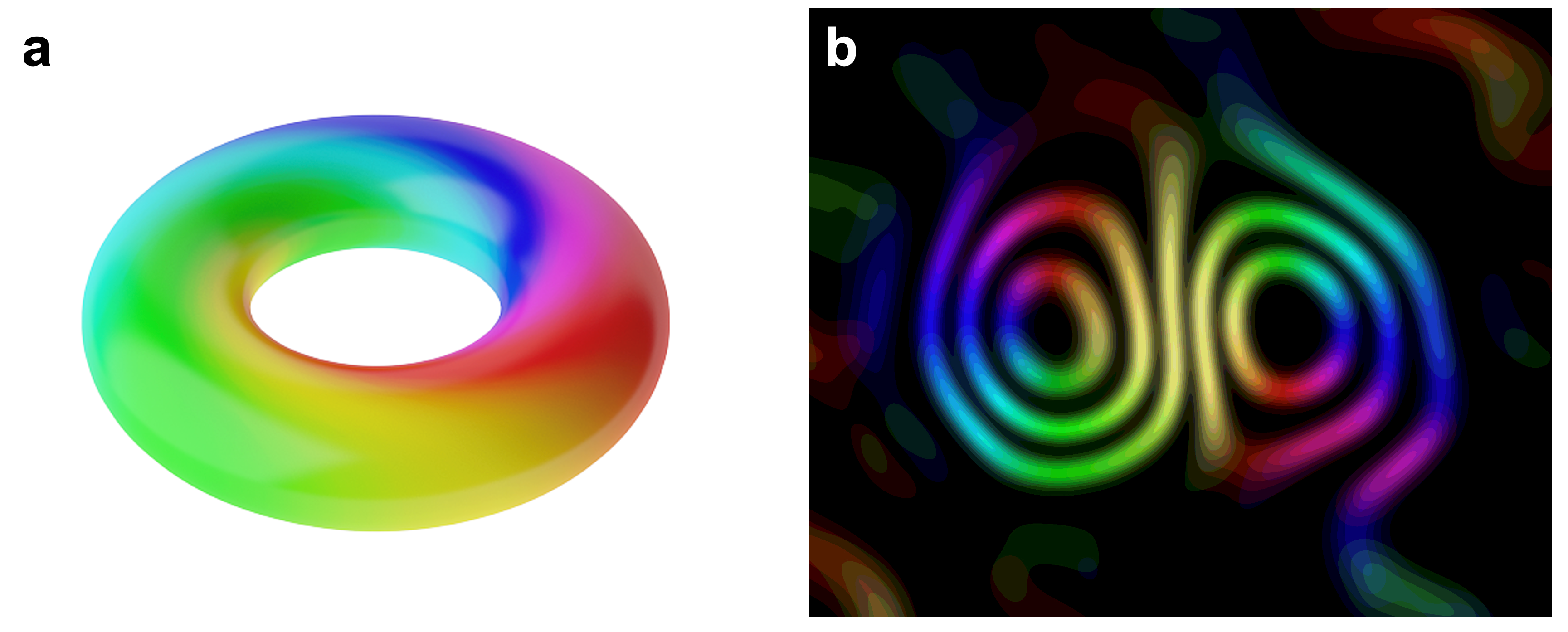
(a)Structure of a magnetic hopfion.(b)Experimental observation of the magnetic induction of the hopfion structure. (Image by LIU Yizhou)
