Newsroom


Chinese researchers have introduced an innovative approach to developing a three-dimensional (3D) surface-enhanced Raman scattering (SERS) substrate, achieving excellent focus tolerance and adhesion robustness. This advancement enhances the practicality of SERS technology for real-world applications.
Published in Advanced Functional Materials, the study was conducted by the researchers from the Institute of Modern Physics (IMP) of the Chinese Academy of Sciences, the City University of Hong Kong and other institutions.
SERS is a powerful analytical technique that amplifies the Raman scattering signals of low-concentration molecules by intensifying the local electromagnetic field intensity on material surfaces. It is widely used in fields such as biochemical sensing, biomedical imaging, food safety, and public security. However, its broader use has been limited by the insufficient laser focus tolerance and structural adhesion stability of traditional substrates.
To address these limitations, the researchers investigated the optical properties of 3D nanowire networks, building on their previous development of a nano-lattice mechanical metamaterial that surpasses size limitations and possesses exceptionally high energy absorption capabilities.
The researchers designed a novel SERS substrate made of highly interconnected 3D gold nanowire networks. Experimental results show that the gold nanowire network demonstrates significant focus tolerance. The substrate can detect non-resonant probe molecules such as 4-mercaptopyridine at concentrations as low as 1×10-12 mol/L, with high signal uniformity.
Due to the solid interconnection of the nanowires in 3D space, the substrate is extremely robust and can withstand ultrasonic treatment, water flow, and even direct sampling in the Yellow River, while maintaining stable performance.
In terms of the optical mechanism, the researchers developed an effective medium model. This model revealed that the substrate's excellent focus tolerance stems from the synergistic effects of an enhanced light scattering rate, an increased local optical state density, and broadened electromagnetic eigenmodes. These features allow the structure to efficiently capture light and exhibit significant 3D near-field enhancement effects.
Overcoming the challenge of focal precision while maintaining robustness, this study proposes a highly sensitive SERS substrate and establishes a viable platform to advance SERS from controlled laboratory environments to challenging real-world scenarios.
This study was supported by the National Natural Science Foundation of China, the Science and Technique Program of Gansu Province of China, and the Research Grants Council of Hong Kong.
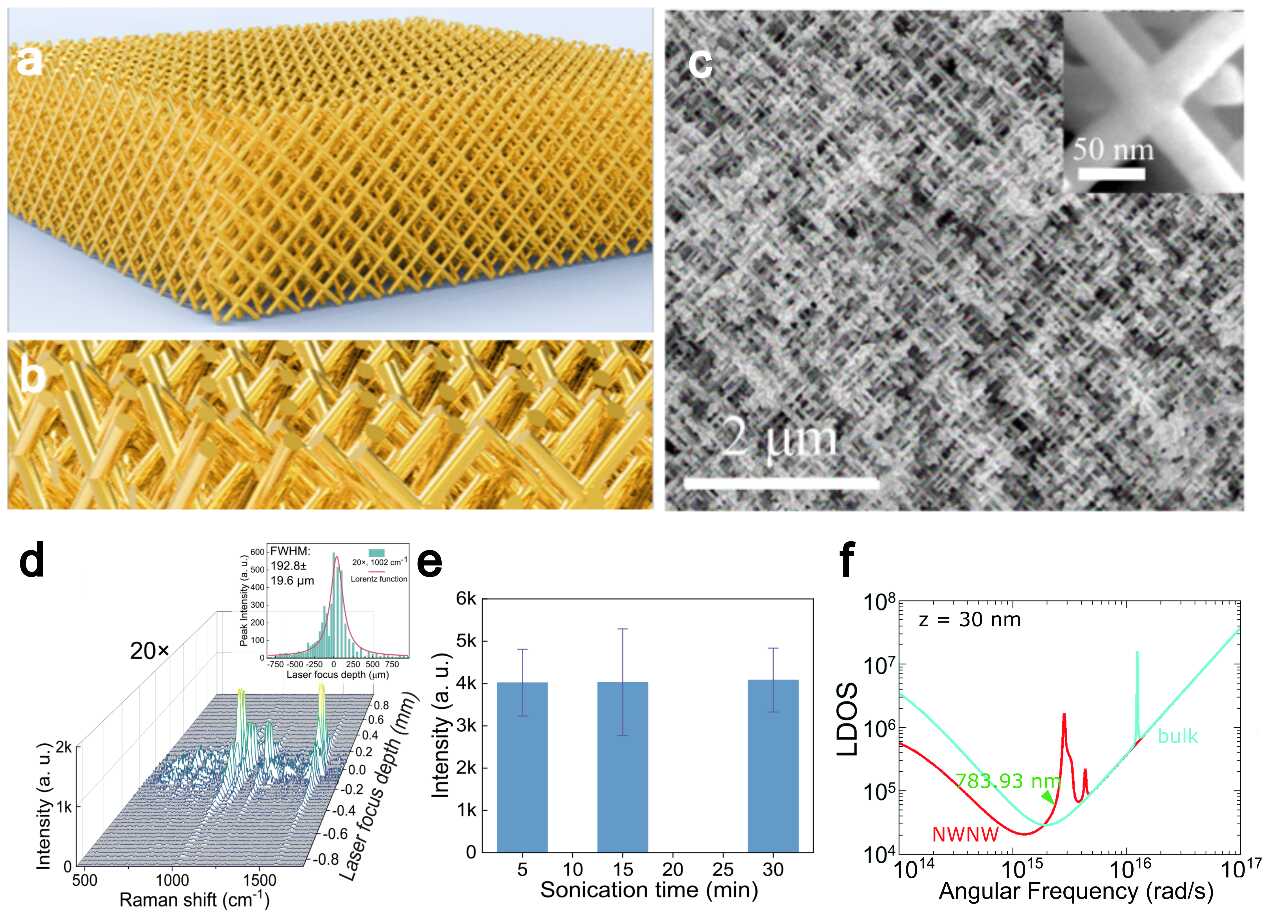
The 3D gold nanowire-network SERS substrate with focus tolerance and structural stability: a-b. Model of the 3D gold nanowire-networks prepared using ion track technology; c. Scanning electron microscope image of the actual substrate, with nanowire diameter of 35 nm; d. The 3D substrate maintains 50% SERS signal within a defocusing range of 192.8±19.6 μm under a 20× objective lens; e. SERS stability test in an ultrasonic water stress environment, which shows stable signal even after 30 minutes of ultrasonic treatment; f. The effective medium model reflects the high local state density of the nanowire-network structure near the excitation light. (Image from IMP)