Newsroom


A research team led by Prof. XU Zhenzhu from the Institute of Botany of the Chinese Academy of Sciences has constructed the first high-resolution (1 km²) continuous spatial atlas of specific leaf area (SLA) across the globe, mapping its current distribution projecting future changes.
Their study, published in Global Ecology and Biogeography on January 4, reveals that under both present and future climate conditions, high-SLA plant species prevail in the mid- to high latitudes of the Northern Hemisphere. Under the worst climate scenario (SSP5-8.5), SLA is projected to increase across most biomes between 2021–2040 and 2081–2100.
The researchers also reported global average SLA values, along with observed estimates and associated variability ranges.
SLA is a key plant functional trait reflecting leaf morphology, physiological function, and resource-use strategies. It is closely linked to leaf size, tissue density, nutrient content, and photosynthetic activity, and plays an important role in modeling large-scale vegetation patterns, ecosystem functioning, and biogeochemical processes such as carbon cycling. Despite its importance, the continuous global distribution of SLA, particularly under future climate change scenarios, has remained poorly understood.
To address this gap, the researchers assembled a comprehensive global dataset comprising 24,237 SLA records from 5,687 vascular plant species across 282 families. The data were compiled from peer-reviewed literature, the TRY database, and original field surveys, all georeferenced to specific sampling locations.
The researchers adopted an integrated analytical approach combining data analysis, machine learning, and model simulations. After evaluating four machine learning models (random forest, LightGBM, XGBoost, and neural networks), the random forest model was selected as the most accurate. It was subsequently refined through hyperparameter optimization and uncertainty analysis to generate continuous global SLA maps for both current conditions and future climate scenarios (SSP2-4.5 and SSP5-8.5) throughout the 21st century.
The results confirm that high-SLA plants dominate Northern Hemisphere mid- and high-latitude zones under current and projected climates. Widespread increases in SLA are anticipated under the SSP5-8.5 scenario by the end of the century.
These findings provide essential information about the distribution, evolution, diversity, and community assembly of plant species across global biomes. Integrating this spatially explicit SLA dataset into terrestrial ecosystem models can improve the accuracy of ecosystem function assessments and support climate-adaptive ecological management.
Furthermore, the approach establishes in this study provides a new framework for quantifying and mapping other key functional traits worldwide.
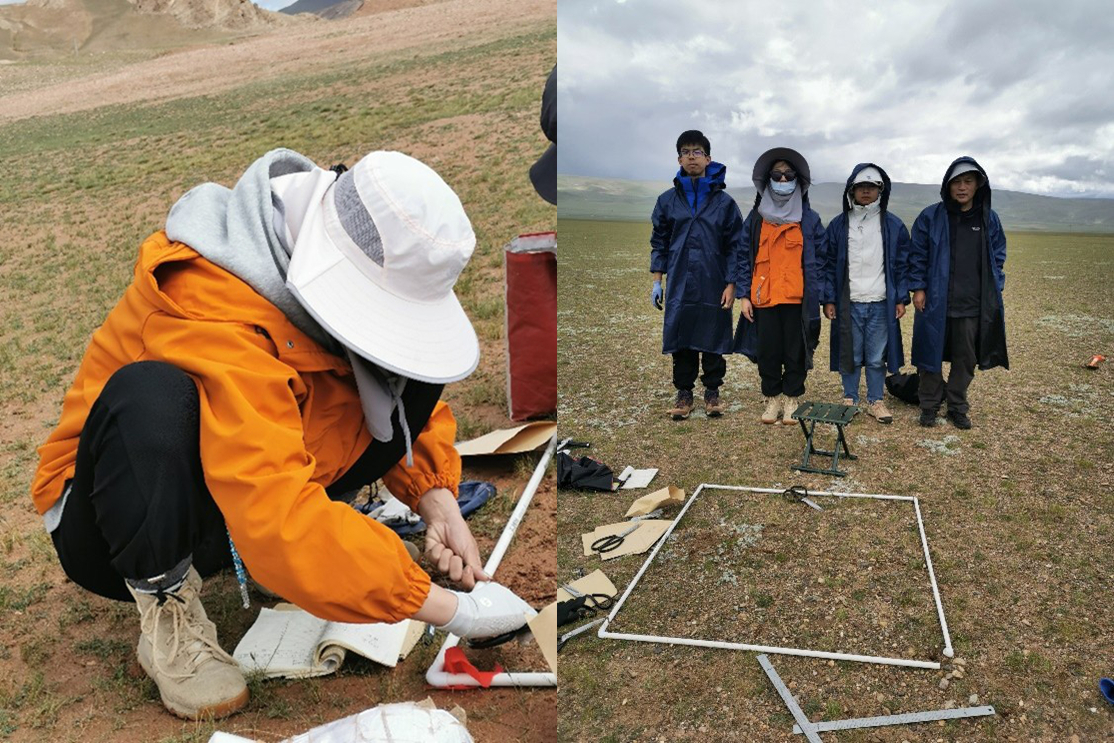
Field sampling for leaf functional traits on the Tibetan Plateau (Image by XU Zhenzhu)
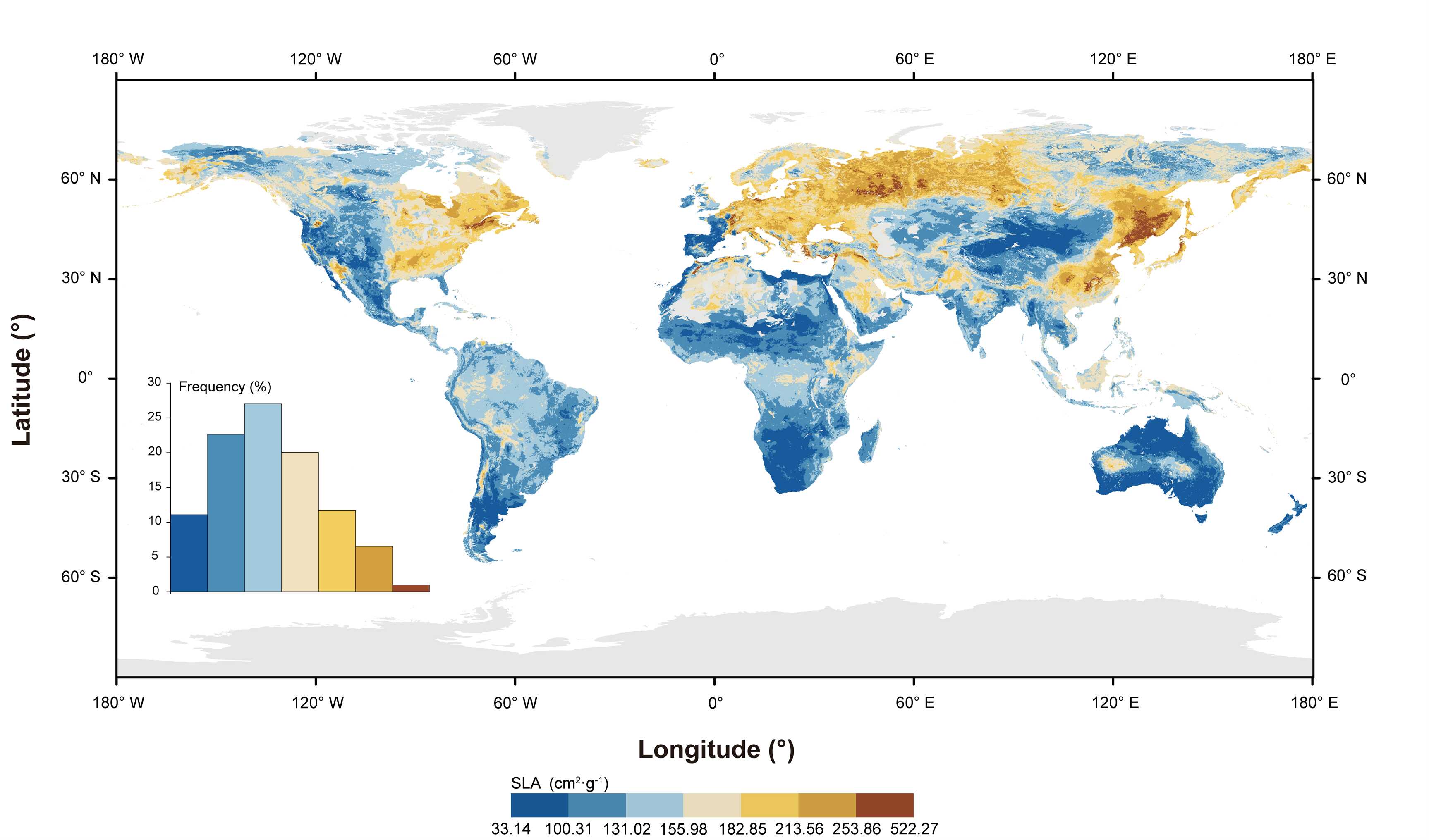
Global spatial distribution of SLA in terrestrial ecosystems in the present. Inset represents frequency of SLA size for the spatial distribution (Image by SUN Kuo)