Newsroom


Recently, a research team led by Prof. ZHANG Chengcai from the Institute of Hydrobiology (IHB) of the Chinese Academy of Sciences revealed that chloroplast budding mediates β-carotene transport for early stage astaxanthin hyperaccumulation in Haematococcus pluvialis (H. pluvialis). This study was published in Plant Physiology.
Unicellular green alga H. pluvialis is widely used in industrial production due to its ability to accumulate large amounts of astaxanthin. In the biosynthesis of astaxanthin, precursor β-carotene is synthesized in chloroplasts, transported to cytoplasm, and further catalyzed into astaxanthin, which is stored in cytoplasmic lipid droplets. This metabolic partitioning characteristic is one of the key reasons why H. pluvialis accumulates significantly higher levels of astaxanthin compared to other species.
However, the mechanism by which β-carotene is transported to the cytoplasm remains unknown. This process is a critical and rate-limiting step in the regulation of astaxanthin synthesis. Elucidating this mechanism is of great importance for enhancing the astaxanthin production capacity of this alga.
In this study, researchers investigated the early phase of astaxanthin accumulation under non-stressful, baseline conditions, which not only initiate astaxanthin accumulation in H. pluvialis but also preserves cell motility. Confocal microscopy, chloroplast isolation with microscopic examination, and subcellular structural analysis showed that β-carotene accumulates in osmiophilic plastid globules within chloroplasts and is transported to cytoplasm via a budding mechanism.
In addition, researchers observed a vacuole-mediated transport pathway, along with a potential transport mechanism involving direct contact between cytoplasmic lipid droplets and chloroplasts. Transcriptomics and bioinformatics analysis identified seven candidate genes that may be involved in this vesicle transport process.
The astaxanthin accumulation mechanism in cytoplasmic lipid droplets of H. pluvialis may represent an ancestral feature of chromoplast evolution. This alga frequently faces extreme conditions in the habitat. Its life cycle may continuously replay the evolutionary process of plant ancestors colonizing terrestrial environments. Consequently, the Haematococcus lineage might have developed specialized chromoplast structures to cope with extreme habitat fluctuations, representing an ancient chromoplast type.
In contrast, chromoplasts in land plants are primarily derived from chloroplast transformation and are rich in carotenoids and neutral lipids. However, the chloroplast-budding mechanism for carotenoid transport observed in Haematococcus remains exceptionally rare, with similar phenomena reported only in the tomato suffulta mutant. This suggests that some land plants might have evolved novel genes such as suffulta to modify their chromoplast formation patterns.
This study reveals the dynamic processes involved in plastoglobuli budding, vesicle-mediated transport, and the formation of astaxanthin-rich lipid bodies, which provides insights into the transport of β-carotene in H. pluvialis. It also provides important value to the germplasm improvement of H. pluvialis, and new clues about understanding the origin of land plant chromoplast.
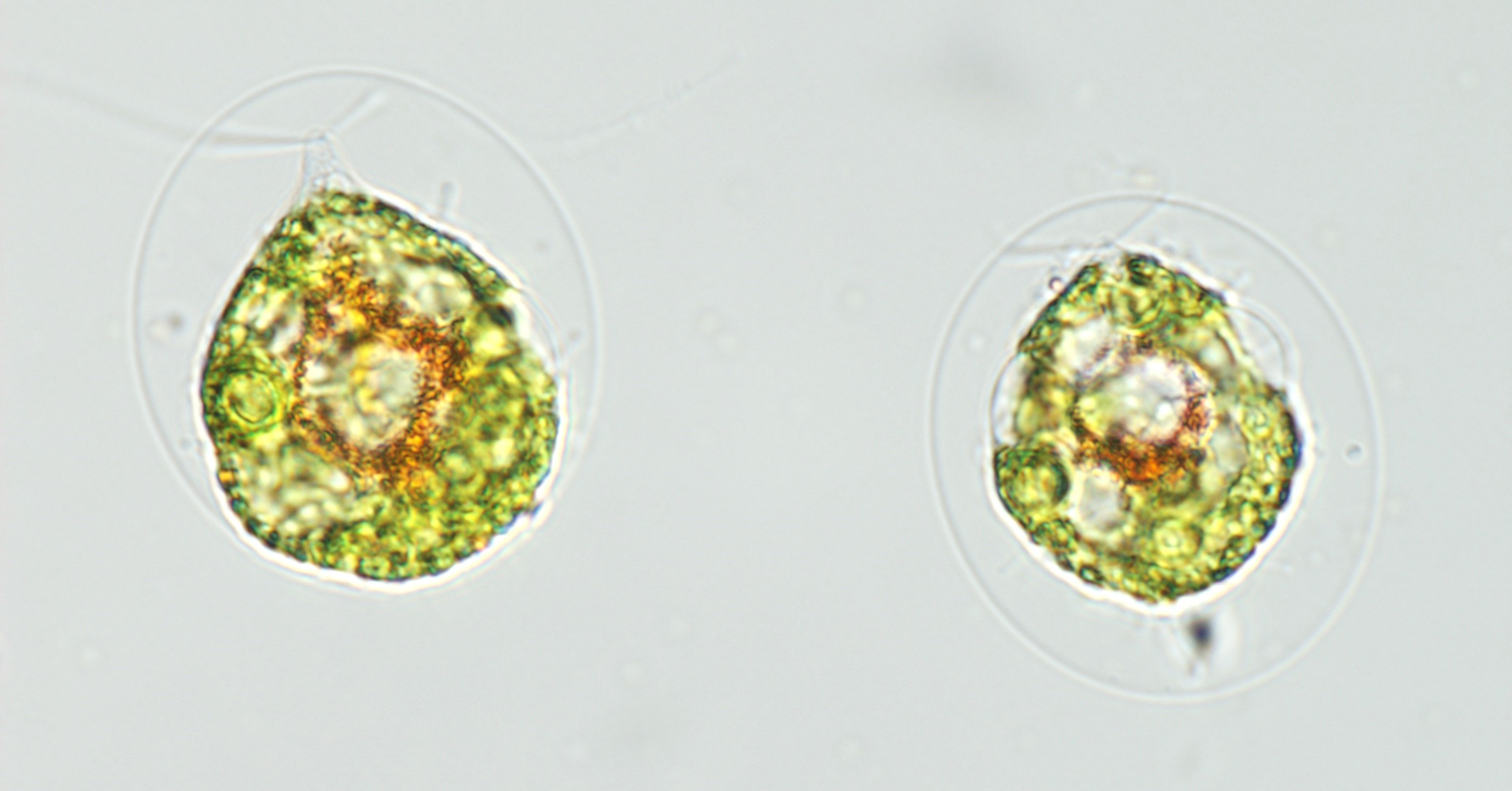
In situ astaxanthin accumulation visualized by microscopy. (Image by IHB)